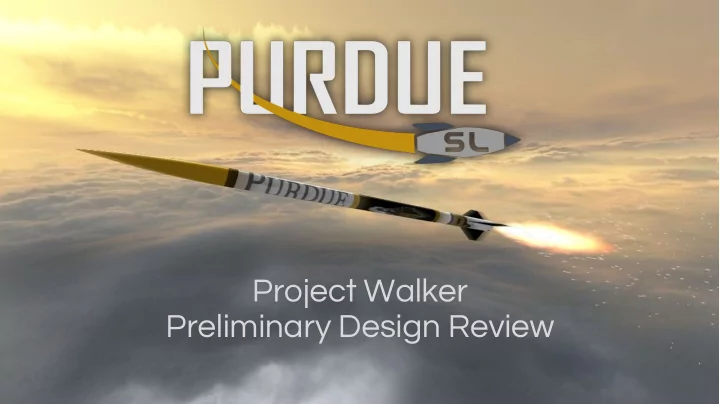
Project Walker Preliminary Design Review Vehicle Design - - PowerPoint PPT Presentation

project walker preliminary design review vehicle design
SMART_READER_LITE
LIVE PREVIEW

Project Walker Preliminary Design Review Vehicle Design - - PowerPoint PPT Presentation

Project Walker Preliminary Design Review Vehicle Design Characteristics NASA Student Launch Initiative 2018 Click to edit Master title style Vehicle Overview 122 long, 5.15 maximum diameter. 39.31 lbs. estimated weight.


slide-1
SLIDE 1

Project Walker Preliminary Design Review

slide-2
SLIDE 2

NASA Student Launch Initiative 2018

Vehicle Design Characteristics

slide-3
SLIDE 3

NASA Student Launch 2018

Click to edit Master title style

Vehicle Overview

  • 122” long, 5.15” maximum diameter.
  • 39.31 lbs. estimated weight.
  • Designed to carry an autonomous rover as a payload to an altitude of 4,950

feet while maintaining safe values of aerodynamic stability, speed, and landing kinetic energy.

  • Utilizes conventional dual deployment techniques.
slide-4
SLIDE 4

NASA Student Launch 2018

Click to edit Master title style

Lower Airframe

  • 30.86” long, 5.15” maximum diameter.
  • 14.7 lbs. estimated weight.
  • Designed to interface with the mid airframe coupler tube at the top 5”, to house and

retain the motor, to transfer thrust loads from the motor to the airframe, and to provide ample aerodynamic stability to meet project requirements.

slide-5
SLIDE 5

NASA Student Launch 2018

Click to edit Master title style

Mid Airframe

  • 30” long, 5.15” maximum diameter.
  • 3.61 lbs. estimated weight.
  • Designed to hold drogue recovery gear and to interface with the avionics

and lower airframe coupler tubes using 5” at each end.

slide-6
SLIDE 6

NASA Student Launch 2018

Click to edit Master title style

Avionics Bay

  • 12” long, 5.15” outer diameter at the 2” long switch band and 5” outer diameter at the coupler
  • 3.91 lbs. estimated weight.
  • Designed to hold redundant avionics systems and interface with the upper and mid airframe sections

using 5” at either end of the coupler.

slide-7
SLIDE 7

NASA Student Launch 2018

Click to edit Master title style

Upper Airframe

  • 30” long, 5.15” maximum diameter.
  • 6.05 lbs. estimated weight.
  • Designed to hold main recovery gear and to interface with the payload and avionics bay

coupler tubes using 6” at the fore end and 5” at the aft end.

slide-8
SLIDE 8

NASA Student Launch 2018

Click to edit Master title style

Payload Bay

  • 10” long, 5.15” outer diameter at the 2” long switch band (located 2” from fore side) and 5” outer

diameter at the coupler

  • 8 lbs. estimated weight.
  • Designed to hold the payload retention system, the payload deployment system, and the rover

payload and to interfaces with nose cone for 2” and upper airframe for 6”

slide-9
SLIDE 9

NASA Student Launch 2018

Click to edit Master title style

Nose Cone

  • 25” long with 5.15” maximum diameter at base and an extended 2” to interface with the payload

coupler

  • Weight with the cone, coupler, bulk plates, and switch band is 2.84 pounds; cone alone is 1.43 pounds.
  • Designed to reduce drag, to feature an increased interior volume for future payloads or electronics, and

to interface with upper payload coupler.

slide-10
SLIDE 10

NASA Student Launch 2018

Click to edit Master title style

Current Motor Choice

  • Aerotech Rocketry L1520 Blue:

○ Total impulse: 841.55 lbf-s. ○ Max thrust: 381.42 lbf. ○ Average thrust: 323.67 lbf. ○ Liftoff thrust: 355.2 lbf. ○ Burn time: 2.6 seconds. ○ Propellant mass: 4.08 lb.

  • Hardware:

○ Dimensions: 2.95” dia x 20.91” length. ○ Loaded mass: 8.04 lb. ○ Empty weight: 3.96 lbs.

slide-11
SLIDE 11

NASA Student Launch 2018

Click to edit Master title style

Thrust/Weight and Exit Velocity

  • The thrust-to-weight ratio that the vehicle achieves is ~8.99:1.

○ Liftoff Thrust: 355.2 lbs. ○ Liftoff weight: 39.5 lbs.

  • Maximum Acceleration is ~287 ft/sec^2.
  • Maximum Velocity is ~ 620 ft/sec.
  • Rail exit velocity is 79.4 ft/sec.
slide-12
SLIDE 12

NASA Student Launch 2018

Click to edit Master title style

Altitude Predictions

  • Simulated in OpenRocket 15.03.

○ Maximum altitude: 5,023’ AGL. ○ Chosen altitude for competition: 4,950’ AGL

  • Simulation settings:

○ Calculation: Extended Barrowman. ○ Simulation: 6-DOF Runge-Kutta 4. ○ Geodetic: Spherical approximation. ○ Time step: 0.02 seconds.

slide-13
SLIDE 13

NASA Student Launch 2018

Click to edit Master title style

Stability Margins

  • Static:

○ Stability margin: 3.58 calibers. ○ CP location: 89.782” from datum. ○ CG location: 71.345” from datum.

  • At takeoff:

○ Stability margin: 2.71 calibers.

slide-14
SLIDE 14

NASA Student Launch 2018

Click to edit Master title style

Landing Energy

  • Landing velocity: 13.7 ft/s.
  • Total landing energy: 103.31 ft/lbs.
  • Lower section energy: 48.74 ft/lbs.
  • Mid section energy: 21.93 ft/lbs.
  • Upper section energy: 31.62 ft/lbs.
slide-15
SLIDE 15

NASA Student Launch 2018

Click to edit Master title style

Drift Calculations

  • Maximum drift distance of 1489.27’.
  • Wind Speed: 20 MPH.
  • Standard Deviation: 10%.
  • Turbulence Intensity: 2.0 MPH.
slide-16
SLIDE 16

NASA Student Launch Initiative 2018

Recovery System Information

slide-17
SLIDE 17

NASA Student Launch 2018

Click to edit Master title style

Recovery Overview

  • Standard dual deployment configuration:

○ 24” drogue parachute at apogee. ○ 100” main parachute at 700’ AGL. ○ Kevlar Shock cord. ○ Nomex heat shields. ○ ¼” SS connection points.

slide-18
SLIDE 18

NASA Student Launch 2018

Click to edit Master title style

Shock Cord

  • Kevlar tether:

○ ½” thickness. ○ 7,200 lbs. breaking strength. ○ Fireproof. ○ 3 sewn loops:

■ One on each end for bulkhead attachment. ■ One ⅓ the length from the top for parachute attachment.

○ Estimated weight: 0.4 lbs.

slide-19
SLIDE 19

NASA Student Launch 2018

Click to edit Master title style

Drogue Parachute

  • Skyangle Cert-3 Drogue parachute:

○ 24” diameter. ○ Four ⅝” shroud lines rated at 2,250 lbs. ○ 0 porosity 1.9 ounce ripstop nylon. ○ Drag coefficient of 1.16. ○ Surface area of 6.3 square feet. ○ Rated for 1.0-2.2 lbs. ○ Estimated weight: 0.375 lbs.

slide-20
SLIDE 20

NASA Student Launch 2018

Click to edit Master title style

Main Parachute

  • Skyangle Cert-3 XLarge parachute:

○ 100” diameter. ○ Four ⅝” shroud lines rated at 2,250 lbs. ○ 0 porosity 1.9 ounce ripstop nylon. ○ Drag coefficient of 2.59. ○ Surface area of 89 square feet. ○ Rated for 32.6-70.6 lbs. ○ Estimated weight: 3.8125 lbs.

slide-21
SLIDE 21

NASA Student Launch 2018

Click to edit Master title style

Fireproofing

  • Nomex heat shield:

○ Protects parachute from ejection gases. ○ 18x18” square. ○ Slides directly over shock cord. ○ Burrito wrap parachute. ○ Estimated weight: 0.5 lbs.

slide-22
SLIDE 22

NASA Student Launch 2018

Click to edit Master title style

Ejection Charges

  • Used weighted decision matrix:

○ Black powder (FFFFg) or CO2

  • Primary criteria:

○ Volume, simplicity, reliability, and weight.

  • Secondary/tertiary criteria:

○ Style and cleanliness.

slide-23
SLIDE 23

NASA Student Launch 2018

Click to edit Master title style

  • Estimated/calculated values for criteria:

○ Applied to weighted decision matrix.

  • Black powder score: 245.
  • CO2 score: 195.

Ejection Charges

slide-24
SLIDE 24

NASA Student Launch 2018

Click to edit Master title style

Ejection Charges

  • Ejection canister caps to contain black powder.
  • FFFFg is the chosen black powder type.
  • Calculation for how many grams needed for smooth ejection:

C*D2*L= Grams: ○ D: Diameter of airframe => 5.15 inches. ○ L: Length of recovery => 30 inches. ○ C: Constant Conversion from 10 PSI => 0.00399. ○ Yielded: 3.22 +/- 0.15 g per capsule.

slide-25
SLIDE 25

NASA Student Launch 2018

Click to edit Master title style

Avionics

  • Missile Works RRC2, Missile Works RRC3+ Sport,

Eggtimer TRS, and the Altus Metrum TeleMetrum.

  • We compared the four altimeters based on set criteria

with specific weights.

  • Primary criteria:

○ Cost, altitude, efficiency, reliability, and extras.

  • Secondary criteria:

○ Battery/voltage and size.

  • Tertiary criteria:

○ Operating system.

  • TeleMetrum is the primary altimeter.
  • RRC3+ Sport is secondary altimeter.
slide-26
SLIDE 26

NASA Student Launch 2018

Click to edit Master title style

Avionics

  • The avionics bay consists of:

○ 2 altimeters:

■ TeleMetrum. ■ RRC3+ Sport.

○ 2 batteries:

■ 3.7V LiPo. ■ 9V.

○ 1 3D-printed sled. ○ Eye bolts. ○ Steel threaded rods. ○ 4Fg black powder. ○ Capsules to hold black powder. ○ External key switches.

slide-27
SLIDE 27

NASA Student Launch 2018

Click to edit Master title style

Avionics

  • The overall weight of the avionics bay ~ 0.54 lbs.
  • We will use the TeleDongle in combination with the

Arrow 3-element Yagi as our form of communication with the launch vehicle.

  • Altimeters turned on externally by key switches on

the side of the rocket, then both altimeters will be powered on.

  • At apogee the drogue chute will be released, then at

700’ AGL the main parachute will be released.

  • The redundant ejection charge for the drogue will

have a time delay of 1 second and for the main parachute it will be at 650’ AGL.

slide-28
SLIDE 28

NASA Student Launch Initiative 2018

Safety

slide-29
SLIDE 29

NASA Student Launch 2018

Click to edit Master title style

Safety Officer Information

  • The Safety Officer for the Purdue SL Team participating in the 2019

competition will be Jory Lyons.

  • Some of the Safety Officer’s most important duties are as follows:

○ Enforcing all safety plans and procedures set by the team. ○ Enforcing all laws and regulations set for the team by authorities and governing bodies. ○ Ensuring that all team members are properly trained and supervised to be carrying out their current task.

slide-30
SLIDE 30

NASA Student Launch 2018

Click to edit Master title style

NAR/TRA Personnel Procedures

  • Victor Barlow is the NAR mentor currently working with the team.
  • This NAR mentor will:

○ Be on location whenever the rocket is being launched to serve as Range Safety Officer. ○ Work with the Safety Officer to ensure that all team members follow the NAR High Power Rocket Safety Code during all launches. ○ Prepare motors and ejection charges during full-scale flights as needed, even though other team members have certification for such tasks.

slide-31
SLIDE 31

NASA Student Launch 2018

Click to edit Master title style

Hazard Recognition/Avoidance

  • Prior to the first construction meeting, the team will hold a short

briefing on basic launch vehicle construction safety, in which all team members will be instructed on fundamental safety procedures (e.g. wearing protective eyewear during construction), as well as how to use lab equipment and recognize any potential hazards associated with it.

  • Briefings will be carried out before major events and launches.
slide-32
SLIDE 32

NASA Student Launch 2018

Click to edit Master title style

Project Risks

  • The seriousness of a risk will be evaluated by two criteria:

the likelihood of an event to occur and the impact of the event should it happen or fail to be prevented.

  • By cross-examining the likelihood of an event with the

impact it would have if it occurred, the total numerical risk is determined using the displayed table.

  • Using this table, one can use charts of possible events to

conduct analyses of preliminary personnel hazards, preliminary failure mode and effects, and environmental concerns.

Green: Very low risk Yellow: Low risk Orange: Medium risk Red: High risk Dark red: Very high risk

slide-33
SLIDE 33

NASA Student Launch 2018

Click to edit Master title style

Safety Considerations

  • Risks above ‘medium’ must be signed off by the team lead, safety officer, or other

commanding officer.

  • Failures to the program must be addressed ahead of time to insure continued individual and

team safety and success.

  • For the protection of individuals and the team, PPE must always be worn and verified by

team members for working on a task.

  • Safety tables are to include hazards, likelihood, severity, risk, mitigation, and verification

(and risk after mitigation). ○ These tables will help demonstrate the collective understanding of all components needed to complete the project, and how risk/delays impact the project.

slide-34
SLIDE 34

NASA Student Launch 2018

Click to edit Master title style

Safety Checklists

  • Three checklists were created for team members to use to ensure safe

procedures are followed before, during, and after launch.

  • Pre-launch checklist: Includes general safety procedures, checks for safe

rocket construction, ensures proper use of the launch pad, and gives proper procedures for launching.

  • Launch checklist: Ensures team members are behaving safely during the

launch and gives instruction on how to safely handle a misfire.

  • Post-launch checklist: Ensures the rocket and launch pad are properly

tended to after the launch.

slide-35
SLIDE 35

NASA Student Launch 2018

Click to edit Master title style

Plan for Compliance with Laws

  • The project team will follow regulations listed in NFPA 1127 and CFR 27

Part 55.

  • All launches will be conducted in an area with an active FAA waiver that

extends the projected altitude of the launch vehicle.

  • All team members present at launch will closely follow the NAR High

Power Rocket Safety Code and the team safety agreement, which both encourage lawful rocketry.

slide-36
SLIDE 36

NASA Student Launch 2018

Click to edit Master title style

Hazardous Materials Plan

  • Hazardous materials will be stored off-site, within the Zucrow Labs research

facilities adjacent to the Purdue University Airport.

  • Certain members of the team currently hold a Low Explosives User Permit,

and these are the members who will handle the acquisition, transportation, and storage of the hazardous materials involved in this project.

  • All team members will be given a briefing on the plan to properly handle

hazardous materials by the safety officer, which will emphasize use of personal protective equipment and material safety data sheets.

slide-37
SLIDE 37

NASA Student Launch 2018

Click to edit Master title style

Team Safety Statement

  • All team members must sign a printed safety statement.
  • This statement is an affirmation by team members that they will comply

with all relevant laws and regulations and the NAR High Power Rocketry Safety Code and will obey all instructions given by the Safety Officer and Range Safety Officer, whether verbally or through team safety documents.

  • The statement ensures members realize any violation of these agreements

can completely halt a rocket launch and may result in that team member being unable to participate in Project Walker or the NASA SL program.

slide-38
SLIDE 38

NASA Student Launch Initiative 2018

Payload

slide-39
SLIDE 39

NASA Student Launch 2018

Click to edit Master title style

Payload Design

  • Mission

○ Deploy an autonomous rover. ■ Drives 10 feet from rocket. ■ Collects and stores 10 mL soil sample.

  • Requirements

○ Less than 8 lbs. ○ Dimensions: ■ 12” long & 4.815” diameter. ○ 3 hours of battery life. ○ Rover can autonomously navigate and avoid

  • bstacles.

○ Rover must stay inside of payload bay until landing.

  • Key components

○ 2 x wheel. ○ 2 x LIDAR sensors. ○ 1 x Anker PowerCore power supply. ○ 1 x Arduino unit. ○ 1 x soil collection apparatus.

slide-40
SLIDE 40

NASA Student Launch 2018

Click to edit Master title style

Payload/Vehicle Interface

  • Hinged capsule.

○ 3D printed. ○ Spring loaded hinge to stay open. ○ Rounded front face. ○ Rover held in by wheels.

  • Black powder ejection.
  • Shear pins to hold capsule

during flight.

  • Located near nose of

rocket.

slide-41
SLIDE 41

NASA Student Launch 2018

Click to edit Master title style

On Board Computer

  • Arduino Pro Mini 328 - 5V/16MHz:

○ Cost: $9.95.

  • I/O Pins:

○ 14 Digital input/output. ○ 8 Analog. ○ 6 PWM.

  • Mass: < 2g.
  • Dimensions:

○ 1.3x0.7”.

  • Processing Performance:

○ ATmega 328 @ 16 MHz.

slide-42
SLIDE 42

NASA Student Launch 2018

Click to edit Master title style

Soil Sampling System

slide-43
SLIDE 43

NASA Student Launch 2018

Click to edit Master title style

Power Supply

  • Requirements:

○ Less than $30 per battery. ○ Less than one pound. ○ Less than four inches wide.

  • Leading Choice: Anker PowerCore 10,000mAh:

○ Allows for even weight distribution. ○ Meets all requirements. ○ Provides significant power for dimensions and cost.

https://www.anker.com/products/variant/PowerCore-10000mAh/A1263011

slide-44
SLIDE 44

NASA Student Launch 2018

Click to edit Master title style

Software

  • Software Development:

○ Arduino IDE.

  • Coding Language:

○ C/C++.

  • Algorithms:

○ Object detection:

■ Landmark extraction. ■ Landmark avoidance.

○ State estimation:

■ Position relative to rocket.

slide-45
SLIDE 45

NASA Student Launch Initiative 2018

Derived Requirements and Verification Plans

slide-46
SLIDE 46

NASA Student Launch 2018

Click to edit Master title style

General Derived Requirements I

  • Create and maintain a functioning website and social media profile with regular project updates,

documents, and milestones that highlight our progress as it relates to the scope of the project.

  • Not spend any money out of pocket using personal funds without a means of being fully reimbursed

through Purdue SEDS or some other school related organization.

  • Have a successful subscale flight and recovery on a subscale motor while simulating a payload

system.

  • Have a successful full scale test flight and recovery on a full scale motor while carrying a fully

functional payload system.

  • Successfully design, build, and test a working on-board payload capable of meeting the requirements

derived by the team and presented to us by NASA within the 2019 NASA Student Launch Handbook.

slide-47
SLIDE 47

NASA Student Launch 2018

Click to edit Master title style

General Derived Requirements II

  • Fulfill and exceed all educational engagement requirements presented to us

by NASA within the 2019 NASA Student Launch Handbook.

  • Have a functioning and attractive rocket booth that highlights the work done

by our team, including a functional payload on display for viewers to see and a full scale rocket for spectators to interact with.

  • No disqualification by any means whatsoever.
  • No breaches of safety by any means whatsoever.
  • Successful completion of the competition in Huntsville, Alabama.
slide-48
SLIDE 48

NASA Student Launch 2018

Click to edit Master title style

Vehicle Derived Requirements I

  • The vehicle will deliver the payload to an apogee altitude of 4,950 +/- 100 feet above ground

level (AGL).

  • The vehicle will feature a retainment system which is able to maintain the condition of the

payload during flight so that it remains in good condition to be fully operational for the next flight.

  • Upon reaching the ground, the vehicle will expel the payload such that it may operate

autonomously without physical contact with the launch vehicle.

  • The vehicle will carry at least two commercially available, barometric altimeters for

recording the official altitude.

  • Each altimeter will be armed by a separate, dedicated power supply.
  • The launch vehicle will not horizontally drift more than 2000 feet from where it launches.
slide-49
SLIDE 49

NASA Student Launch 2018

Click to edit Master title style

Vehicle Derived Requirements II

  • The launch vehicle must be able to maintain full functionality when launched on a day with at

least 20 mph wind speeds.

  • The launch vehicle will achieve its objective using three sections in a dual-deployment

recovery configuration.

  • The launch vehicle will be proven to be airworthy via the construction and fully-successful
  • peration of a 0.45x scale model by 12/09/2018.
  • The full-scale rocket will be launched and recovered in a test flight by 03/03/2019, configured

in the same configuration that will be used on the final launch day. ○ If the Student Launch office determines that a re-flight is necessary, then another flight of the full-scale vehicle will be successfully conducted before March 28th, 2018.

slide-50
SLIDE 50

NASA Student Launch 2018

Click to edit Master title style

Recovery Derived Requirements

  • The launch vehicle will stage the deployment of its recovery devices, where a drogue parachute is

deployed at apogee and a main parachute is deployed at an altitude of 700 feet.

  • If the drogue parachute does not immediately deploy at apogee, the secondary altimeter will detect

this and eject the parachute at one second after reaching apogee.

  • If the main parachute does not immediately deploy once the vehicle reaches 700 feet AGL, the

secondary altimeter will detect this and eject the parachute at 650 feet AGL.

  • The recovery system will contain two redundant, commercially available altimeters with separate

power systems.

  • Recovery area will be limited to a 2000 foot radius from the launch pads.
  • The recovery system electronics will be properly shielded from interference and will be placed at

a suitable distance from any transmitting devices stored in the payload bay or any e-matches.

slide-51
SLIDE 51

NASA Student Launch 2018

Click to edit Master title style

Payload Derived Requirements

  • Successfully deploy the rover.
  • Rover moves at least 20 feet from the nearest rocket component.
  • Soil collection system effectively loosens the soil such that the hopper can

collect and contain a 10mL soil sample.

  • Sum of the payload components must not exceed six pounds.
  • Battery supply power system must operate for at least three hours.
  • The LIDAR sensor used on the payload will be able to detect objects within

at least a 25-foot radius from the payload.

slide-52
SLIDE 52

NASA Student Launch 2018

Click to edit Master title style

Safety Derived Requirements

  • Remain in full compliance with local, state, and federal laws and maintain a

positive reputation as a team which prioritizes lawful rocketry.

  • Create team-wide knowledge of how to work safely with high-power rockets.
  • Maintain fully-functional hazard analysis and contingency plans to both prevent

and react optimally to any emergency situations.

  • Organize a set of procedures which can be followed to enforce safe construction

and launch practices and to be prepared for any emergency.

  • Help create other derived requirements and help prove why they are necessary to

help justify why the requirement exists, and how it will be verified or attempted with.

slide-53
SLIDE 53

NASA Student Launch 2018

Click to edit Master title style

General Reqs. Verification Plan

  • Ensure each subteam knows their respective tasks, plans, and procedures

and how they pertain to the project.

  • Encourage team members to become familiar with tasks, plans, and

procedures of other subteams and how they relate to the project as well as their own subteam.

  • Gain experience in multiple disciplines and more knowledge of the vehicle

by having all members attend build and launch days.

slide-54
SLIDE 54

NASA Student Launch 2018

Click to edit Master title style

Vehicle Reqs. Verification Plan

  • Ground test electronics to ensure complete circuits without shorts or opens.

○ Will use light bulbs as a continuity check rather than energetics.

  • Ground test ejection charges to ensure proper pressurization.

○ Must completely deploy recovery gear.

  • Successfully complete one sub scale flight with an active payload.
  • Successfully complete one full scale flight with an active payload.
slide-55
SLIDE 55

NASA Student Launch 2018

Click to edit Master title style

Recovery Reqs. Verification Plan

  • Ground test electronics:

○ Ignite charges, pressurize airframe enough to break shear pins, and fully deploy recovery gear.

  • Drop test parachutes:

○ Determine inflation time and altitude loss between deployment and inflation.

  • Full scale flight test using exact same recovery gear and setup as will be

used in the final flight in Huntsville.

slide-56
SLIDE 56

NASA Student Launch 2018

Click to edit Master title style

Payload Reqs. Verification Plan

  • Ground test of individual components:

○ Successful payload deployment. ○ The rover successfully traveling a distance of at least 20 feet away from the closest component. ○ Successful soil collection.

  • All three components work together as intended on a final ground test.
  • Full scale flight:

○ The payload survives no damage during rocket flight. ○ All three components successfully complete their tasks.

slide-57
SLIDE 57

NASA Student Launch 2018

Click to edit Master title style

Safety Reqs. Verification Plan

  • The requirements of the safety team are verified by how well team members

follow safe rocketry procedures as well as how safe the launch is overall.

  • In order to ensure all students working on this project understand the safe

practices which are relevant to it, all team members must sign a team safety statement.

  • Documents created by the safety team for this project and relevant safety

resources will be discussed by the safety officer in front of the project team to inform them on safety procedures and any dangers associated with high-power rocketry of which they may not be aware.

slide-58
SLIDE 58

NASA Student Launch Initiative 2018

Funding and Educational Engagement

slide-59
SLIDE 59

NASA Student Launch 2018

Click to edit Master title style

Budget

Total estimated project cost: ~$10,500.

  • Full Scale: $2067
  • Sub Scale: $609
  • Travel: $6080
  • Branding: $960
  • Avionics: $685
  • Payload: $86
  • Social: $8
slide-60
SLIDE 60

NASA Student Launch 2018

Click to edit Master title style

Educational Engagement

Outreach Events:

  • Purdue Space Day

○ Assisted with the teaching of space topics such as launch vehicle construction and propulsion. ○ Lead groups of students in working on space-themed projects and activities. ○ Astronaut Charlie Walker (right) interacted with and presented to the kids.

  • Future plans
slide-61
SLIDE 61

Question and Answer Session