Project Takeaway submitted. Next submission: Software Testing - - PDF document

project
SMART_READER_LITE
LIVE PREVIEW

Project Takeaway submitted. Next submission: Software Testing - - PDF document

Project Takeaway submitted. Next submission: Software Testing Nim Oct 26 th Remember: okay to change framework Make sure all games work with framework Memory checks Your program should do proper memory


slide-1
SLIDE 1

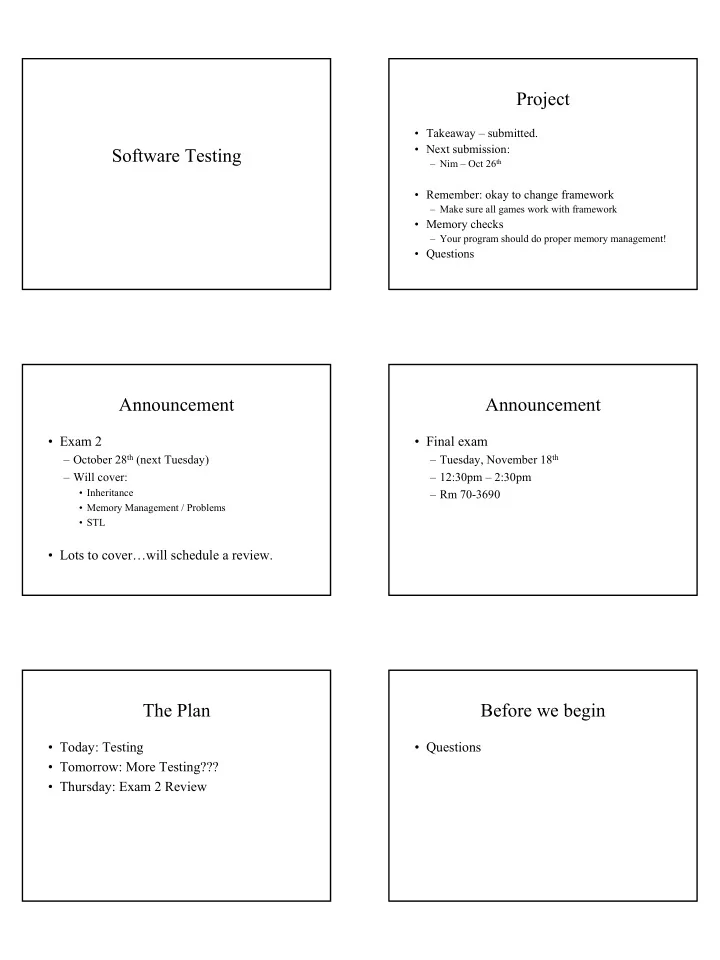
Software Testing Project

  • Takeaway – submitted.
  • Next submission:

– Nim – Oct 26th

  • Remember: okay to change framework

– Make sure all games work with framework

  • Memory checks

– Your program should do proper memory management!

  • Questions

Announcement

  • Exam 2

– October 28th (next Tuesday) – Will cover:

  • Inheritance
  • Memory Management / Problems
  • STL
  • Lots to cover…will schedule a review.

Announcement

  • Final exam

– Tuesday, November 18th – 12:30pm – 2:30pm – Rm 70-3690

The Plan

  • Today: Testing
  • Tomorrow: More Testing???
  • Thursday: Exam 2 Review

Before we begin

  • Questions
slide-2
SLIDE 2

Software Testing

  • From the software testing FAQ

– TESTING means "quality control" – QUALITY CONTROL measures the quality

  • f a product

– QUALITY ASSURANCE measures the quality of processes used to create a quality product.

  • No such thing as bug-free code!

Software testing

  • Some definitions:

– Error – Improper action of a programmer – Fault – The result of an error (improper logic). – Failure – Improper action of an executing program due to a fault.

Software testing

  • Programmer writes:

char *foo = 0; strcpy (foo, “I smell pointer problems”);

– This is an error

  • The fault is that strcpy accesses a null pointer.

– Many faults in C++ are pointer problems – Bad logic are problems too

  • The failure:

Segmentation fault (Core dumped)

Software Development Cycle

  • Gather Requirements

– Find out what the user needs

  • System Analysis

– Express these needs formally in system terms

  • Design

– Design a high level solution

  • Implementation

– Turn solution into code

  • Testing

– Verify that the solution works

  • Maintenance

– Iterate the cycle

Testing Strategies

  • 1. All tests should be traceable to customer requirements.
  • 2. Tests should be planned long before testing begins.
  • 3. 80% of errors are traceable to 20% of the modules (Pareto

Principle)

  • 4. Testing should begin in the small and progress to larger

components.

  • 5. Exhaustive testing is NOT possible.
  • 6. Testing is more effective when conducted by an

independent party.

Software Testing

  • When to test

– Incrementally during implementation phase

  • Assure each unit or class meets design and functional specs

– Limited testing of overall system during implementation – Formal system test during testing phase (after implementation is complete)

  • Alpha / Beta Testing
  • Tests program requirements
slide-3
SLIDE 3

Software Testing

  • Levels of testing

– Unit testing

  • individual classes

– Integration Testing

  • Assembly of one or more classes

– System Test

  • System as a whole

Software Testing

  • Types of Testing

– Formal Verification

  • Reduce program to logical assertions and “prove”

mathematically that the program is correct

– Empirical Testing

  • Generate Test cases to see where errors exist.
  • Most testing that you will do will be empirical

Software Testing

  • Empirical Testing

– White Box testing

  • Assumes access to the code
  • Test all program flows
  • Covers all statements and conditions

– Black Box Testing

  • Assumes no access to code or knowledge of implementation
  • Test cases generated based on requirements
  • Test valid and invalid input
  • Follow the contract

Programming by Contract

  • Introduced by Bertrand Meyer, the creator of

Eiffel.

  • Creates a contract between the software developer

and software user

– Every feature, or method, starts with a precondition that must be satisfied by the consumer of the routine. – each feature ends with postconditions which the supplier guarantees to be true (if and only if the preconditions were met). – each class has an invariant which must be satisfied after any changes to the object represented by the class.

Programming by Contract

SomeClass::someFunction ( AnotherClass *fillMeWithData ) { // check any preconditions here preCondition ( fillMeWithData ); // non-NULL check // do your stuff to add the functionality here ... // check post conditions postCondition ( fillMeWithData->hasData() ); // did we do what we said postCondition ( checkInvariant() ); // class invariant check required }

Assertions

  • Debugging mechanism to test condition at

any point in the code

– If condition is false, the program aborts and dumps core. – Useful for testing preconditions, postconditions and invariant checks.

slide-4
SLIDE 4

Assertions

#include <cassert> void foo (int *p) { // At this point p should not be null assert (p != 0); … }

Assertions

// constructor // // Preconditions: // last & first are not empty (emptyString) // age is not negative // Person::Person( string last, string first, int age, string firstJobName ): lastName(last), firstName(first), currentAge(age), currentJob(0) { assert( last != emptyString ); assert( first != emptyString ); assert( age >= 0 ); if ( firstJobName != noJob ) { currentJob = new Job( firstJobName ); } }

Questions? Unit Testing

  • A unit test tests at a “unit” (in C++, class)

level.

  • Why test classes individually?

– Limit the scope of testing – Easier to generate test cases – Bugs found earlier (before integration) are easier to fix.

Unit Testing

  • Black box approach

– Must rely on functional specs and contracts – Supply inputs, check outputs.

  • Call methods with well chosen parameters
  • Call methods in various orders
  • Check object state via access methods.

Unit Testing

  • White Box Approach

– You have the code, look directly at execution,

  • Use debugger to set data member values
  • Use debugger to get data member values
  • Use debugger to check flow of execution
  • Must test all execution paths
slide-5
SLIDE 5

Unit Testing – White Box

  • Testing Loops

– Simple loops (for I=0; I < n; I++)

  • 1. Skip the loop entirely.
  • 2. Only one pass through the loop.
  • 3. Two passes through the loop.
  • 4. m passes through the loop where m<n.
  • 5. n-1, n, n+1 passes through the loop

Unit Testing – White Box

  • Loop Testing

– Nested Loops

  • 1. Start with the innermost loop. Set all other loops to

minimum values.

  • 2. Conduct simple loop tests for the innermost loop while

holding the outer loops at their minimum iteration values.

  • 3. Work outward, conducting tests for the next loop, but

keeping all other outer loops at this minimum iteration count.

  • 4. Continue until all loop have been tested.

Unit Testing

  • Consider all paths

Unit Testing

  • About writing test cases

– Testing for success

  • Method gives expected results on good input

– Testing for failure

  • Methods should fail on bad input

– Test the contract! – values within ranges

  • Test boundaries and within range

Unit Testing

  • About writing test cases (black box)

– A test case should be able to...

  • ...run completely by itself, without any human input. Unit

testing is about automation.

  • ...determine by itself whether the function it is testing has

passed or failed, without a human interpreting the results.

  • ...run in isolation, separate from any other test cases (even if

they test the same functions). Each test case is an island.

– This is what try does for lab submissions!

Equivalence Classes

  • Testing all possible stimuli sequences is

impossible

  • Choose “groups” of stimuli that you guess

will cause the same reaction

– Based on your knowledge of the code

  • These groups are equivalence classes.
  • Choose only one test from each class.
  • Still a large number of tests to be run
slide-6
SLIDE 6

Equivalence classes

  • Two inputs are in the same Equivalence Class if they are handled

similarly by system

  • eg. data field valid value in 1-50

– So, 20, 38, 1, 47 belong to the same Equivalence Class

– no need to test multiple values from same Equivalent Class – Bounds testing

  • eg. test 38, then end points 1 and 50

– test valid and invalid equivalence classes – reduces the number of test cases required

Example: 3 inputs I1 has 10 equivalence classes Total tests cases required: I2 has 10 equivalence classes 10 x 10 x 10 = 1000 test cases. I3 has 10 equivalence classes

Unit Testing

  • Questions?

Summary

  • Software Testing
  • Error / Fault / Failure
  • Level of Testing
  • White Box vs. Black Box
  • Unit Testing
  • Questions