
SLIDE 1
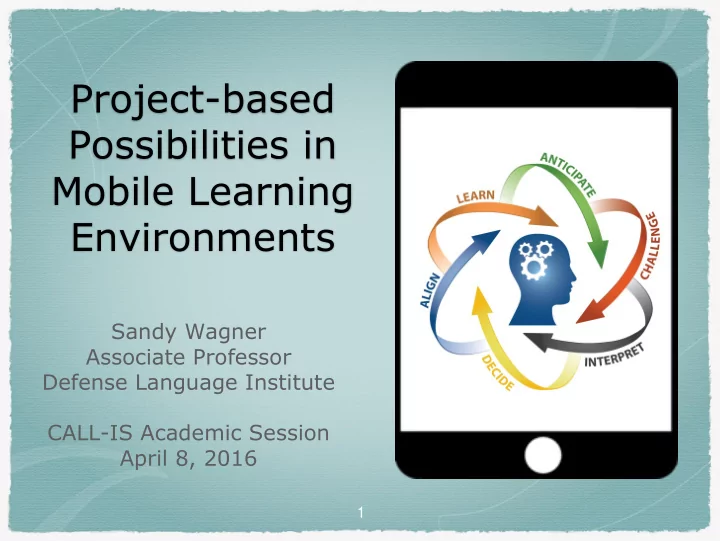
Project-based Possibilities in Mobile Learning Environments
Sandy Wagner Associate Professor Defense Language Institute CALL-IS Academic Session April 8, 2016
1
Project-based Possibilities in Mobile Learning Environments Sandy - - PowerPoint PPT Presentation
Project-based Possibilities in Mobile Learning Environments Sandy Wagner Associate Professor Defense Language Institute CALL-IS Academic Session April 8, 2016 1 Agenda Define mobile learning and mobile learning environments Show support
Sandy Wagner Associate Professor Defense Language Institute CALL-IS Academic Session April 8, 2016
1
2
The views, opinions, and /or findings contained in this presentation are those of the author and should not be construed as an official Department of the Army position, policy, or decision, or as views of the Defense Language Institute Foreign Language Center. All material displayed within this presentation is for educational purposes only. The content of this presentation is the sole responsibility of Sandy Wagner
3
4
1 973 Motorola DynaTAC
https://www.washingtonpost.com/news/the-switch/wp/201 4/09/09/the-history-of-the-mobile-phone/
5
6
text me at (831) 652-1724
7
8
Learning methods and materials that involve the use of mobile phones or handheld computers -Macmillan Dictionary e-Learning through mobile computational devices: Palms, Windows.... even your digital cell phone (Quinn, 2000)
It's about the device
9
The use of mobile devices as personal tools to help people learn wherever they go, through formal training or informal support and conversation. Utilizing the expanded capabilities of mobile devices to promote best pedagogical practices and learning
More than devices and apps
1
Any type of learning that takes place in learning environments and spaces that take into account the mobility of technology, mobility of learners, and mobility of learning
(El-Hussein & Cronje, 2010)
1 1
around
"Mobile devices used to deliver higher education content and instruction can also function as audio-players, media- players, and digital cameras." (El- Hussein&Cronje, 2010)
Source: "Defining Mobile Learning in the Higher Education Landscape", http://ifets.info/journals/13_3/3.pdf
1 2
communication (send a text rather than call)
"Overall advantages provided by mobile learning are...more flexible, accessible and personalized learning activities that keep the learner engaged in the ongoing learning activities and enhance their productivity and effectiveness." (Ting, 2005)
I suddenly remembered I needed to transfer monies to my son. (BoA app)
1 3
autonomy, reflection, creativity, critical thinking, real- world interactions
"Mobile learning is at the intersection of mobile computing and e-learning, providing accessible resources wherever you are, strong search capabilities, rich interaction, powerful support for effective learing and performance-based assessment." (Ally, 2005)
1 4
1 5
"Pedagogy, not technology, must lead."
project-based learning task-based authentic materials / contexts Learner- centered/ learner voice active/networ ked learning higher-order critical thinking experiential situated learning
communicative collaboration
creation curation learning styles / learner skills
constructivism
self-directed individualized
1 6
"...mobile learning can work, reaching places that other learning cannot; it is best provided as part of a blend of learning activities; it offers a collection of pieces to be fitted to a learning need.....can be used for learning through creativity, collaboration, and communication." (m-Learning project, 2005)
1 7
Blended Learning Environments - face-to- face, synchronous, asynchronous (classroom learning with learning in alternate locations) Blended skills (integration) for language learning Blended learning - formal and informal contexts Blended learning and leisure - "geocaching" treasure hunts to learn about geography, history, archaeology
1 8
1 9
"A broader consequence of (the MOBIlearn project) was a shift in focus from learning with handheld devices towards support for the mobility of learning." (Kukulska-Hulme, Sharples, et.al., 2011) "Another outcome was to develop a theory of learning for the mobile age that explores the system of learning enabled by mobility of people and technology and identifies specific aspects of mobile learning.." (Sharples, Taylor & Vavoula, 2007)
20
Offers functions and applications to teach and learn in innovative ways (more than just an online document repository) Expands learning to new contexts incorporating enhanced functionalities and opportunities for learning Changes focus away from the tech and towards enabled social practice nature of knowledge and discourse extends education outside of classroom into everyday life personalised and ubiquitous access to learning anytime/anywhere new language/idioms for written communications (4=for) PDF on a tablet Book behind glas s
21
NP How R U?
22
Teacher role is as important as ever
* Guide to knowledge acquisition and tech expert and relevant resources * Partner in the learning process - a mindset of "useful ignorance", exploring and learning alongside learners (http://edutalkstory.blogspot.com * Be flexible, supportive and engaged
It's a very ancient saying, But a true and honest thought, That if you become a teacher, By your pupils you'll be taught
("Getting to Know You", The King and I)
23
24
25
"Technology is not here to make us lazy or to avoid basic communication skills, but it is here to make us think critically, solve problems, collaborate, communicate, create, and ideate."
The Invisible iPad: It's Not About the Device (Cohen, 2014)
Role of Technology (Mobile)
26
27
National Institute for Literacy Initiative, Equipped for the Future Project-Based Activities,2002-2003)
Definition of PBL A collaborative approach to teaching in which learners are placed in situations where they use authentic language to accomplish whatever is needed to complete the project objectives Best projects have a meaning
28
Project-bas ed Learning Mobile S upport I dentify a project, problem or topic to research brainstorm, research, discuss Create an end product as a solution presentation, infographic, publication, video, quest, app S ignificant Content authentic materials, RS S feeds, multiple resources of information Collaboration document sharing, discussion boards Critical Thinking Bloom's taxonomy of apps Reflection Discussions, blogs (writing or speaking source)
29
Learners share ideas with each other through open- ended conversation or discussion Brainstorm Communicate/ Collaborate
3
3 1
Presentation Infographic Video Publication
3 2
3 3
Learners decide what information is needed and search and discover accordingly
QR Code Scanner RSS Feeds Search/Curate/Or ganize Content Authentic Content
3 4
3 5
Source: http://www.educatorstechnology.com/2014/05/new-handy-chart-on-ipad-blooms-taxonomy.html
3 6
View 3 7
Pedagogy, not technology, must lead
Apply mobile appropriately - get the most out of what the technology has to offer to provide purposeful learning Overcome obstacles * teacher buy in, training, and the development of device awareness * student frustration using mobile for learning * limited bandwidth and unreliable electricity and firewalls * using new tech to teach in the same old ways * match use to effective pedagogical practice * fossilized in e-learning practices - Internet Yahoo vs. App
Pedagogy
3 8
3 9
40
Edutalkstory (Smith, 2014). http://edutalkstory.blogspot.com Mobile Learning in the PBL Classroom (Miller, 2013). http://www.edutopia.org/blog/mobile-learning-in-pbl-classroom-andrew-miller Essential Elements of Project-based Learning, http://bie.org/object/document/pbl_essential_elements_checklist Innovation in Mobile Learning: a European Perpsective (Kukulska-Hulme, Sharples et. al.,2008). http://oro.open.ac.uk/12711/1/ijmbl_pre-print_19_dec_2008.pdf Defining Mobile Learning in the Higher Education Landscape (El-Hussein & Cronje, 2010). http://www.ifets.info/journals/13_3/3.pdf Learning Using Mobile and Handheld Devices (Sharples & Kukuluska-Hulme). http://wiki.alt.ac.uk/index.php/Learning_using_mobile_and_handheld_devices 3 Ways Mobile Technology Boosts Instruction (Lynch, 2015). http://www.theedadvocate.org/3-ways-mobile-technology-boosts-instruction/ Landscape Study in Wireless and Mobile Learning in the post-16 Sector (Kukulska- Hulme, Evans et.al., 2005). http://oro.open.ac.uk/43927/ The Invisible iPad: It's Not About the Device (Cohen, 2014). http://ww2.kqed.org/mindshift/2014/05/07/the-invisible-ipad-its-not-about-the-device/ USA in My Pocket (Wagner, 2003). http://www.floridaliteracy.org/pdf-docs/Disc13.pdf
41