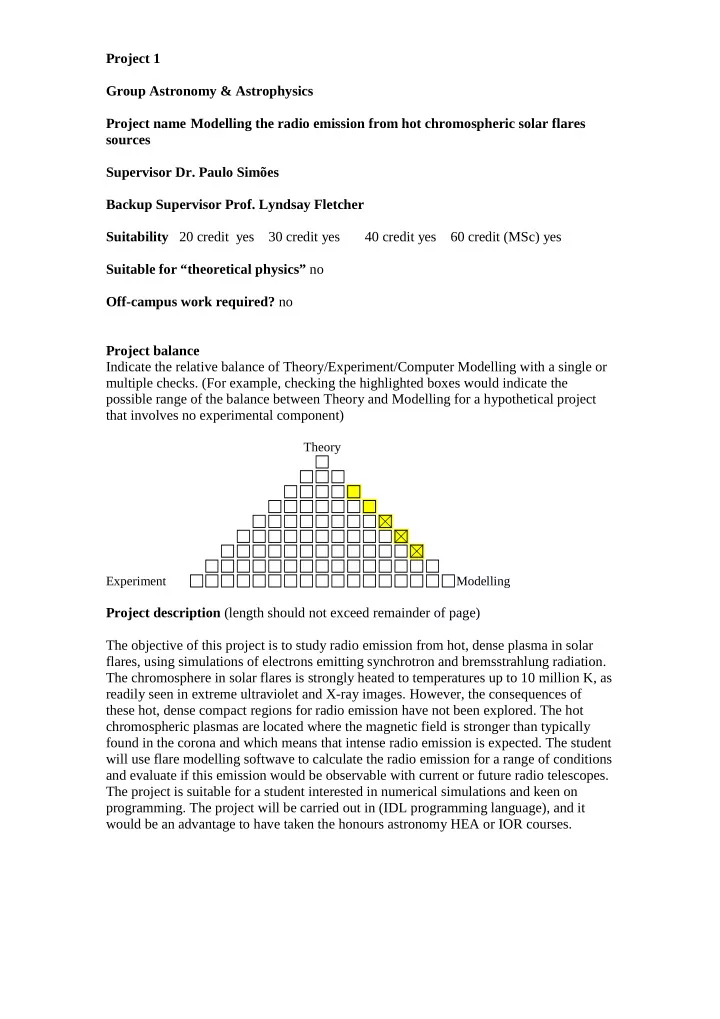
SLIDE 1 Project 1 Group Astronomy & Astrophysics Project name Modelling the radio emission from hot chromospheric solar flares sources Supervisor Dr. Paulo Simões Backup Supervisor Prof. Lyndsay Fletcher Suitability 20 credit yes 30 credit yes 40 credit yes 60 credit (MSc) yes Suitable for “theoretical physics” no Off-campus work required? no Project balance Indicate the relative balance of Theory/Experiment/Computer Modelling with a single or multiple checks. (For example, checking the highlighted boxes would indicate the possible range of the balance between Theory and Modelling for a hypothetical project that involves no experimental component)
Theory Experiment Modelling
Project description (length should not exceed remainder of page) The objective of this project is to study radio emission from hot, dense plasma in solar flares, using simulations of electrons emitting synchrotron and bremsstrahlung radiation. The chromosphere in solar flares is strongly heated to temperatures up to 10 million K, as readily seen in extreme ultraviolet and X-ray images. However, the consequences of these hot, dense compact regions for radio emission have not been explored. The hot chromospheric plasmas are located where the magnetic field is stronger than typically found in the corona and which means that intense radio emission is expected. The student will use flare modelling softwave to calculate the radio emission for a range of conditions and evaluate if this emission would be observable with current or future radio telescopes. The project is suitable for a student interested in numerical simulations and keen on
- programming. The project will be carried out in (IDL programming language), and it
would be an advantage to have taken the honours astronomy HEA or IOR courses.
SLIDE 2 Project 2 Group A&A Project name Solar prominence catalogue: analysis of large-scale prominence properties over more than a solar cycle Supervisor Dr Nicolas Labrosse Backup Supervisor Dr Jonathan Taylor Suitability 20 credit yes 30 credit yes 40 credit yes 60 credit (MSc) yes Suitable for “theoretical physics” no Off-campus work required? no Project balance Indicate the relative balance of Theory/Experiment/Computer Modelling with a single or multiple checks. (For example, checking the highlighted boxes would indicate the possible range of the balance between Theory and Modelling for a hypothetical project that involves no experimental component)
Theory Experiment Modelling
Project description (length should not exceed remainder of page) A solar prominence catalogue is being developed (and is close to completion), based on automatic feature recognition and advanced image processing. Depending on the length
- f the project and the student's interest, the goals will be one or more of:
- Assist with the prominence image reconstruction and tracking over successive frames.
- Use this catalogue covering 12 years of SOHO/EIT prominence observations to derive
the evolution of the prominence main characteristics over a whole solar cycle and identify any link with flares and Coronal Mass Ejections.
- Adapt the image processing algorithm to other space-based instruments.
During the project the student will learn: 1) basic physics of solar prominences, 2) basics
- f image processing, 3) how to analyse data from space-based observatories, 4) how to
search the literature to identify relevant research papers. This is an observational (data analysis, image processing) computer-based project involving algorithm development (feature-tracking). A willingness to engage with programming is essential.
SLIDE 3 Project 3 Group A&A Project name Two-dimensional radiative transfer models of cool solar coronal loops Supervisor Dr Nicolas Labrosse Backup Supervisor Prof Lyndsay Fletcher Suitability 20 credit no 30 credit no 40 credit yes 60 credit (MSc) yes Suitable for “theoretical physics” no Off-campus work required? no Project balance Indicate the relative balance of Theory/Experiment/Computer Modelling with a single or multiple checks. (For example, checking the highlighted boxes would indicate the possible range of the balance between Theory and Modelling for a hypothetical project that involves no experimental component)
Theory Experiment Modelling
Project description (length should not exceed remainder of page) The aim of the project is to develop a better understanding of cool solar chromospheric structures, and gain new insight on the physical conditions in these regions of the solar
- atmosphere. The chromosphere can be thought of as composed of bundles of small
magnetised loops. These small loop structures are represented in our models by 2D cylindrical objects. We perform radiative transfer calculations to compute the spectrum emitted under various physical conditions. The predicted spectrum can then in principle be compared with observations. This is a computational project which also aims to produce a new set of data to help observers interpret their observations. This is a computer-based project using a radiative transfer code developed in FORTRAN. A good understanding of radiative transfer basics is needed, from independent reading, or the Honours astronomy 'Circumstellar Matter' course. An ability to understand FORTRAN codes is preferable.
SLIDE 4 Project 4 Group A&A Project name Stellar flare statistics Supervisor Prof Lyndsay Fletcher Backup Supervisor Dr Matthew Pitkin Suitability 20 credit no 30 credit yes 40 credit yes Suitable for “theoretical physics” yes Off-campus work required? no Project balance Indicate the relative balance of Theory/Experiment/Computer Modelling with a single or multiple checks. (For example, checking the highlighted boxes would indicate the possible range of the balance between Theory and Modelling for a hypothetical project that involves no experimental component)
Theory Experiment Modelling
Project description (length should not exceed remainder of page) Data from the Kepler satellite is a great resource for finding large numbers of stellar
- flares. It could therefore provide much new information on the statistics of stellar flare
properties, such as the distribution of flare energies and rates. Software has been developed to automatically find flares, but this has yet to be applied to the majority of Kepler data. This project would first require applying this search software to identify a large number of flares. Using the identified flares we would develop a way to classify their characteristics, such as their energies, and uncover their distributions.
SLIDE 5 Project 5 Group A&A Project name EUV spectroscopy of solar flare footpoints Supervisor Prof Lyndsay Fletcher Backup Supervisor Dr Nicolas Labrosse Suitability 20 credit no 30 credit yes 40 credit yes Suitable for “theoretical physics” yes Off-campus work required? no Project balance Indicate the relative balance of Theory/Experiment/Computer Modelling with a single or multiple checks. (For example, checking the highlighted boxes would indicate the possible range of the balance between Theory and Modelling for a hypothetical project that involves no experimental component)
Theory Experiment Modelling
Project description (length should not exceed remainder of page) During a solar flare, the Sun’s atmosphere receives an energy flux on the order of 1011 watts m2, focused into patches known as footpoints. As a result of this energy input the atmosphere heats rapidly, and starts to expand. It may also become turbulent, a suggestion supported by recent observations of large linewidths observed in the solar chromosphere by the Extreme Ultraviolet Imaging Spectrometer onboard the Hinode
- spacecraft. In this project, the student will use the EIS software to measure line widths in
flares and to examine relationships between line widths and other properties of the flare plasma such as its density or Doppler shift, and to deduce the timescale on which line broadening appears and dies away. The project is particularly suitable for a student who has taken the 'Astronomical Data Analysis' course, and who is keen on data analysis and
- programming. It will involve the use of professional, and self-written software in the IDL
programming language
SLIDE 6 Project 6 Group Astronomy & Astrophysics Project name Lyman lines during solar flares: analysis of EVE observations Supervisor Prof. Lyndsay Fletcher Backup Supervisor Dr. Nicolas Labrosse Suitability 20 credit yes 30 credit yes 40 credit yes 60 credit (MSc) yes Suitable for “theoretical physics” no Off-campus work required? no Project balance Indicate the relative balance of Theory/Experiment/Computer Modelling with a single or multiple checks. (For example, checking the highlighted boxes would indicate the possible range of the balance between Theory and Modelling for a hypothetical project that involves no experimental component)
Theory Experiment Modelling
Project description (length should not exceed remainder of page) The Extreme Ultraviolet Variability Experiment on NASA’s Solar Dynamics Observatory is a ‘Sun-as-a-Star’ instrument that records the EUV and UV spectrum from the whole Sun every 10 seconds. It has observed of solar flares in the part of the spectrum containing high-order members of the hydrogen Lyman series, as well as the Lyman
- continuum. Such observations are rarely. As part of an ongoing research project into the
deduction of the physical properties of the plasma in solar flares, the student will work on these data, including isolating the flare spectral signatures, correcting them for instrumental effects, fitting spectral line profiles and measuring Lyman series intensities. A longer project might also involve comparison of these results to theoretical predictions. The programming will be done in MATLAB or the similar IDL programming language: the student must enjoy coding, have an interest in solar physics or astrophysics, and it would be beneficial to have completed the honours astronomy ADA course.
SLIDE 7 Project 7
Group Astronomy & Astrophysics Project name The temperatures of solar flares from the Solar Dynamics Observatory /EVE instrument Supervisor Dr. Hugh Hudson Backup Supervisor Prof. Lyndsay Fletcher Suitability 20 credit yes 30 credit yes 40 credit yes Suitable for “theoretical physics” no Project balance Indicate the relative balance of Theory/Experiment/Computer Modelling with a single
- check. (For example, checking the highlighted box would indicate a project that includes
equal components of theory and modelling with no experimental component)
Theory Experiment Modelling
Project description (length should not exceed remainder of page) The EUV Variability Experiment (EVE) on the Solar Dynamics Observatory measures the extreme ultraviolet spectrum of the 'Sun as a star'. During solar flares, spectral lines emitted by highly ionised iron in the solar corona become visible. In this project, the temperature of the flaring plasma as the flare evolves will be determined by, looking at the ratios of a series of iron lines. The goal is to determine flare heating and cooling timescales, and finding out whether higher temperature flares heat and/or cool faster than lower temperature flares. This project is suitable for a student who has taken the 'Astronomical Data Analysis' course as it will call on basic ideas about background and signal-to-noise ratio, as well as temperature diagnostics from emission line ratios. The project will involve a substantial amount of programming, and the intention is that this will be done by the student in
- MATLAB. The opportunity also exists for the student to use IDL and learn about remote
data access from the Virtual Solar Observatory.
SLIDE 8
Project 8 Group A&A Project name electron-moderated plasma chemistry of low-energy discharges Supervisor D A Diver Backup Supervisor Suitability 20 credit yes 30 credit yes 40 credit yes 60 credit (MSc) yes Suitable for “theoretical physics” yes Off-campus work required? no Project balance Indicate the relative balance of Theory/Experiment/Computer Modelling with a single or multiple checks. (For example, checking the highlighted boxes would indicate the possible range of the balance between Theory and Modelling for a hypothetical project that involves no experimental component)
Theory Experiment Modelling
Project description (length should not exceed remainder of page) Atmospheric plasma discharges are complex chemical systems in which a mixture of neutrals, radicals, positive and negative ions and free electrons are constantly interacting. The electron-moderated chemistry can create atomic and molecular pre-cursors that enable non-thermal chemical pathways to be explored. This unique chemistry accompanied by low thermal burden has fuelled the recent growth in atmospheric plasma discharge experiments across the plasma community, with diverse applications including plasma medicine. A zero-dimensional simulation (ie at a point in space) has been developed to model the evolution of around 15 molecular species in approximately 45 reactions, in order to explore the reactivity of the plasma. This project will extend the simulation in two very significant ways: (i) the code will incorporate competitive species diffusion and a temperature gradient, to go beyond the simple 'solution at a single point' approach; and (ii) the effect on a variable electron temperature will be examined, once (i) is implemented, in order to see if profiling the electron energy can be beneficial.
SLIDE 9 Project 9 Group A&A Project name plasma body forces in gas bubble evolution Supervisor D A Diver Backup Supervisor Suitability 20 credit yes 30 credit yes 40 credit yes 60 credit (MSc) yes Suitable for “theoretical physics” yes Off-campus work required? no Project balance Indicate the relative balance of Theory/Experiment/Computer Modelling with a single or multiple checks. (For example, checking the highlighted boxes would indicate the possible range of the balance between Theory and Modelling for a hypothetical project that involves no experimental component)
Theory Experiment Modelling
Project description (length should not exceed remainder of page) This project addresses the efficient calculation of the electrostatic field arising from distributed free charge on a discrete electron-plasma-bubble boundary, constrained by fixed, imposed boundary conditions that offer a potential gradient in one direction, but repulsive potential in all others. The self-consistent evolution of this bubble and associated self-field as the body forces distort the charged particle distribution, driving it to a potential minimum are is the key goal in this numerical study. The whole system conserves both charge and energy, so that as the bubble deforms and translates, the surface potential changes (altering the electrostatic energy of the system), and its center
- f mass acquires a speed, altering the global kinetic energy. We shall explore the
accuracy and efficiency of such a calculation strategy in modelling the evolution of short electron bursts in hollow-cathode geometries, with a view to applications in beam formation in lightning discharges (including sprites).
SLIDE 10 Project 10 Group A&A Project name Genetic Algorithms for breeding solutions to differential equations Supervisor D A Diver Backup Supervisor Suitability 20 credit yes 30 credit yes 40 credit yes 60 credit (MSc) yes Suitable for “theoretical physics” yes Off-campus work required? no Project balance Indicate the relative balance of Theory/Experiment/Computer Modelling with a single or multiple checks. (For example, checking the highlighted boxes would indicate the possible range of the balance between Theory and Modelling for a hypothetical project that involves no experimental component)
Theory Experiment Modelling
Project description (length should not exceed remainder of page) Genetic algorithms (GA) use a Darwinian approach to generating solutions to a penalty- driven problem. GAs are the most efficient multi-parameter search strategies that can be employed numerically. A possible solution to a defined problem is expressed as a character string which encodes all of the features of the solution to the problem: for exampe, the solution to an ODE can be written as a concatenation of the numerical values
- f the function (evaluated at the desired values of the argument), together with the
boundary conditions (which can be written directly at the ends of the string). In this format, the string is the analogy to DNA. The goodness-of-fit is expressed in terms of how close to the actual solution is one such string when translated. A collection of such potential solutions is designated as the parent population, and variants are generated by breeding from them. The resultant population is ranked according to fitness, and the process repeats until a satisfactory fit to the original ODE is found. This technique works well for stiff problems, and has real potential to work for PDEs too: project targets.
SLIDE 11 Project 11 Group A&A Project name Field-aligned flows in MHD Supervisor D A Diver Backup Supervisor Suitability 20 credit yes 30 credit yes 40 credit yes 60 credit (MSc) yes Suitable for “theoretical physics” yes Off-campus work required? no Project balance Indicate the relative balance of Theory/Experiment/Computer Modelling with a single or multiple checks. (For example, checking the highlighted boxes would indicate the possible range of the balance between Theory and Modelling for a hypothetical project that involves no experimental component)
Theory Experiment Modelling
Project description (length should not exceed remainder of page) Magnetohydrodynamical plasmas are characterised by long-wavelength, low-frequency fluid behaviour in which the magnetic field plays a signficant role in modifying the
- hydrodynamics. In this project, we will explore the unique context of field-aligned flows,
in which the bulk fluid flow is parallel or anti-parallel to the magnetic field u=fB, which allows significant simplification, making the fluid incompressible (div u = 0), and creating the concept of 'negative inertia' in which the fluid flow profile in restricted channels behaves counter to intuition. We will explore analytically the implications for a variety of flow contexts, ranging from simple Bernoulli flow to the analogies with classical potential flow, in which the fluid circulation becomes identified with the current
- density. This project will contain a significant amount of mathematical analysis, rather
than numerical modelling (though there will be scope for adjusting the relative balance).
SLIDE 12 Project 124 Group A&A Project name Pulsar telescope antenna noise and pattern modelling Supervisor Graham Woan Backup Supervisor Hamish Reid Suitability 20 credit no 30 credit yes 40 credit yes 60 credit (MSc) yes Suitable for “theoretical physics” yes Off-campus work required? no Project balance Indicate the relative balance of Theory/Experiment/Computer Modelling with a single or multiple checks. (For example, checking the highlighted boxes would indicate the possible range of the balance between Theory and Modelling for a hypothetical project that involves no experimental component)
Theory
X
Experiment Modelling
Project description (length should not exceed remainder of page)
The Acre Road pulsar telescope has been monitoring the pulsar PSR B0329+54 for several months at 408 MHz, gathering timing data for spindown measurements and long-term pulsar
- timing. We hope to extend the number of pulsars that can be monitored in this way by improving
the sensitivity of the array, and this involves a better understanding of the noise in the system. This project involves modelling the antenna pattern of the array using standard antenna-modelling NEC code (http://en.wikipedia.org/wiki/Numerical_Electromagnetics_Code) in a suitable wrapper such as 4nec2 (http://www.qsl.net/4nec2/). This antenna pattern will depend on the pointing direction and polarization, and the noise in the system is largely determined by spillover into this antenna pattern from ground emission. The second part of this project involves placing this antenna pattern in a simulation of the ground and sky at Acre Road, including the observed sky brightness at 408MHz developed by Haslam et al (eg http://lambda.gsfc.nasa.gov/product/foreground/haslam_408.cfm), to determine how the antenna temperature due to sky noise and spillover varies with hour angle as we track this source (and
- ther sources such as the Crab pulsar). The project can then go on to investigate how this noise
can be minimized by adjusting the positions of the antennas in the array. The student would be happy with coding in a variety of environments and have a familiarity with the basics of antenna theory. (Background information: Data taken with an Ettus Research software defined radio (https://www.ettus.com/product/details/UB100A-BDL) and recorded using Gnuradio (http://gnuradio.org/redmine/projects/gnuradio/wiki).
SLIDE 13 Project 24
Group Institute for Gravitational Wave Research Project name Characterisation of hydroxide-catalysis bonds Supervisor Karen Haughian Backup Supervisor Marielle van Veggel/ Sheila Rowan Suitability 20 credit yes 30 credit yes 40 credit yes Suitable for “theoretical physics” no Project balance Indicate the relative balance of Theory/Experiment/Computer Modelling with a single
- check. (For example, checking the highlighted box would indicate a project that includes
equal components of theory and modelling with no experimental component)
Theory Experiment Modelling
Project description (length should not exceed remainder of page) Hydroxide catalysis bonding is a technique used in the construction of quasi-monolithic mirror suspensions in gravitational wave detectors. Using this technique the mirrors are chemically bonded to silica prisms, 'ears', which are welded to thin silica fibres. The reason for using this technique is that the bond has very similar properties to the silica used and can be made extremely thin, which means any noise introduced by the bond is kept at a minimum. Currently we are looking at hydroxide catalysis bonding and indium bonding of silicon and sapphire as future generation gravitational wave detectors will possibly operate at cryogenic temperatures with mirrors made of these materials. We are always looking to further understand and optimise the bond properties and procedures and the chemistry behind it. The aim of your project would be to further characterise hydroxy-catalysis and/or indium bonds, in terms of strength, thickness or thermal conductivity, to help develop the bonding procedure for future generation detectors. The project is mostly experimental and will involve learning to work with chemicals, surface characterisation equipment, strength testing machines and cryostats.
SLIDE 14 Project 25 Group Institute for Gravitational Research Project name A monolithic interferometer for measuring creep in fused silica Supervisor Dr. Marielle van Veggel Backup Supervisor Dr Giles Hammond Suitability 20 credit yes 30 credit yes 40 credit yes Suitable for “theoretical physics” no Off-campus work required? no Project balance Indicate the relative balance of Theory/Experiment/Computer Modelling with a single or multiple checks. (For example, checking the highlighted boxes would indicate the possible range of the balance between Theory and Modelling for a hypothetical project that involves no experimental component)
Theory Experiment Modelling
Project description (length should not exceed remainder of page) Test mass suspensions in gravitational wave detectors utilise hydroxide catalysis bonding
- f fused silica to produce monlithic components of exceptional low thermal noise
- performance. As advanced LIGO undergoes commissioning there is significant interest to
measure these bonds under an applied stress in order to test their long term stability. This project will setup a high precision Michelson interferometer with bonded components for maximum stability. One of the end mirrors of the interferometer will be part of a suspension which will allow a stress to be aplied to the bond. By monitoring the stability of the interferometer, at a stress level x10 higher than normally used in detector suspensions, we will look for creep events in the bonds. The work will combine expertise in vacuum systems, building/testing electronics, and looking at environmental factors including temperature and tilt stability in the laboratory over long timescales.
SLIDE 15
Project 26 Group IGR Project name Measurements of eddy current damping for gravitational wave detector suspensions Supervisor Dr Liam Cunningham Backup Supervisor Dr Giles Hammond Suitability 20 credit yes 30 credit no 40 credit no Suitable for “theoretical physics” no Off-campus work required? no Project balance Indicate the relative balance of Theory/Experiment/Computer Modelling with a single or multiple checks. (For example, checking the highlighted boxes would indicate the possible range of the balance between Theory and Modelling for a hypothetical project that involves no experimental component)
Theory Experiment Modelling
Project description (length should not exceed remainder of page) The Institute for Gravitational Research is involved with several Gravitational Wave projects around the world (aLIGO, KAGRA, GEO-HF). As part of our collaboration with the Albert Einstein Insitute (AEI) in Hannover we are designing a prototype monolithic fused silica suspension with 100g test masses. The interferometer will be used to develop novel opto-mechanical techniques that can be applied to full scale experiments in the future. The project will involve building a small pendulum incorporating a passive eddy current damping system and calculating the damping constant for bobs made of different materials moving at a range of velocities. Comparison with models in ANSYS finite element software will be used to design optimum dampers. The pendulum will be sensed with a commercial vibrometer which measures velocity and monitored with Labview.
SLIDE 16 Project 27 Group IGR Project name Gravitational waves from binary black hole mergers Supervisor Ik Siong Heng Backup Supervisor Matthew Pitkin Suitability 20 credit no 30 credit yes 40 credit yes 60 credit (MSc) yes Suitable for “theoretical physics” yes Off-campus work required? no Project balance Indicate the relative balance of Theory/Experiment/Computer Modelling with a single or multiple checks. (For example, checking the highlighted boxes would indicate the possible range of the balance between Theory and Modelling for a hypothetical project that involves no experimental component)
Theory Experiment Modelling
Project description (length should not exceed remainder of page) The detection of gravitational waves will allow us to observe phenomenon not accessible through current astronomical observations. For example, will allow us to directly probe a black hole and shed light on the internal structure of neutron stars. It is also possible to use gravitational waves to test Albert Einstein's General Theory of
- Relativity. There are alternative treatments of gravity that can have visible effects on the
expected gravitational wave signal. In this computational project, we will test different analysis techniques and characterise their performance for binary black hole merger different waveforms. The results of these tests are potentially interesting to the international gravitational wave community and lead to a publication. This project will build on Matlab skills acquired in earlier years. Depending on how the project progresses, familiarity with the linux environment and knowledge of python and shell scripting will also be helpful.
SLIDE 17 Project 28 Group IGR Project name Classifying graviational wave transients Supervisor Ik Siong Heng Backup Supervisor Jade Powell Suitability 20 credit yes 30 credit yes 40 credit yes 60 credit (MSc) no Suitable for “theoretical physics” yes Off-campus work required? no Project balance Indicate the relative balance of Theory/Experiment/Computer Modelling with a single or multiple checks. (For example, checking the highlighted boxes would indicate the possible range of the balance between Theory and Modelling for a hypothetical project that involves no experimental component)
Theory Experiment Modelling
Project description (length should not exceed remainder of page) Data from gravitational wave detectors often suffer from periods of spurious transient
- noise. Such noise sources can have distinct features depending on their origin.
In this computational project, we study the properties of these noise transients and classify them using Bayesian model selection. Such an approach can lead to insight to on the behaviour of the detector and shed light on the physical processes involved. This project will use developed algorithms, run on computing clusters, and require familiarity with the linux environment as well as knowledge of python and shell scripting.
SLIDE 18 Project 29 Group IGR Project name Exploring the gravitaitonal wave sky Supervisor Ik Siong Heng Backup Supervisor Martin Hendry Suitability 20 credit no 30 credit yes 40 credit yes 60 credit (MSc) no Suitable for “theoretical physics” yes Off-campus work required? no Project balance Indicate the relative balance of Theory/Experiment/Computer Modelling with a single or multiple checks. (For example, checking the highlighted boxes would indicate the possible range of the balance between Theory and Modelling for a hypothetical project that involves no experimental component)
Theory Experiment Modelling
Project description (length should not exceed remainder of page) The estimation of the signal sky location is a vital component for multimessenger astronomy with gravitational waves. For example, observing a gamma ray burst occur in the same sky location as a gravitational wave source will provide strong evidence that gamma ray bursts are driven by the merger of two neutron stars or a neutron star and a black hole. In this computational project, we will use a novel statistical technique (mixed MCMC) developed by the IGR to estimate the sky location of gravitational wave sources, characterising the performance of mixed MCMC using a standard catalogue of simulated
- sources. This project will build on existing Matlab code. Therefore, competence with
Matlab is essential.
SLIDE 19 Project 30 Group IGR Project name Measuring the optical absorption of silicon wafers and getting rid of that pesky noise Supervisor Angus Bell Backup Supervisor Iain Martin Suitability 20 credit yes 30 credit yes 40 credit no 60 credit (MSc) no Suitable for “theoretical physics” no Off-campus work required? no Project balance Indicate the relative balance of Theory/Experiment/Computer Modelling with a single or multiple checks. (For example, checking the highlighted boxes would indicate the possible range of the balance between Theory and Modelling for a hypothetical project that involves no experimental component)
Theory Experiment Modelling
Project description (length should not exceed remainder of page) We have a system that we use to measure low levels of optical absorption in silicon. The system relies on the fact that a small thermal lens is created in a material when it absorbs light and that will cause a reference laser beam to be deflected. Unfortunately, the reference laser is also deflected by air currents in the room, which gives false signals or
- noise. This project will allow the student to make measurements on several different
types of sample as well as characterising the noise in the measuring machine and designing shielding to minimise noise from air currents. For students who enjoy computer modelling there may be scope to work on the modelling of the response of the samples to temperature and provide theoretical ouputs of the signal as a function of temperature. This project is only available in the first semester.
SLIDE 20 Project 31 Group IGR Project name Labview control of an instrument for optical absorption Supervisor Angus Bell Backup Supervisor Iain Martin Suitability 20 credit yes 30 credit yes 40 credit no 60 credit (MSc) no Suitable for “theoretical physics” no Off-campus work required? no Project balance Indicate the relative balance of Theory/Experiment/Computer Modelling with a single or multiple checks. (For example, checking the highlighted boxes would indicate the possible range of the balance between Theory and Modelling for a hypothetical project that involves no experimental component)
Theory Experiment Modelling
Project description (length should not exceed remainder of page) In the IGR we do a lot of measurements of the optical absorption of materials. Much of this is automated using various individual Python scripts. Each script runs a single type of measurement, such as looking at the signal from the sample as a function of time, or as a function of power. This project will allow a student to create a single Labview program that will pull together the functionality of the different Python scripts into a single
- program. The individual scripts control various different lab instruments and allow the
reading in of data over various serial interfaces. The student will use their program to measure the absorption of various different samples and obtain real data. This project is only available in the 2nd semester.
SLIDE 21 Project 32 Group IGR Project name Demonstrating and characterising the intensity noise of a stable laser and helping to reduce that noise Supervisor Angus Bell Backup Supervisor Ken Strain Suitability 20 credit yes 30 credit yes 40 credit no 60 credit (MSc) no Suitable for “theoretical physics” no Off-campus work required? no Project balance Indicate the relative balance of Theory/Experiment/Computer Modelling with a single or multiple checks. (For example, checking the highlighted boxes would indicate the possible range of the balance between Theory and Modelling for a hypothetical project that involves no experimental component)
Theory Experiment Modelling
Project description (length should not exceed remainder of page) The IGR is about to put together a laser system with very low intensity and frequency
- noise. This will be the workhorse laser for our interferometry reseach towards future
gravitational wave detectors. This project will allow a student to work with other members of the IGR on putting together the parts required for an intensity feedback servo for that system. The student will help put together the optical components required to sample some of the light from a fibre coupled laser and direct it to a detector. They will also put together appropriate electronic components to amplify the signal from the detector and then use that signal as the input to a servo system to reduce the intensity noise. This project is only available in the first semester.
SLIDE 22 Project 33 Group IGR Project name Characterising and frequency stabilising a 1550 nm laser, and testing and characterising a feedback servo-control loop. Supervisor Angus Bell Backup Supervisor Ken Strain Suitability 20 credit yes 30 credit yes 40 credit no 60 credit (MSc) no Suitable for “theoretical physics” no Off-campus work required? no Project balance Indicate the relative balance of Theory/Experiment/Computer Modelling with a single or multiple checks. (For example, checking the highlighted boxes would indicate the possible range of the balance between Theory and Modelling for a hypothetical project that involves no experimental component)
Theory Experiment Modelling
Project description (length should not exceed remainder of page) The IGR is about to put together a laser system with very low intensity and frequency
- noise. This will be the workhorse laser for our interferometry reseach towards future
gravitational wave detectors. In this project the student will work with other members of the IGR to build an optical system that directs some light from a fibre coupled laser to a suitable frequency reference, such as a silicon etalon. They will then look into obtaining an error signal from this by using a frequency modulator provided, and then optimise the electronic feedback servo to provide the best frequency lock of the laser to the reference. The project can also be extended to look at other frequency references, such as high finesse Fabry-Perot cavities and could include the modelling of the response of these cavities This project is only available in the 2nd semester.
SLIDE 23
Project 34 Group Institute for Gravitational Research Project name Characterisation of thin film coated cantilevers Supervisor Dr. Peter Murray Backup Supervisor Dr. Iain Martin Suitability 20 credit yes 30 credit yes 40 credit no 60 credit (MSc) no Suitable for “theoretical physics” no Off-campus work required? no Project balance Indicate the relative balance of Theory/Experiment/Computer Modelling with a single or multiple checks.
Theory Experiment Modelling
Project description (length should not exceed remainder of page) Thermal noise associated with the highly reflective mirror coatings are expected to set a limit, at the most sensitive frequency range, of the advanced Gravitational Wave Detectors currently under construction. In order to further develop coatings a series of mechanical and optical requirements have been set, and complicating things, many of the properties of materials being considered are not fully characterised. This project will focus on the study of different thin film coatings applied to both silicon and fused silica subsrates and students will be able to gain exerience in experimental measurements using a variety of techniques, for example; energy dispersive x-ray flourecense spectroscopy, or EDXRF (a non-destructive analytical technique used in the elemental analysis of samples), drop shape anaylsis (the concact angle between a liquid drop and a sample surface can be used to calculate the "surface free energy"), as well as ellipsometry, atomic force microscopy and profiling machines to measure the thickness, composition and to study the surfaces of these thin film coatings.
SLIDE 24
Project 35 Group IGR Project name Gravitational wave audiation : Simulating the cosmic symphony Supervisor Chris Messenger Backup Supervisor Morag Casey Suitability 20 credit no 30 credit no 40 credit yes 60 credit (MSc) yes Suitable for “theoretical physics” yes Off-campus work required? no Project balance Indicate the relative balance of Theory/Experiment/Computer Modelling with a single or multiple checks. (For example, checking the highlighted boxes would indicate the possible range of the balance between Theory and Modelling for a hypothetical project that involves no experimental component)
Theory Experiment Modelling
Project description (length should not exceed remainder of page) Gravitational waves (GWs) are often said to be analogous to sound waves and the reasons are mainly 2-fold. Ground-based GW detectors are sensitive in a frequency range that strongly overlaps with that of the human ear and GW detectors are, in general, sensitive to nearly all spatial directions. This project will aim to design and write the software required to simulate, in audible sound, the superposition of populations of the main GW sources in the universe. This is to be used as part of a science-outreach tool for the promotion of GWs to the general public whereby the participant is played the audio simulation of the GW universe in order to mimic what GW detectors are trying to “hear”. Of key importance will be the use of stereo sound effects (phase and time delays) in simulating GW source directionality. The student will take on the second phase of this project and aim to develop the interactive software tools needed to make this a widely used outreach resource.
SLIDE 25 Project 36 Group IGR Project name Studying the dynamics of optical springs Supervisor Bryan Barr Backup Supervisor Ken Strain Suitability 20 credit no 30 credit no 40 credit yes 60 credit (MSc) no Suitable for “theoretical physics” no Off-campus work required? no Project balance Indicate the relative balance of Theory/Experiment/Computer Modelling with a single or multiple checks.
Theory Experiment Modelling
Project description (length should not exceed remainder of page)
Gravitational wave detectors require sensitive displacement measurements based on laser interferometry. Current and future interferometers employ such high light power (~1MW) that the radiation pressure, acting on the freely-suspended mirrors of the interferometer, produces an effect called "optical rigidity" where the first-order dynamical effect is that of a spring, that can be as stiff as diamond (but made of light). PhD student Neil Gordon has designed a test system that provides for several optical springs to be formed in a resonant cavity system and we are in a position to characterise the interactions. In this project the student will work with Neil and the rest of the team in the Glasgow 10m interferometer lab*, to learn the relevant technques for characterisation and measurements, and some associated
- modelling. The project is flexible in nature, but requires some investment in learning new physics and
experimental technques, so is only offered at 40 credits. This is an excellent research opportunity and may lead to publishable work. * A substantial part of the work will be carried out in this lab, which is a clean-room. It is necessary to wear clean-room clothes and laser safety training will be required. Speak with Neil or the supervisors if you are in doubt about this, or to see the lab and working conditions before deciding. This project is only available for one student.
SLIDE 26 Project 37 Group IGR Project name Observing transients with the Large Synoptic Survey Telescope Supervisor Ik Siong Heng Backup Supervisor Martin Hendry Suitability 20 credit no 30 credit yes 40 credit yes 60 credit (MSc) yes Suitable for “theoretical physics” yes Off-campus work required? no Project balance Indicate the relative balance of Theory/Experiment/Computer Modelling with a single or multiple checks. (For example, checking the highlighted boxes would indicate the possible range of the balance between Theory and Modelling for a hypothetical project that involves no experimental component)
Theory Experiment Modelling
Project description (length should not exceed remainder of page) The Large Synoptic Survey Telescope (LSST) will produce an unprecedented wide-field astronomical survey of our universe using an 8.4-metre ground-based telescope. The LSST, with its repeated, wide-area coverage of the night sky will enable the discovery and analysis of a wide range of astrophysical transients such as gamma ray bursts, X-ray flashes and supernovae. In this computational project, we will use light curves for transients associated with gravitational wave sources to model their observed variability as the LSST surveys the
- sky. The aim is to characterise how well the LSST can observe optical transients in its
nominal survey mode and determine how well it can observe optical counterparts to gravitational wave signals and distinguish them from other transient phenomena.
SLIDE 27
Project 38 Group IGR Project name:Exploring the possibilities of imaging and laser beam position stabilisation with the Raspberry Pi Camera Supervisor Dr. Borja Sorazu, Dr. Alan Cumming Backup Supervisor Prof. Ken Strain, Dr Giles Hammond Suitability 20 credit yes 30 credit yes 40 credit yes Suitable for “theoretical physics” no Off-campus work required? no Project balance
Indicate the relative balance of Theory/Experiment/Computer Modelling with a single or multiple checks. (For example, checking the highlighted boxes would indicate the possible range of the balance between Theory and Modelling for a hypothetical project that involves no experimental component)
Theory Experiment Modelling
Project description (length should not exceed remainder of page)
The Raspberry Pi (Pi) is a low cost credit-card sized computer with processing power, portability, programming capabilities etc. that make it a contender for applications previously reserved only to microcontrollers. The IGR is developing Pis for cost effective sensing and control applications. We offer related projects for students to exploit the potential of the high resolution Pi camera module. The camera is sensitive to IR, and has a native 5 megapixel resolution, capable of 2592 x 1944 pixel static images and supports high definition video at frame rates of up to 90 frames per second, opening up many potential uses in low cost control systems, possibly using multiple Pi camera systems. IGR’s interest forms two project strands (for either a pair of 20/30 credit students, or a single 40 credit student): 1) A sizable online community has already explored possibilities for use of the camera module for various imaging applications and we would like to further tap into this. The student will be able to work on the implementation of a temperature/brightness monitor of laser heating of fused silica as part of our state of the art fused silica fibre pulling machine, which is used to fabricate the silica fibres that will suspend the very high quality mirrors of the next generation of ground based gravitational wave detectors. Another aspect that may be explored is applying the Raspberry Pi for dimensional characterisation of the resulting silica suspension fibres. 2) The Raspberry Pi camera sensor is sensitive to the infrared laser light (1064 nm) used in our interferometer experimental facilities. We plan to develop a system for monitoring the position of a laser beam, and therefore allowing the beam position to be stabilised. A digital servo system would be developed to control the beam using an actuator consisting of loudspeaker drives acting on springs that are connected to steering mirrors. Students will investigate these areas of imaging with the Pi-Camera, looking to explore its capabilities, extend its use by interacting with the Pi-community and writing new code to exploit the full potential of the hardware. In all projects the student should have interests in the areas of programing (The Pis are Linux based, and use Python, C++. Integration with LabView may also be required), circuits, systems and control (the Circuits and Systems course is useful, but not essential).
SLIDE 28 Project 39 Group IGR Project name Acoustic coupling in sensitive interferometric measurements Supervisor Borja Sorazu Backup Supervisor Ken Strain Suitability 20 credit yes 30 credit yes 40 credit yes 60 credit (MSc) no Suitable for “theoretical physics” no Off-campus work required? no Project balance Indicate the relative balance of Theory/Experiment/Computer Modelling with a single or multiple checks. (For example, checking the highlighted boxes would indicate the possible range of the balance between Theory and Modelling for a hypothetical project that involves no experimental component)
Theory Experiment Modelling
Project description (length should not exceed remainder of page)
Gravitational wave detectors use interferometry for sensitive displacement measurements. Sound can affect the measurement in various ways that are difficult to characterise since sounds with ~1m wavelengths bounce around in the lab, creating multi-path interference effects. In this project the student will a) learn the relevant measurement techniques b) carry out measurements on a model system consisting of loudspeakers and microphones and apply similar techniques to those used for digital room correction. c) measure how an optical mount vibrates in reaction to sound d*) investigate the coupling of sound to a beam of laser light in air e*) investigate the coupling of sound to the walls of a 1m vacuum tank * - these more advanced topics apply in the case of longer projects and/or would provide parallel strands for a pair of students working on the same project. At 20 credits, the project can be carried out in S1 or S2. Measurements will be carried out using an state of the art data collection and digital signal processing
- system. The student should have interests in the areas of circuits, systems, signals and information.
SLIDE 29 Project 40 Group Institute for Gravitational Research Project name Measuring the speed of light: citizen science for the International Year of Light Supervisor Dr. Giles Hammond Backup Supervisor Prof. Martin Hendry Suitability 20 credit yes 30 credit yes 40 credit no Suitable for “theoretical physics” no Off-campus work required? yes Project balance Indicate the relative balance of Theory/Experiment/Computer Modelling with a single or multiple checks. (For example, checking the highlighted boxes would indicate the possible range of the balance between Theory and Modelling for a hypothetical project that involves no experimental component)
Theory Experiment Modelling
Project description (length should not exceed remainder of page) 2015 is the International Year of Light and to celebrate we are proposing a recreation of the classic Roemer delay experiment. Ole Roemer (1676) noted a perioidic variation in the eclipses of Io and in a brilliant piece of deduction argued this was due to the changing distance between Earth and Jupiter. He thus was the first to make an estimate of the speed
The project will focus on laying thegroundwork for a citizen science project to be run in
- 2015. There will be components of modelling/theoretical work where the Roemer delay
will be calculated from the ephemeris of the earth-sun-jupiter system. There will be the
- pportunity to write code to extract the speed of light, given observations at different
longitudes, in addition to planning the optimum time for observation across different
- countries. Some observing of the eclipses of Io might also be possible at Acre Road to
test the feasability of the project with bincolulars/small telescopes.
SLIDE 30 Project 41
Group IGR Project name Speedmeter Interferometry to Outperform Heisenberg Supervisor Stefan Hild Backup Supervisor Christian Graef, Sebastian Steinlechner Suitability 20 credit no 30 credit yes 40 credit yes 60 credit (MSc) no Suitable for “theoretical physics” no Off-campus work required? no Project balance Indicate the relative balance of Theory/Experiment/Computer Modelling with a single or multiple checks. (For example, checking the highlighted boxes would indicate the possible range of the balance between Theory and Modelling for a hypothetical project that involves no experimental component)
Theory Experiment Modelling
Project description (length should not exceed remainder of page) The world's first Sagnac Speedmeter (SSM) is under construction in one of Glasgow University's IGR labs. It is theoretically capable of outperforming the Heisenberg uncertainty principle, and our proof of principle experiment seeks to establish the SSM's
- capabilities. This student project will focus on the continuing development of sub-
systems and analysis of the SSM. A number of areas are open to investigation. There is a strong experimental focus within the SSM group, but there are also opportunities for modelling work. The project can include working with lasers, designing and building electronic circuits for processing signals or controlling systems, fiber optics for guiding and cleaning light for the interferometer, in air optics, and Matlab modelling. The project allows for the student to focus on their preferred area.
SLIDE 31 Project 42 Group IGR Project name Analog filters revisited: improving a less than popular experiement! Supervisor Henry Ward Backup Supervisor David Robertson Suitability 20 credit yes 30 credit no 40 credit no Suitable for “theoretical physics” no Off-campus work required? no Project balance Indicate the relative balance of Theory/Experiment/Computer Modelling with a single or multiple checks. (For example, checking the highlighted boxes would indicate the possible range of the balance between Theory and Modelling for a hypothetical project that involves no experimental component)
Theory Experiment Modelling
Project description (length should not exceed remainder of page) The Analogue Filters experiment in the Honours lab has been in its current form for rather a long time. While it complements key parts of the Circuits and Systems course, making the circuit response measurements can tend to consume a lot of time and certainly limits the range of circuit types that can be studied. We propose to bring the experiment up-to-date, using a recently introduced computer- driven all-in-one device - the National Instruments VirtualBench. The challenge of the project is to develop (in LabView) software to do Bode and Polar plotting in essentially real-time, so that the effects of varying circuit topologies and component values can be readily investigated. The project will also develop an additional part to the experiment - the investigation of impulse responses - that will complement the Laplace transform part
The end result will be a revised experiment, and re-written experiment guide, that will be deployed from next year.
SLIDE 32 Project 43 Group IGR Project name Visualising interference in MHz heterodyne interferometry Supervisor Henry Ward Backup Supervisor David Robertson / Christian Killow Suitability 20 credit no 30 credit yes 40 credit yes Suitable for “theoretical physics” no Off-campus work required? no Project balance Indicate the relative balance of Theory/Experiment/Computer Modelling with a single or multiple checks. (For example, checking the highlighted boxes would indicate the possible range of the balance between Theory and Modelling for a hypothetical project that involves no experimental component)
Theory Experiment Modelling
Project description (length should not exceed remainder of page) Heterodyne interferometry is often used for precision measurement of very small
- displacements. In such an interferometer two lasers beams that are relatively offset by a
small frequency shift are interfered. One beam acts as the reference; the other beam travels the additional path that is to be monitored. Path length changes then cause a corresponding phase shift of the heterodyne beat note formed at the photodiode that detects the interfering beams. Spatially sensitive measurements of the beat-note phase shift in the interference pattern carry information about relative beam alignment and about relative spatial properties. If the frequency offset is small (close to dc, for example) the interefence pattern can be inspected by eye and recorded using a simple camera. Very sophisticated high-speed cameras can be used if the heterodyne frequency is in the kHz
- region. But for large frequency offsets, well into the MHz region, direct visualisation
becomes impossible. This project will explore - and demonstrate - a possible experimental approach that will solve this problem.
SLIDE 33 Project 44 Group IGR Project name Cosmic calibration of gravitational wave detectors Supervisor Dr Ik Siong Heng Backup Supervisor Dr Matthew Pitkin & Dr Chris Messenger Suitability 20 credit no 30 credit yes 40 credit yes Suitable for “theoretical physics” yes Off-campus work required? no Project balance Indicate the relative balance of Theory/Experiment/Computer Modelling with a single or multiple checks. (For example, checking the highlighted boxes would indicate the possible range of the balance between Theory and Modelling for a hypothetical project that involves no experimental component)
Theory Experiment Modelling
Project description (length should not exceed remainder of page) Calibrating gravitational wave detectors currently must be performed by direct manipulation of the detectors. However, there may exist inspiralling compact binary sources for which enough is known about them that they can be used as external detector
- calibrators. This project involves simulating detector data containing compact binary
signals as using Bayesian parameter estimation methods to estimate how well the calibration can be recovered. This can expand to involve the use of multiple detectors and multiple signals.