Progress of Disposal of Disaster Waste Directly Governed by the - - PowerPoint PPT Presentation

progress of disposal of disaster waste directly governed
SMART_READER_LITE
LIVE PREVIEW

Progress of Disposal of Disaster Waste Directly Governed by the - - PowerPoint PPT Presentation

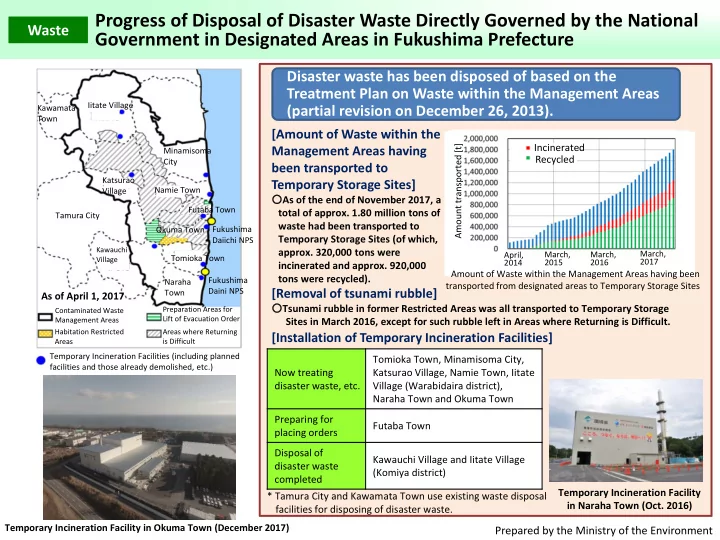
Progress of Disposal of Disaster Waste Directly Governed by the National Waste Government in Designated Areas in Fukushima Prefecture Disaster waste has been disposed of based on the Treatment Plan on Waste within the Management Areas Iitate


slide-1
SLIDE 1

[Installation of Temporary Incineration Facilities]

* Tamura City and Kawamata Town use existing waste disposal facilities for disposing of disaster waste. Now treating disaster waste, etc. Tomioka Town, Minamisoma City, Katsurao Village, Namie Town, Iitate Village (Warabidaira district), Naraha Town and Okuma Town Preparing for placing orders Futaba Town Disposal of disaster waste completed Kawauchi Village and Iitate Village (Komiya district)

Disaster waste has been disposed of based on the Treatment Plan on Waste within the Management Areas (partial revision on December 26, 2013).

[Amount of Waste within the Management Areas having been transported to Temporary Storage Sites]

○As of the end of November 2017, a total of approx. 1.80 million tons of waste had been transported to Temporary Storage Sites (of which,

  • approx. 320,000 tons were

incinerated and approx. 920,000 tons were recycled).

[Removal of tsunami rubble]

○Tsunami rubble in former Restricted Areas was all transported to Temporary Storage Sites in March 2016, except for such rubble left in Areas where Returning is Difficult. Temporary Incineration Facility in Naraha Town (Oct. 2016)

Waste

Progress of Disposal of Disaster Waste Directly Governed by the National Government in Designated Areas in Fukushima Prefecture

Temporary Incineration Facilities (including planned facilities and those already demolished, etc.)

Temporary Incineration Facility in Okuma Town (December 2017)

Prepared by the Ministry of the Environment

Amount transported [t] Amount of Waste within the Management Areas having been transported from designated areas to Temporary Storage Sites

Incinerated Recycled As of April 1, 2017

Fukushima Daiichi NPS Fukushima Daini NPS

Contaminated Waste Management Areas Habitation Restricted Areas Preparation Areas for Lift of Evacuation Order Areas where Returning is Difficult

Iitate Village Katsurao Village Namie Town Minamisoma City Naraha Town Tomioka Town Futaba Town Okuma Town

Kawauchi Village

April, 2014 March, 2015 March, 2016 March, 2017 Kawamata Town Tamura City

slide-2
SLIDE 2

Waste

Ensuring Safety for Temporary Storage of Designated Waste

Temporary storage work (in the case of agricultural by‐products)

Elevate a certain parcel of land by adding soil Put waste in tough bags and surround those bags with sandbags Cover them up with soil to shield radiation Cover the whole area with an impermeable sheet

Structure of a Temporary Storage Site (in the case of agricultural by‐products) Checking of storage status

  • Take measures to prevent scattering and runoff of

waste

  • Take required measures against radiation

(isolation or shielding using sandbags, etc.)

  • Take measures to prevent infiltration of rainwater

using impermeable sheet, etc.

The status of storage at Temporary Storage Sites is to be checked to ensure that designated waste is properly stored in compliance with the standards, etc. specified in the Act on Special Measures.

Staff of the Regional Environmental Office checking the storage status Prepared based on the website, "Information on Disposal of Radioactive Waste," of the Ministry of the Environment

slide-3
SLIDE 3

Waste within the Management Areas

(former Restricted Areas and Deliberate Evacuation Areas)

Designated waste (exceeding 8,000 Bq/kg)

100,000 Bq/kg or lower

Existing controlled disposal site

Volume reduction, recycling, final disposal

Exceeding 100,000 Bq/kg

Interim Storage Facility

Volume reduction project

Terminal treatment plant in Horikawa Town, Fukushima City

Drying treatment of dehydrated sludge, etc. was completed at the end of October 2014 and the plant was demolished at the end of March 2016. Incineration

  • f

agricultural waste was completed at the end of July 2015.

Fukushima Prefecture Central Purification Center (Koriyama City)

Incineration

  • f

dehydrated sludge, etc. was completed in March 2014, and Fukushima Prefecture took over the work and incinerated waste with radioactivity concentrations of 8,000 Bq/kg or lower and the incineration work was completed at the end of May 2016.

Warabidaira District, Iitate Village

Volume reduction of contaminated waste generated in Iitate Village and surrounding five municipalities; A Temporary Incineration Facility started operation in January 2016 and a facility to make recycled materials constructed on the same site also started

  • peration in April 2016.

Samegawa Village Switching stations (Tamura City and Kawauchi Village)

Volume reduction

  • f

agricultural waste generated in 24 municipalities in the central and southern parts of Fukushima Prefecture; Operation started in June 2017.

Adachi District (Nihonmatsu City)

Volume reduction of agricultural waste and inflammable waste generated from decontamination activities in three municipalities in the Adachi District (Nihonmatsu City, Motomiya City and Otama Village); Preparation for the construction work is underway.

Incineration at Temporary Incineration Facilities (inflammable waste)

Waste

Procedures for Disposal of Designated Waste in Fukushima Prefecture

The Ministry of the Environment has been carrying out a program to reduce volume and stabilize properties of designated waste through incineration and drying, etc. With regard to designated waste generated in Fukushima Prefecture, waste with radioactivity concentrations exceeding 8,000 Bq/kg but 100,000 Bq/kg or lower is to be transported to the existing controlled disposal site, while waste with radioactivity concentrations exceeding 100,000 Bq/kg is to be transported to the Interim Storage Facility. Specified waste Sewage sludge Agricultural waste, etc.

Prepared by the Ministry of the Environment

slide-4
SLIDE 4

福島 第一 原発 福島 第二 原発

Specified Waste Landfill Disposal Facility (Former Fukushima Ecotec Clean Center)

[Outline of the facility]

  • Location: in Tomioka Town (transport via Naraha Town)
  • Area: approx. 9.4 ha
  • Capacity: approx. 960,000 m3 (Possible landfill capacity: approx. 650,000 m3)

Tomioka Town

Prepared by the Ministry of the Environment

Naraha Town Okuma Town Futaba Town

Temporary Incineration Facilities (including planned facilities and those already demolished, etc.)

Contaminated Waste Management Areas Habitation Restricted Areas Areas where Returning is Difficult Preparation Areas for Lift of Evacuation Order

Waste

Landfill Disposal Plan of Specified Waste Utilizing the Controlled Disposal Site

In order for reconstruction of eight municipalities in Futaba County and ultimately the entirety of Fukushima Prefecture, the issue of waste contaminated with radioactive materials needs to be solved as early as possible. It is planned to safely and promptly bury waste with radioactivity concentrations not exceeding 100,000 Bq/kg at the existing controlled disposal site, former Fukushima Ecotec Clean Center. Transport of specified waste was commenced in November 2017.

Outline of the landfill disposal program

Fukushima Daiichi NPS Fukushima Daini NPS

○ Waste to be buried ・Household refuse of returned residents in eight municipalities in Futaba County < approx. 27,000 m3 > ・Waste within the Management Areas < approx. 445,000 m3 > ・Designated waste in Fukushima Prefecture < approx. 182,000 m3 > ○ Period ・Household refuse from eight municipalities in Futaba County: for approx. 10 years ・Waste within the Management Areas and designated waste: for approx. 6 years ○ Landfill disposal, radiation monitoring, etc. ・Multiple safety measures should be taken to prevent leakage of radioactive materials such as curbing elution of radioactive cesium or infiltration of rainwater. ・The status of seepage control and leachate treatment facility, etc. is to be periodically checked and ambient dose rates and radioactivity concentrations of groundwater, etc. should be monitored. ○ Responsibility of the Ministry of the Environment and its management system

・Based on the Act on Special Measures, the Ministry of the Environment will serve as the

responsible entity and initially nationalize the disposal site and responsibly conduct landfill disposal of specified waste. ・The Ministry of the Environment constantly stations a supervisor at a newly established local

  • ffice, thereby ensuring a system to properly manage landfill disposal and related facilities.
slide-5
SLIDE 5

< Tochigi Prefecture >

  • Municipal mayors'

conference (8 meetings) [April 2013 to Oct. 2016] 2014 July: One candidate site for detailed survey was presented (Terashimairi,

Shioya Town).

2016 Oct.: Results of the remeasurement for designated waste were released and future directions were presented. 2017 July: Meeting of mayors of municipalities concerning measures to ease burdens

  • f farm households storing

waste by themselves → Dra of Policy for measures to ease burdens of farm households storing waste by themselves were presented.

< Ibaraki Prefecture >

  • Municipal mayors'

conference (4 meetings) [April 2013 to Jan. 2015] 2015 April: Meeting of mayors of municipalities where waste is temporarily stored 2016 Feb.: 2nd meeting of mayors

  • f municipalities where

waste is temporarily stored →The policy to continue on‐ site storage and promote staged disposal was determined. 2017 March: Results of the remeasurement for designated waste, etc. in the prefecture were released.

< Gunma Prefecture >

  • Municipal mayors'

conference (3 meetings) [April 2013 to Dec. 2016] 2016 Dec.: The policy to continue on‐ site storage and promote staged disposal was determined.

< Chiba Prefecture >

  • Municipal mayors'

conference (4 meetings) [April 2013 to April 2014] 2015 April: 1 candidate site for detailed survey was presented.(Part of the

premises of Tokyo Electric Power Company (TEPCO)'s Chiba Thermal Power Station (Chuo Ward, Chiba City))

2016 July: Designation was removed for designated waste whose radioactivity concentrations had become lower than 8,000 Bq/kg.

< Miyagi Prefecture >

  • Municipal mayors' conference

(14 meetings) [Oct. 2012 to July 2017] 2014 Jan.: 3 candidate sites for detailed survey were presented

(Fukayamadake, Kurihara City; Shimohara, Taiwa‐cho; Tashirodake, Kami Town).

Aug.: The prefectural governor announced the acceptance of a detailed survey as a consensus of all municipal mayors. Aug.: A detailed survey was

  • commenced. An on‐site survey

was not possible due to protests by local residents. 2016 March: Results of the remeasurement for designated waste were released. Nov.: Results of the remeasurement for other types of designated waste were released. 2017 June: The prefecture presented draft disposal policies such as to require each area to independently incinerate contaminated waste generated therein, and each municipality would carry out further municipality‐level discussions on the draft. July: The draft disposal policies were agreed as they are. Prepared based on reference material for the Third Panel on Safety Measures against Radioactive Materials (Nov. 2015), Ministry of the Environment

The Ministry of the Environment had meetings (nine times) to discuss the safety of long‐term management facilities and process of selecting candidate sites from a scientific and technological point of view, in tandem with the municipal mayors' conferences held by these prefectures. [March 2013 to March 2016]

(Reference) Expert meeting of the Ministry of the Environment

Waste

Status of the Five Prefectures concerning Designated Waste