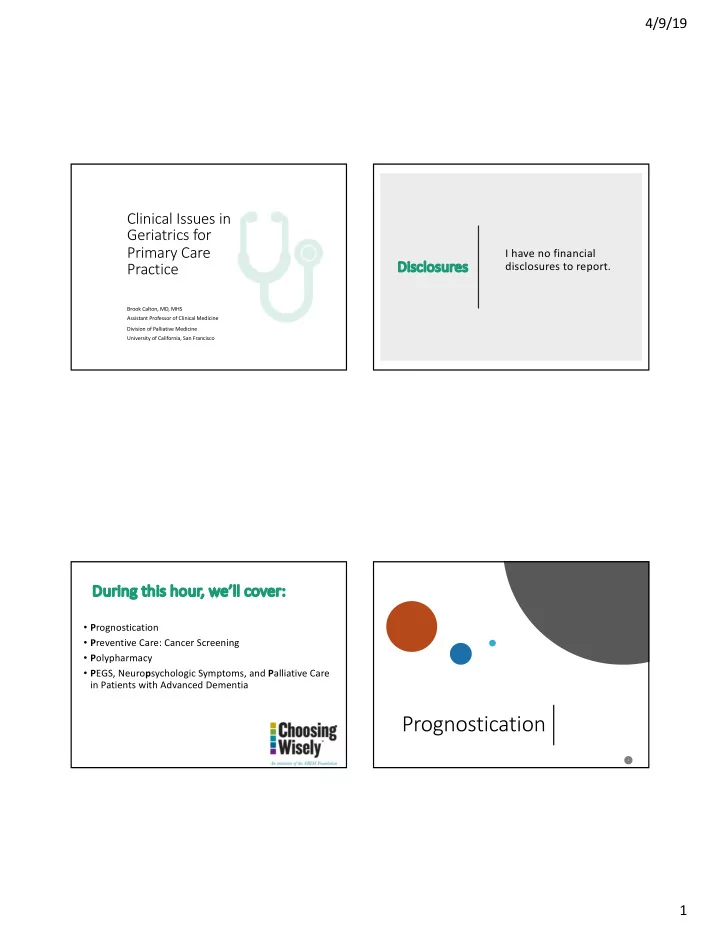
Prognostication 4 1 4/9/19 Prognostication Mrs. Alvarez is a 79 - - PDF document

prognostication
SMART_READER_LITE
LIVE PREVIEW

Prognostication 4 1 4/9/19 Prognostication Mrs. Alvarez is a 79 - - PDF document

4/9/19 Clinical Issues in Geriatrics for Primary Care I have no financial Di Disclosures Practice disclosures to report. Brook Calton, MD, MHS Assistant Professor of Clinical Medicine Division of Palliative Medicine University of


slide-1
SLIDE 1

4/9/19 1

Clinical Issues in Geriatrics for Primary Care Practice

Brook Calton, MD, MHS Assistant Professor of Clinical Medicine Division of Palliative Medicine University of California, San Francisco

Di Disclosures

I have no financial disclosures to report.

Du During this hour, we’ll cover:

  • Prognostication
  • Preventive Care: Cancer Screening
  • Polypharmacy
  • PEGS, Neuropsychologic Symptoms, and Palliative Care

in Patients with Advanced Dementia

Prognostication

4
slide-2
SLIDE 2

4/9/19 2

Mrs. Alvarez

  • Mrs. Alvarez is a 79 yo woman with COPD,
  • n 4L O2, with two hospitalizations in the

past year. She has difficulty walking a block because of dyspnea. She lives with her son’s family who help with iADLs but she is independent in ADLs. She has a previous 50 pack year history of cigarette use but she hasn’t smoked in 10 years. Based on this description, what is the likelihood Ms. A will be alive in 10 years: 1. 10% or less 2. 25% 3. 50% 4. 75%

Prognostication – Why It’s Important

  • Helps patients and providers to determine realistic,

achievable goals of care and proceed with interventions consistent with goals “If your heart stops, do you want electrical shocks and chest compressions to try to get your heart beating again?”

  • Helps patients with life planning
  • Most patients want to know!

Clinical Decisions Influenced by Life Expectancy

Life Expectancy Clinical Decision

<4-6 weeks Methylphenidate over SSRI for depression <6 months Discontinue statins <6 months Refer to hospice <1-2 years Nonoperative management of AAA <2-3 years Tight BP control in diabetes unlikely to prevent stroke, MI <5 years Bio-prosthetic heart valve over mechanical <9 years Discontinue tight blood sugar control in diabetes

Prognostication – Why It’s Hard

  • Younger patients (often with

cancer):

  • Usually clearer trajectory
  • Older adults:
  • Absence of a dominant

terminal condition

  • Age + Functional +

Cognitive + Multimorbidity

slide-3
SLIDE 3

4/9/19 3

Heterogeneity in Aging

HEALTHY Life Expectancy > 10 yrs Independent MEDICALLY VULNERABLE Life Expectancy: 5-10 yrs Assisted in Living FRAIL Life Expectancy < 1-2 yrs Totally Dependent

Multiple Domains Independently Impact Prognosis

  • Functional Status
  • Comorbid Medical

Conditions

  • Cognition
  • Nutrition
  • Polypharmacy
  • Psychological Status
  • Social Support
  • Geriatric Syndromes

How should we prognosticate?

Clinical Judgement Life Tables

Great Variation in Life Expectancy for People

  • f Similar Ages

5 10 15 20 25 70 75 80 85 90 Top 25t h P e rcentile 50t h P e rcentile Lowest 25t h Percentile

Years

Age (Years) Years

Walter LC. JAMA 2001

Life Expectancy for Women

slide-4
SLIDE 4

4/9/19 4

How should we prognosticate?

Clinical Judgement Life Tables Prognostic Indices

4/9/19 14

eprognosis.ucsf.edu

Age Sex BMI General Health Status PMH Cig Use

Hospitalizations ADLs/iADLS Your Guess

slide-5
SLIDE 5

4/9/19 5

10 year mortality risk: 87%

Discussing Prognosis

  • Ask for permission and preferences for how information

is relayed

  • Use ranges
  • “In other people in a similar situation to you….”

Preventive Care: Cancer Screening

Mrs. Alvarez (cont.)

Based on a combination of your own clinical judgement and using a prognostic index you decide you would be very surprised if Mrs. A lived longer than 10

  • years. Which of the following cancer

screening strategies are appropriate for her? 1. Breast, colorectal and lung cancer screening 2. Breast and colon cancer screening alone 3. Lung Cancer screening alone 4. None of the above

slide-6
SLIDE 6

4/9/19 6

Approach to Cancer Screening

  • Should be individualized
  • Consider lag-time to benefit
  • ~10 years for breast, colorectal, lung cancer screening
  • ~15 years for prostate cancer screening
  • Cervical cancer screening different—risk of cancer

remote in women 65+ with normal Paps regardless of life expectancy

Lee SJ. BMJ 2013;346:e8441 Lee SJ. JAMA 2013; 310(24): 2609–2610.

Cancer General Consensus Breast Mammogram q2 years Stop if life exp < 10 years Prostate Do not perform vs shared decision-making Stop if life exp < 10 years Cervical Stop at age 65 in women who have had 3 consecutive neg cytology or 2 consecutive neg cotests in pasts 10 years Colorectal Start at age 50, age “cutoffs” vary by society Stop if life exp < 10 years Lung Start at age 55 with 30 pack year history and currently smoke or quit in last 15 years; Medicare covers to age 77 D/c if limited life expectancy

To Screen or Not to Screen…

Salzman R. Am Fam Phys 2016

To To Screen or Not to Screen (c (continued)…

Proposed Framework:

  • 1. Estimate Life Expectancy
  • 2. Determine possible benefits/harms
  • 3. Weigh benefits and harms alongside

patient preferences

Resources:

USPSTF Preventive Services Selector Tool (http://epss.ahrq.gov/PDA/index.jsp) Eprognosis (http://eprognosis.ucsf.edu/)

slide-7
SLIDE 7

4/9/19 7

Cancer Screening is inadvisable for Mrs. A Stopping Screening - Communication

  • Trusting relationship crucial
  • Personalized recommendations
  • Poor health status or functional

status are good reasons to not screen

  • Antagonism to avoiding screening

based on limited life expectancy

  • “That’s like hitting you over the head

with a hammer. Its too harsh”

  • Schoenborn. JAMA Intern Med. 2017
slide-8
SLIDE 8

4/9/19 8

What To Say…

  • Do not say:
  • “You will not live long enough to benefit from this test”
  • Instead, say:
  • “This test will not help you live longer”
  • Patients wanted to discuss health care that could help them

live longer or better

  • “When patients have medical conditions like yours and

need help for day to day activities, this test can cause more harm than benefit”

  • “It sounds like the doctor has considered my personal issues

and decided I should not have the test”

Polypharmacy

Harms of Polypharmacy

  • ~50% Medicare beneficiaries

take 5+ meds

  • Associated with bad
  • utcomes:
  • Mortality
  • Hospitalization
  • Falls
  • Not taking medications

correctly

  • Adverse drug events and

DDI

Steinman M. JAMA 2010 Fried TR. JAGS 2014

  • Ms. Pachenko

8 months ago: Started HCTZ for BP. 7 months ago: Started oxybutynin for urinary incontinence. 5 months ago: Forgetful, confused at times, MMSE 20/30, loss

  • f function. Started donepezil for dementia. She takes tylenol

PM (diphenhydramine) for sleep problems. 4 months ago: Loss of appetite, started PPI then megace. Developed DVT, started coumadin. Now: Admitted with fall and SDH.

slide-9
SLIDE 9

4/9/19 9

  • Ms. Pachenko (continued)

8 months ago: HCTZ à caused incontinence 7 months ago: oxybutynin à caused confusion 5 months ago: donepezil, tylenol PM (diphenhydramine) à donepezil caused low appetite, diphenhydramine risk of confusion 4 months ago: PPI, megace, coumadin. à PPI can cause drug- drug interactions, megace caused clot, coumadin increased risk

  • f SDH

Now: Admitted with fall and SDH. à >5 meds & centrally-acting meds (oxybutynin, donepezil, diphenhydramine) all increase risk of falls

DE DE- Pr Prescribing Pr Principles

  • Symptom ≠ Medication

Stop before you start

  • A clear indication
  • Be evaluated for side effects
  • Be at the lowest dose/frequency
  • Be substituted with a safer

alternative

  • Be renally-dosed

All medicines should have:

DE-Prescribing Principles (continued)

  • In older adults, harm reduction is critical.
  • If not benefiting patient, it is only potentially causing

harm

  • Look for potentially inappropriate medications
  • “Beers List” (http://geriatricscareonline.org/)

Approach to De-Prescribing

  • Steinman. JAMA. 2010

Condition Drug for that Condition Pot’l Problems Notes Dementia Memantine 10 mg BID Potentially ineffective/ unnecessary Withdrawl trial and reassess Anemia Ferrous sulfate 325 mg BID Constipation No current indication, d/c

1. D/c meds that don’t link to a condition 2. D/c drugs that have limited or no benefit given patients current condition 3. D/c or sub out meds that are high risk

slide-10
SLIDE 10

4/9/19 10

  • Ms. Pachenko (continued)
  • Never needed surgery, just monitored
  • Coumadin stopped
  • Megace weaned off
  • HCTZ stopped (permissive HTN to goal in 160s/80s)
  • Oxybutynin stopped and did bladder training with OT
  • Confusion gradually cleared over a couple weeks and back

near baseline

Choosing Wisely Campaign “Don’t prescribe a medication without conducting a drug regimen review.”

PEGS, Neuropsychological Symptoms, and Palliative Care in Patients with Advanced Dementia

  • Mr. Tuttle
  • Mr. Tuttle has advanced dementia and has been

living in a nursing home for 3 years. The nursing home has described progressive difficulties in getting Mr. Tuttle to eat over the past three

  • months. He is losing weight and they have urged

his son to have the physician insert a PEG tube to make her more comfortable. In patients with advanced dementia, feeding tubes: 1. prevent aspiration and aspiration pneumonia 2. increase the risk of pressure ulcers 3. improve quality of life for patients with dementia 4. improve survival in patients with dementia

  • In comparison to hand feeding, tube feeding:
  • Does not increase survival or improve function
  • Does not prevent aspiration or improve nutrition
  • Increases the risk of new pressure ulcers; AND, does not

heal existing pressure ulcers.

  • Is associated with increased agitation and use of

restraints Choosing Wisely Campaign “Don’t recommend percutaneous feeding tubes in patients with advanced dementia; instead offer oral assisted feeding.”

Tube Feeding in Patients with Advanced Dementia

slide-11
SLIDE 11

4/9/19 11

Tube Feeding in Patients with Advanced Dementia

34% of nursing home residents have a feeding tube More than two-thirds placed during a hospitalization Meaningful conversations about feeding tubes with caregivers are uncommon

Managing Feeding Difficulties

Anticipation and education of pt and caregivers Discuss options early in course of the disease Investigate and treat reversible causes

Constipation, Xerostomia, Medication Sides Effects

Liberalize diet Mealtime as an event, family and caregiver support

Dementia is ultimately terminal

  • 5th leading cause of death, ages 65+
  • Advanced care planning critical
  • Palliative care and hospice should be offered to patients

with advanced dementia

  • Hurley. JAMA 2002

Mitchell S. NEJM 2015

Hospice Eligibility in Dementia

— Must meet both criteria:

¡ FAST scale 7c or beyond: ÷ Stages 1-5 none to mod cognitive impairment ÷ Stage 6 and sub-stages: ADLs (dressing, bathing, toileting) ÷ Stage 7 and sub-stages:

¢ 7a: <6 intelligible words during day ¢ 7b: <1 intelligble word during day ¢ 7c: can’t ambulate independently ¢ 7d: can’t sit up independently ¢ 7e: can’t smile ¢ 7f: can’t hold head up

¡ One or more of the following: asp PNA, pyelo, septicemia,

multiple or stage 3-4 pressure ulcer, recurrent fever despite abx, can’t sustain life with oral intake

slide-12
SLIDE 12

4/9/19 12

Managing Behavioral and Psychological Challenges Behavioral Psychological Calling out Refusal to cooperate with care Physical aggression Repeated questioning Restlessness Screaming Sexually inappropriate behavior Verbal aggression Pacing or wandering Anxiety Apathy Delusions Depressed mood Disinhibition Euphoria Hallucinations Misidentifications Sleeplessness

  • Ms. Lum
  • Ms. Lum spends many

afternoons banging on the chairs causing a lot of noise.

  • Her daughter is asking if

there is “anything we can give her to calm her down?” so the staff will stop calling her

An Approach to NPS

1. Identify and describe the behavior 2. Identify triggers 3. Identify if it’s a problem and if it is leading to potential harm 4. Individually-tailored interventions

Identify the behavior

  • Ms. Lum

Behavior-- repetitive behavior, agitation Examples:

  • Repetitive behaviors-

cleaning, reorganizing

  • Agitation - Yelling,

vocalizing, hitting

slide-13
SLIDE 13

4/9/19 13

Identify Triggers

  • Needs: thirst/hunger,

pain, toileting, boredom, tired, comfort

  • Environment: Attendant

gender, bathing, undressing

  • Over or under-stimulated
  • Isolation and

loneliness

  • Unwanted interaction,

fear

  • Depression, anxiety
  • Ms. Lum
  • Ms. Lum was a housekeeper

prior to retirement

  • In reviewing her needs, staff

noticed she was not taken to the toilet enough during the afternoon because she was resistant

Identify if it’s a problem

  • What is the

consequence of this behavior?

  • Caregiver stress
  • Harm to others/self
  • What has been tried?

Individually-Tailored Interventions (non-pharm)

Common NPS Interpretations/solutions

Toileting issues Timed voiding Agitated, upset, restless Overstimulation, unrealistic expectations, delirium? Provide structure, calm, pets, music Repetitive behavior Give outlet for activity, safe environment, substitutions Argumentativeness Agree, avoid debates, calm environment

Adapted from Kathryn Eubank, MD

slide-14
SLIDE 14

4/9/19 14

Individually- Tailored Interventions (Pharm)

Porsteinsson AP. JAMA 2014

  • Worth trying in patients with NPS

and mild to moderate dementia Anticholinesterase Inhibitors

  • Requires further study

Memantine

  • CITAD trial - Supports trial of

Citalopram up to 20 mg qday in

  • lder adults; QTc cautions

SSRIs

  • Anti-psychotics
  • Black box warning for mortality
  • 2nd gen antipsychotics fewer EPS effects
  • Consider when other interventions not working and

safety risk to patient/caregivers

Choosing Wisely Campaign “Don’t use antipsychotics as the first choice to treat behavioral and psychological symptoms of dementia.”

Individually-Tailored Interventions (Pharm)

Dextromethorphan-Quinidine

  • 210 patients with AD and clinically

significant agitation

  • Mean age 78
  • Some concerns about study design
  • Improved NPI Agitation score: 1.6

point improvement (12 point scale)

  • 5% increase in falls (NNH 21); 3%

increase in diarrhea (NNH 36); 2% increase in dizziness (NNH 45)

  • Evidence of effectiveness is very

modest, and risk for harm substantial

Cummings JL. JAMA 2015; 14(12):1242-54

Sum Summary

Utilize clinical intuition AND prognostic indices to prognosticate Consider prognosis when determining medical interventions (including cancer screening) Less is more in medication management for

  • lder adults

For patients with advanced dementia, caregiver education and support key to managing NPS; avoid PEGs; consider hospice