Professor John Webster Professor Emeritus Department of Biomedical - - PowerPoint PPT Presentation

professor john webster
SMART_READER_LITE
LIVE PREVIEW

Professor John Webster Professor Emeritus Department of Biomedical - - PowerPoint PPT Presentation

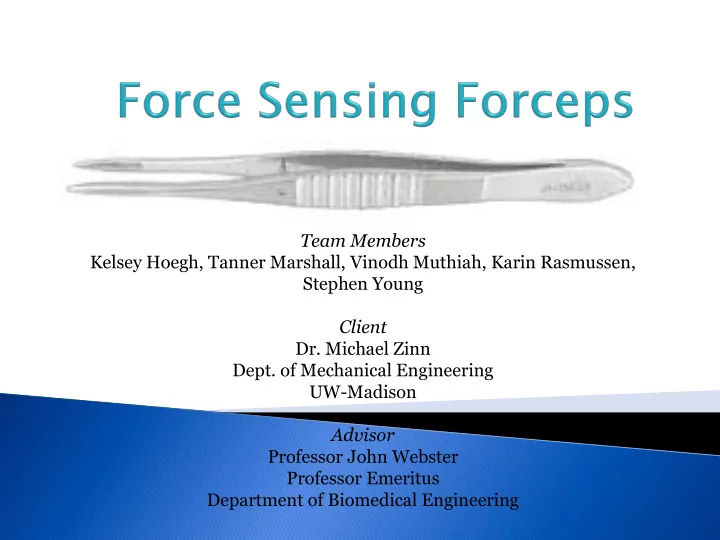
Team Members Kelsey Hoegh, Tanner Marshall, Vinodh Muthiah, Karin Rasmussen, Stephen Young Client Dr. Michael Zinn Dept. of Mechanical Engineering UW-Madison Advisor Professor John Webster Professor Emeritus Department of Biomedical


slide-1
SLIDE 1

Team Members Kelsey Hoegh, Tanner Marshall, Vinodh Muthiah, Karin Rasmussen, Stephen Young Client

  • Dr. Michael Zinn
  • Dept. of Mechanical Engineering

UW-Madison Advisor Professor John Webster Professor Emeritus Department of Biomedical Engineering

slide-2
SLIDE 2

 Background/Motivation  Current Devices  Problem Statement  Client Specifications  Design Option1 - Silicon Macro Force Sensor

Caps

 Design Option 2 - Piezoelectric Sensors  Design Option 3 - Strain Gages  Design Matrix  Future Work

slide-3
SLIDE 3

 Develop „force sensing forceps‟  Nothing, quantitatively,

known about forces applied to tissues

 Currently based on “trial

and error”

 Used as a training tool  Visual or auditory cue

slide-4
SLIDE 4

 Similarities

  • Developed force sensing surgical instrument
  • Used piezo materials
  • Differences
  • Not specific to forceps
  • Focused on degradation of medical alloys
slide-5
SLIDE 5

Similarities

  • Developed force

sensing surgical instrument

  • Used strain gages
  • Design considerations
  • Differences
  • Specific to laparoscopy
  • Different type of

forceps

slide-6
SLIDE 6

 Training and research device  Interface with standard surgical forceps  Measure forces  Provide quantitative output  Avoid hindrance to normal use of forceps

slide-7
SLIDE 7

 Requirements:

  • Production of 1 initial working prototype
  • Allow for normal use of surgical forceps

 Holding technique  Lightweight  Standard size forceps

  • Sanitation
  • Quantitative forces measurement

 Convenient output  Calibration

  • Bio Safe
slide-8
SLIDE 8

 Preferences

  • Prevention of excessive force
  • Aesthetically pleasing
  • Wireless
  • Digital display
  • Axial and torsional measurements
slide-9
SLIDE 9

 Pros

  • Takes force measurement

directly at tips

 Cons

  • Difficult to manufacture
  • Requires many cap types
  • Temperature sensitive
slide-10
SLIDE 10
  • Uses the charge retaining properties in certain

solid materials

  • Measurable piezoelectricity is released upon

deformation

slide-11
SLIDE 11

 Pros

  • Can be effective when space is limited; strain gage

transducer can be up to 30 times larger

  • Two wires connecting sensor
  • Cons
  • Considerable drift is present, making them more

short-term

  • Doesn‟t compensate for temperature effectively
slide-12
SLIDE 12

 Converts mechanical

motion into electronic signal

 Uses metallic foil

  • rganized into grid like

pattern

 Depends on

proportional variance

  • f electrical resistance

to strain

 Full bridge

configuration – uses a total of 4 strain gages

slide-13
SLIDE 13

 Pros:

  • Using 4 strain gages

helps eliminate temperature effects

  • Choose range/accuracy

easily

  • Easy to manufacture/low

cost (5 strain gage dual grids for 49$)

  • Light-weight

 Cons:

  • 4 wires running down

side of forceps

  • Need of calibration –

dependent on the stability

  • f the stainless steel
  • Will need assistance to

mount strain gages onto forceps

slide-14
SLIDE 14

Weighting Design Capped Ends silicon macro force sensor Strain Gages Piezo electric Does not detract from function of standard surgical forceps 25 22 23 24 Range of force measuring capability 20 15 19 19 Does not obstruct proper forceps holding technique 10 10 10 10 Precision of measuring capability 20 15 18 16 Ease of manufacture 5 1 3 4 Measurement consistency with varying conditions 20 15 19 12 Total 100 78 92 84

slide-15
SLIDE 15

 Consult surgeons on typically applied loads  Signal conditioning  Build rough version of the forceps  Test measurement accuracy under various

conditions

  • Experiment with sensor location

 Develop calibration technique

slide-16
SLIDE 16

 Make forceps wireless  Audio/visual feedback for surgeon  Measurement of force in multiple dimensions

  • Requires more complicated sensor setup
  • Measure push/pulling force
  • Measure twisting force

 Compatibility with cauterization technique

slide-17
SLIDE 17

 Dr. Michael Zinn  Carter Smith  Professor Webster  John Dreger

slide-18
SLIDE 18

 “Load Sensing Surgical Instruments”, Jacq, Maeder, Ryser”  “Development of Force Measurement System for Clinical Use in

Minimal Access Surgery,” Hanna, Drew, Arnold, Fakhm, Cuschieri”

slide-19
SLIDE 19