
SLIDE 1
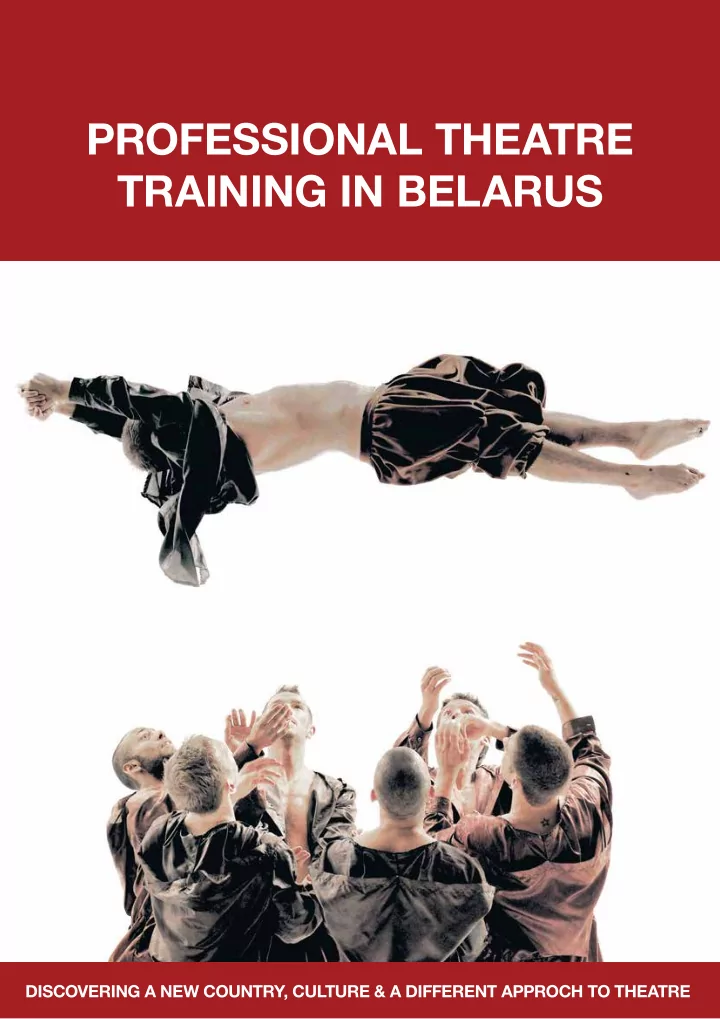
PROFESSIONAL THEATRE TRAINING IN BELARUS
dIScOvERING A NEw cOUNTRy, cULTURE & A dIFFERENT APPROcH TO THEATRE
PROFESSIONAL THEATRE TRAINING IN BELARUS dIScOvERING A NEw cOUNTRy, - - PDF document
PROFESSIONAL THEATRE TRAINING IN BELARUS dIScOvERING A NEw cOUNTRy, cULTURE & A dIFFERENT APPROcH TO THEATRE tRAining SUMMARY TRAININGS LOCATION : M INSK , R EPUBLIC OF B ELARUS INTENSIVE COURSES : 1. PRESENTATION OF THE PARTNER
dIScOvERING A NEw cOUNTRy, cULTURE & A dIFFERENT APPROcH TO THEATRE
TRAINING’S LOCATION : MINSK, REPUBLIC OF BELARUS
INTENSIVE COURSES :
ONE MONTH PROGRAMME: JULY
LANGUAGE OF INSTRUCTION :
FRENCH, ENGLISH, GERMAN, SPANISH, ITALIAN. TOTAL DURATION OF THE PROGRAMME : 200 HOURS (50 HOURS OF CLASSES
PER WEEK)
ONE MONTH PROGRAMME: AUGUST
LANGUAGE OF INSTRUCTION: FRENCH, SPANISH
TOTAL DURATION OF THE PROGRAMME : 200 HOURS (50 HOURS OF CLASSES
PER WEEK)
ANNUAL COURSE :
MASTERCLASS : SEPTEMBER TO JUNE (10 MONTHS)
LANGUAGE OF INSTRUCTION: FRENCH
TOTAL DURATION OF THE PROGRAMME: 2000 HOURS (50 HOURS OF CLASSES
PER WEEK)
THE MAXIMUM NUMBER OF STUDENTS FOR THE CLASS IS 20.
The price shown doesn’T include Travel, accommodaTion
you can conTacT us, for any quesTions concerning prices.
5
The French Association “Demain le Printemps”, established in Paris in 1994, is an international theatre school, but also a centre for artistic and cultural events. Since 1994 it trains actors in techniques and methods of the Eastern European countries. The workshops take place in Minsk, the capital of the Republic of Belarus. Its headquarter is located in the 9th arrondissement of Paris. Since 1994, “Demain le Printemps” trains young theatre amateurs in Minsk in order for them to be able to pur- sue a professional career.
The Belarusian Association “Teatro” founded in Minsk in 2007 unites over a hundred members from Belarus, France, Belgium, Switzerland and Canada. Most of the members are actors, stage directors, musicians, students, interpreters or teachers. Each year the two organisations “Teatro” and “Demain le Printemps” are partner associations which organize Master classes, trainings as well as artistic and cultural exchanges.
7
VLADIMIR IVANOVICH NEMIROVICH-DANCHENKO AND KONSTANTIN SERGEEVICH STANISLAVSKY ARE RENOWNED AS THE FOUNDERS OF THE RUSSIAN THEATRE SCHOOL.
“The Russian Theatre School” is an approach to the art of acting, which was initiated at the end of 19th century by an innovative approach : «Being an actor means to continuously develop your artistic talent, your sensibility and empathy with the audience». The training of the actor is based on various teaching techniques but in particular on the personal development of the actor and his attitude towards his work. It is a work and life ethic fjrmly grounded
the actor fjrst and foremost an actor with conviction. The Russian stage director and pedagogue Constantin Stanislavski has added a dimension
« an actor works with his body, his spirit and his own feelings and emotions».
9
WHAT DOES THE pROjECT CONSIST OF ?
ToTAl IMMERSIon… DISCovERIng ThE RuSSIAn ThEATRE SChool...
The project aims to provide its participants with a multidisciplinary artistic training that is based on the actor’s skills and techniques. Beyond the artistic training this project ofgers the participants a unique opportunity to discover not only a new country and a new culture but in particular a new approach to acting and theatre: the one of the Russian Theatre School. Finally it’s a unique human experience that the participants share: a life that rests on sharing and solidarity but at the same time is very demanding and requires rigor, discipline and persistence during the classes. THE pARTICIpANTS : … you Don’T nEED To SPEAk RuSSIAn ! This project is intended for actors from theatre and cinema who are students, professionals of at least i8 years old. Most importantly the participant must be eager to discover and benefjt from this new approach to theatre: «The Russian Theatre School », as it can be studied in experienced in Belarus according to the principles and methods of Stanislavsky, Michael Chekhov, Meyerhold and Tovstonogov. The participants come from France, Germany and the United Kingdom. It is not necessary to speak Russian: all courses are simultaneously translated into English, French and German. ToTal immersion. discovering The russian TheaTre school...
11 10
ObjECTIVES
The aim is to discover and acquire a deep understanding of the Russian Theatre School and allow each participant to acquire new techniques aiding the participant to expand his “actor’s tools”. Although knowledge of the Russian language is not required it is possible to learn more about the Russian and European culture and the basis of the languages (the 200 hours long course is simultaneously translated into English, French and german). Staying away from one’s mother country each participant will discover a new lifestyle. We would like to gather responsible actors, each with his own personal background to enrich an ambitious art project. WHY bELARUS ? Since 1998 Belarus hosts our course, which takes place in Minsk, the capital of the Republic of Belarus and organizes with us theatre- and other cultural events. A Belarusian team of 25 people looks after the well-being of the participants and tries everything to create a pleasant environment. It should be noted that the Republic of Belarus is geographically located in the centre of Europe. on the one hand this country is considered to be a gateway to the European union, on the other hand a cradle of Russian culture: one of the former Republics of the uSSR, Belarus is a country with living traditions of the Russian Theatre School. HOW DOES THE TRANSLATION WORK? All classes are translated into English, French and german. Translation plays a crucial part in discovering of this cultural and educational approach.
to allow you to feel what is happening during the classes. There is no doubt that teaching methods are difgerent in each country. our role is to allow you to integrate in this system without being faced by any language barriers. Translators are actually pedagogical extension during your journey of discovering another culture.
you don’T need To speak russian !
13
pROGRAMME
The training takes place in two phases. In the fjrst phase of training participants work on the concept “from acting to feelings”. The aim of this exercise is to achieve that real actions automatically evoke true feelings and emotions in the actor. Firstly, the working method is based on the search for processes that needs help the actor in his play, to experience these true feelings and, secondly, in analyzing “the psycho-physiological process” that happens on stage. For this purpose, various modules and exercises are
all stages of the process of a character creation. In a second phase of the training the work is based on the play’s analysis.
analysis and work on situations as well on characters. This approach is put into practice through studies and improvisations that participants are asked to carry out around the study rooms.
A MULTIDISCIpLINARY EDUCATION
In addition, various other techniques and skills are taught in this multidisciplinary workshop. Amongst these are: Singing, Dance, Martial Arts and Fencing, Exercises aiding the actor’s self-expression
both the mental imaginative power of the actor as well as the command of useful acting techniques and a high level of voice and body control. All these various disciplines are not considered as “specialties” but as “tools in the service of the actor”. That is why this actor training also takes place by learning
not just as “specialty”, but also “tools” to serve an actor.
CERTIFICATE AFTER COMpLETION OF THE COURSE
At the end of the course “Teatro” and “Demain le Printemps” are pleased to equip students with a certifjcate of the completed course. The certifjcate contains:
Further, the 10 months long Masterclass also has a celebratory opening and closing ceremony.
15 14
SCHEDULE
Classes are held from Monday to Saturday, approximately 8,5 hours per day. Sundays are intended for rest or for possible rehearsals. Classes are taught by professors from the “Belarusian State Academy of Arts”. These are simultaneously translated into French, german and English in the following disciplines: ACTORS’ TECHNIQUES, ACROBATICS/ BODY CONTROL, INDIVIDUAL AND GROUP SINGING, FIGHTING/FENCING/JUGGLING, TEMPO-RHYTHM AND BIOMECHANICS, SPEAKING EXERCISES, CLASSICAL DANCE. The day is usually organized in the following way: Morning: work through exercises on the body, concentration, attention and hearing, senses, imagination, idea about individual and group, sensory memory, precision of the gestures. Work on the senses of tempo and rhythm (movement’s rate and emotional intensity), spacial coordination (balance, impulsion, gravity center, precision of movement). Afternoon: practical implementation of the morning’s exercises and analyses of the acting (action’s logic). Training of actor’s technique, improvisations and work on etudes and observations. TRANSMISSION OF KNOWLEDGE Diction course with students of international relations from Belarusian State University (BSU) animated by participants of the Master class.
For intensive courses, students have the singing 2 times per week instead of piano
(In 2012: TRIP To MoSCoW AnD gRouP’S PARTICIPATIon AT ThE Song AnD ThEATRE FESTIvAl In PERM).
WHAT HAppENS DURING THE TRAINING
Every two weeks the students of the course are asked to take part in various public events in front of children and adults. Performances before an audience are a key step in the actor’s development. Thus the students are invited to develop a performance for children, which take place around the whole Belarus at schools and orphanages. At the end of each course plays are performed in theatres in Minsk in front of an audience of various backgrounds. The steps of the training are recorded in the programme of the Francophonie organized with the Embassy of France in Minsk. Courses for children within the Festival francophone de Theatrea Minsk organized by the Embassy of France with students of the Masterclass. “At a presentation at the Republican Theatre of Belarusian Drama, Minsk”. “Animation of the tale at the French library in Minsk” A TyPICAl DAy CoulD BE STRuCTuRED In ThE FolloWIng WAy
8H00 à 8H30 8H30 à 9H00 9H00 à 9H30 Plastique Plastique Bio- 9H30 à 10H00 Diction
Diction
R 10H00 à 10H30 1 1 E 10H30 à 11H00 2 Tempo- Tempo- 2 S 11H00 à 11H30 3 3 T 11H30 à 12H00 4 4 I 12H00 à 12H30 N 12H30 à 13H00 G 13H00 à 13H30 5 5 13H30 à 14H00 Break 6 Break Break Break Break 6 Break + 14H00 à 14H30 7 7 14H30 à 15H00 8 8 15H00 à 15H30 9 9 15H30 à 16H00 10 10 + 16H00 à 16H30 11 11 16H30 à 17H00 12 12 17H00 à 17H30 technique 13 technique technique technique technique 13 technique 17H30 à 18H00 14 14 18H00 à 18H30 15 15 18H30 à 19H00 16 16 19H00 à 19H30 19H30 à 20H00 20H00 à 20H30 20H30 à 21H00 Break Break Break Break Break Break 21H00 à 21H30 21H30 à 22H00 22H00 à 22H30 22H30 à 23H00 Monday Tuesday Wednesday Thursday Friday Saturday Sunday Acrobatics Acrobatics individual Individual singing Dance singing mechanics Fighting Dance Fencing History Fighting Rhythm Juggling Rhythm
Fencing theater Juggling GROUP Tap dance Dance Tap dance Group Russian singing singing household Chores Rehearsals Actor's Actor's Actor's Actor's Actor's Actor's Group Group Group Group Group Group
Individual Individual Individual Individual Individual individual rehearsals rehearsals rehearsals rehearsals rehearsals rehearsals
for inTensive courses
(Example for a group of 16 people).
17 16
DAILY LIFE IN MINSK
All courses take place in Minsk in a cottage (655 m2, fully equipped) where participants are also accommodated for the duration of the workshop. All participants live together in this cottage sharing rooms in groups of 2 or 3. I should be noted that all household chores are equally shared between group members. Every participant has also his area of responsibility in the cottage. lunches are prepared by a cook and breakfasts and dinners are prepared by students who change each other every day. A small cottage library, which is mainly composed of books ofgered by former participants, is available to participants. Further, there is a Wi-Fi access.
LUNCH WILL bE pREpARED bY OLGA VALERIEVNA MINITCH ...
however, you will be responsible for preparation of your breakfast and dinner. olga will also help out with the domestic work, which will allow you to concentrate on your training. however, some of the domestic work must be done by the group members. YURY IVANOVICH ZAHARADNIUK Coordinator of the cottage’s life. Decorator
for the group and maintenance assistant of common areas.
19
ACTOR’S TECHNIQUE COURSE Lidia Alekseevna MONAKOVA
Artistic director of the Belarusian association “Moo Teatro”, stage director, theatre pedagogue, head
Arts, lidia Alekseevna became laureate of the prize
contribution to the education of young artists. lidia Alekseevna is a Member of the Cultural Council according to the decision of the Council of Ministers of the Republic of Belarus. She ofgers work technique “from the action to the character”: to be in a situation, imagine, act and build a character thanks to the bases of the system
as well as of M. Chekov. She ofgers training on improvisational work, analysis and refmection.
acTor’s Technique
per week MANAGEMENT AND ORGANIZATION Fabrice CARREY
association “Demain le printemps”, Fabrice Carrey has trained as an actor and then as a stage director at the Minsk Academy of Arts. Besides, he speaks fmuent Russian and visits Minsk regularly. Fabrice Carrey devises the training schedule, coordinates and monitors the training.
TRAINING COORDINATOR FOR ENGLISH SpEAKERS STUDENTS. Olga LAVRENtYEVA
graduated from Saint-Petersburg university of Economics and Finance in Russia, olga took a desicion to move to
Communication at the university of Sorbonne. Since 2014 she has become a part of the Association Tomorrow Spring « Demain le printemps ». She speaks fmuent English, French and Russian.
21 20
ACTOR’S TECHNIQUE AND STANISLAVSKI’S SYSTEM Serguei Aleksandrovitch KOULAJENKO
graduated from the Minsk Academy of Arts. Professor of the actor’s technique specializing in the Stanislavski’s system. he has been working at the Academy of Arts since 2002.
ACTOR’S TECHNIQUE COURSE Igor Gennadievitch BLINKOV
graduated from the Academy of Arts. he taught actor’s technique at the Minsk college of Arts. Besides, Igor Blinkov trained as a stage director at the workshop of Christophe Zanussi. Since 2011 he has been working by Moo Teatro as a professor of actor’s technique.
DANCE Alexandra Vitaliévna KAZIANINA
graduated from the university of Culture and Arts of Belarus. Alexandra vitalievna works as choreographer at the Minsk Theatre of variety. Teaching classical arts of dance she is paying special attention to the development of musicality, agility and fmexibility, coordination, sense of gestures’ forms, rhythm and style.
DANCE Marina Viktorovna FILAtOVA
After the entry in 1967 at the Belarusian State College of Choreography she got the qualifjcation of the ballet artist and then was admitted to the State Theatre of Musical Comedy where from 1995 to 1997 she worked as a ballet master. Since 1990 she has been teaching stage dance at the chair “Actor’s technique” at the Academy of Arts of Belarus. She works on coordination, sense of gestures’ forms, rhythm, style, development of musicality, agility and fmexibility.
TAp DANCE AND pUppETS Natalia Aleksandrovna SLACHtCHEVA
graduated from the Academy of Arts of Belarus State as stage director. natalia Aleksandrovna is also a professional tap dancer. She ofgers an introduction and a deepening in these two disciplines.
FLAMENCO COURSE Anastasia Igorévna VOLtCHEK
Anastasia Igorevna was the actress at the Moscow Academy of theatrical art (EMSI). She has been teaching fmamenco since 2007. Every year Anastasia Igorevna participates in fmamenco trainings in Spain and perfects her technique. She has studied with such masters as laTruco, la lupi, Manuel Betanzos, natala Merino and Javier latorre.
ACRObATICS Youri Adamovitch YANOVICH
graduated from the Belarusian State university of physical education, candidate of pedagogical sciences, master of sports gymnastics, acrobat, a former circus artist, Member of the Executive Board of the Federation of Cheerleading of the Republic of Belarus. yuri’s courses are always very intensive and they give students the possibility during training of muscles, to learn a lot about acrobatic exercises (jumps, gates and equilibria) quickly, but gradually. Besides, an approach of acrobatic rock’n’roll is also being proposed.
FIGHTING, FENCING AND jUGGLING COURSE Sergei Nikolaevitch EFREMOV
graduated from the State Academy of Arts of Belarus, Sergei nikolaevich is professor of plastic, fencing and pantomime and actor of cinema. Since 2011 he is also professor of plastic at the Academy of Arts. 6h par semaine
Tap dance and puppeTs
3h+3h per week
acroBaTics
2h per week
classical dance
3h per week
classical dance
3h per week
flamenco fighTing/ fencing/ Juggling
2h per week 4h per week
acTor’s Technique
per week
inTensive courses
23 22
GREASEpAINT COURSE Konstantine Vassilievitch MAMAtIOUK
graduated from the high School of Theater and Art of Belarus. Since 1975 konstantin vasilyevich has been teaching greasepaint at the Minsk university of Culture and at the Minsk Academy of Arts. Besides, konstantin vasilyevich has participated in the creation of greasepaint for
RUSSIAN LANGUAGE COURSE, INTERpRETER Yulia Sergeevna BOUKCHtANOVItCH
graduated from the Minsk State linguistic university and laureate of the pedagogical contests of Minsk. Since 2008 yulia Sergeevna has been working as a translator, interpreter and teacher of the Russian language.
pROjECT COORDINATION AND INTERpRETER Victoria Viktorovna NOVIKOVA
graduated from the Minsk State linguistic university. Since 2006 she has been actress at the French amateur theatre in Minsk. Since 2008 she has been working as an interpreter and project coordinator of Moo Teatro.
ADMINISTRATION AND pROjECT COORDINATION Anna Igorevna FEDORAK
graduated from the Minsk State linguistic university. Since 2011 she has been working as an interpreter and coordinator.
INTERpRETER Maxime Dmitrievitch NAStOIACHtCHI
Student of the Minsk State linguistic university. During 2010-2012 he has been actor at the French amateur theatre in
Master class.
TEMpO-RHYTHM Alexandra Izraelovna SANDLER
Teacher of singing and musician at the Minsk Academy of Arts, graduate of the Belarusian national Conservatory of Music, Alexandra Izraelovna is working
concentration and availability. her objective is to teach a sufficient basis in order to work on the music improvisation of the group with instruments that are our body and our voice.
SINGING Ilona Sergueievna KAZAKEVItCH
graduated from the Minsk Academy of Arts with the diploma as an actress
international song festivals, since 2000 Ilona Sergeyevna has been working at the Minsk Theatre of Musical Comedy where she interprets leading roles of theatrical and musical performances in such genres as music-hall, rock opera and performances for children. Besides, Ilona Sergeyevna teaches students the position of the voice as well as techniques of lyric singing. She offers work on French, Russian and international repertoire.
DICTION COURSE Pavel Ivanovitch EVtOUCHENKO
he got the diploma of the music in 2007. Training as a chef d’orchestre. During 2011-2013 he was professor of diction and tempo-rhythm at the Academy of Arts. Since 2009 Pavel has been working at the national Academic Drama M.gorky’s Theater.
INDIVIDUAL pIANO LESSONS tatiana Alexsandrovna PANASSIUK
graduated from the Belarusian Conservatory of Music. laureate of international competitions . Currently Tatiana Alexandrovna works as accompanist at the national opera and Ballet Theatre and teaches at the Conservatory of Music.
3h per week
greasepainT
dicTion/ and Biomechanics
2h+2h per week
piano
1/2h per week
individual and group singing
1/2h+1h per week
Tempo/ rhyThm
3h per week
russian
1h per week
inTensive courses
inTensive courses
25
FRANCOpHONE pARTNERS IN MINSK
During 15 years the association has developed numerous cultural exchanges, workshops and master classes uniting over French and Belarusians, but also Francophone all over the world, mostly Quebecers, Swiss and Belgians. the master classes are organized by “Demain le printemps” in Paris and Minsk led by Belarusian professionals offering francophone comedians a serious, high level training according to the Russian theatre School. With Mr. Pavel Latushka, Ambassador
Lidia Alekseevna Monakova and Fabrice Carrey at the Embassy of Belarus in Paris.
27 26
jOLIANE DUFRESNE MA7 the experience gained thanks to the “Demain le printemps”: it is of course impossible to summarize it by giving honor just through a few lines of comments. It’s impossible to describe these intense emotions
depth of meetings, the scope of the teaching. I wish all to get the chance to experience such a journey in their life.” KARIM VOISIN MA8 “Demain le printemps” was for me a personal, as well as theatrical and artistic experience, intense and unique. I have had no stage experience before, but it wasn’t important: if you are motivated, have competent teachers who are always there to help you, from the fjrst moment you begin to trust them. Life at the cottage and parties in Minsk (if they are not so numerous, they are always welcome) were also very enjoyable. I believe that this unforgettable experience has really become one of the highlights of my life.” OLIVIA COMbES MA9 “Because it is not only a great theatre school, but also a unique
surprise and to discover yourself. Because this journey is really worthwhile to be undertaken. Because the course makes you full of energy and desire. Because here you meet a new family, new theatre colleagues”
INFO VINCENNES 2007 I N F O V I N C E N N E S 2 6 VETSHERNI MINSK 2010 COURTELARY 2011
Demain Le PrintemPs
association Loi 1901 14 rue De La tour D’auvergne 75009 Paris teL/Fax : +331 42 81 33 96 courrieL : ecole@dlptheatre.net
www.ecole-theatrale.fr
SPACE - DANIEL SORANO EMBASSY OF FRANCE IN BELARUS MINSK ACADEMY OF ARTS LEAGUE OF EDUCATION THE REPUBLICAN THEATRE OF BELARUSIAN DRAMA.