Prof. Dr. Mohamed A. El-Shanawany Department of Pharmacognosy - - PowerPoint PPT Presentation

prof dr mohamed a el shanawany
SMART_READER_LITE
LIVE PREVIEW

Prof. Dr. Mohamed A. El-Shanawany Department of Pharmacognosy - - PowerPoint PPT Presentation

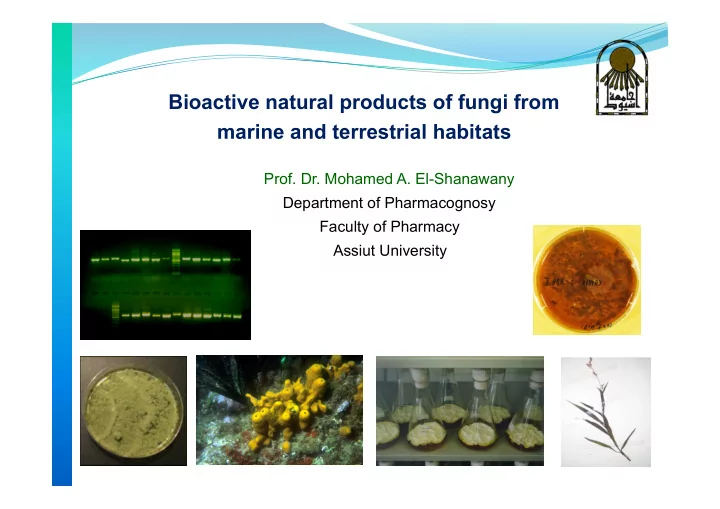
Bioactive natural products of fungi from marine and terrestrial habitats Prof. Dr. Mohamed A. El-Shanawany Department of Pharmacognosy Faculty of Pharmacy Assiut University WHY MICROORGANISMS ? Over 120 of the most important medicines

slide-1
SLIDE 1

Bioactive natural products of fungi from marine and terrestrial habitats

  • Prof. Dr. Mohamed A. El-Shanawany

Department of Pharmacognosy Faculty of Pharmacy Assiut University

slide-2
SLIDE 2

WHY MICROORGANISMS ?

slide-3
SLIDE 3
  • Over 120 of the most important medicines (Penicillins,

Cyclosporin, Adriamycine,... etc.) are obtained from terrestrial microorganisms.

  • Expected enormous biodiversity of microorganisms.
  • Constitute the ultimate ‘Undiscovered’ frontier for the search
  • f marine natural products.
  • Supplying sufficient materials.
slide-4
SLIDE 4

Endophytic fungi inhabit such

  • abiotope. In the course of the

last 12 years, about 6500 endophytic fungi were isolated from herbaceous plants and trees, screened for their biological activities, their metabolites and have isolated and determined the structures

  • f the biologically active

compounds

slide-5
SLIDE 5

The isolated metabolites

  • riginated from different

biosynthetic pathways: isoprenoid, polyketide, amino acid derivatives, and belonged to diverse structural groups: terpenoids, steroids, xanthones, quinones, phenols, isocumarines, benzopyranones …..etc,

slide-6
SLIDE 6

 The potential role of the

endophyte and its biologically active metabolites in its association with its host has been studied . The fungal endophytes possess the exoenzymes necessary to colonize their hosts.

slide-7
SLIDE 7

The fungal endophyte–plant host interaction is characterized by a finely tuned equilibrium between fungal virulence and plant defense. If this balance is disturbed by either a decrease in plant defense or an increase in fungal virulence, disease

  • develops. Many groups of fungi

in different biotopes are waiting to be exploited.

slide-8
SLIDE 8

Since natural products are adapted to a specific function in nature, the search for novel secondary metabolites should concentrate on organisms that inhabit novel biotopes.

slide-9
SLIDE 9

This address some important questions:

  • Which evolutionary pressures led

to gene clustering?,

  • Why closely related species

produce different profiles of secondary metabolites?,

  • whether fungal genomics will

accelerate the discovery of new secondary metabolites of potential biological activity ?

slide-10
SLIDE 10

Secondary metabolites from fungi

slide-11
SLIDE 11

Microorganisms as a source for natural products

slide-12
SLIDE 12

Secondary metabolites from marine-derived fungi Cephalosporin C Acremonium chrysogenum first natural product of a marine-derived fungus (1946) ¡ Sorbicillactone A Penicillium chrysogenum from sponges belonging to the genus Ircinia (2003) ¡

slide-13
SLIDE 13

Isolation of microorganisms from marine sponges

cut with a sterile blade transfer a piece

  • f the inner part
  • f the sponge
  • nto an agar plate

streak over the plate control #2 (sponge surface) primary isolates (mixed cultures) control #1 (surrounding sea water) pick single colonies; inoculate new agar plates ”dilute” the colony pure culture

slide-14
SLIDE 14

Fermentation of fungal strains static culture in Erlenmeyer flasks liquid culture in fermenter (5 L scale) solid-state fermentation (rice-based medium)

slide-15
SLIDE 15

Halovir A R1= OH, R2= CHMe2, n=12 Halovir B R1= OH, R2= Me, n=12 Halovir C R1= H, R2= CHMe2, n=12 Halovir D R1= OH, R2= CHMe2, n=10 Halovir E R1= H, R2= CHMe2, n=10 Flutimide isolated from Delitschia confertaspora

Fungal metabolites with antiviral activity isolated from Scytalidium sp.

slide-16
SLIDE 16

Secondary metabolites from endophytic fungi

Paclitaxel (Taxol)

  • riginally isolated from the Pacific yew tree, Taxus brevifolia, but later

also reported from endophytic fungi, including Taxomyces andreanae and Pestalotiopsis microspora (1993) ¡

slide-17
SLIDE 17

Cytotoxic metabolites from endophytic fungi Alternaria sp. from the Egyptian plant Polygonum senegalense

cytotoxic activity *

  • EC50 6.6 µM vs. L 5178 Y (alternariol sulphate)
  • EC50 6.2 µM vs. L 5178 Y (demethylaltenusin)

* data provided by

  • Prof. W. E. G. Müller, Mainz
slide-18
SLIDE 18

Secondary metabolites from endophytic Alternaria sp. from the Egyptian plant Polygonum senegalense

antibacterial activity towards

  • Bacillus subtilis
  • biofilm forming strains of Staphylococcus

epidermis (MIC 100 µg/mL) *)

* data provided by

  • Dr. U. Hentschel, Würzburg
slide-19
SLIDE 19

Detection of secondary metabolites produced by endophytic fungi in host plant extracts

shown:LC-Ms extracted ion chromatogram (left), full MS (right)

A) extract of Polygonum senegalense B) alternariol monomethylether (isolated from alternaria spp) ¡

Rt [min] Rt [min] m/z m/z

m/z 271 [M+H]+ m/z 271 [M+H]+

271 271 22.65 min 22.67 min

slide-20
SLIDE 20

Fungal metabolites with anticancer, immunosuppressive and antioxidant activities

antioxidant immunosuppressive

cytotoxic cytotoxic cytotoxic cytotoxic

slide-21
SLIDE 21

Unexpected Problems

  • A. Kelecom, Anais da Academia Brasileira de Ciencias 2002, 74(1), 151-170.
  • R. A. MacLeod, The question of the existence of specific marine bacteria. Bacterial Rev. 1965, 29, 9-23.
  • Taxonomy of marine bacteria and marine fungi is very poorly

defined.

  • Technical problems that arise in culturing marine microorganisms.
  • Metabolic changes may occur probably due to partially unsatisfied

micronutrients in culture medium.

  • High unpredictability of expected results.
slide-22
SLIDE 22

General goals of work on microorganisms

  • The first goal of the studies on microorganisms (as bacteria,

fungi…etc.) to prove which are the true sources of isolated metabolites, either the host or their associated microorganisms.

  • It should be possible to obtain reasonable amounts of valuable

substances through large-scale production by culture or fermentation.

  • A random search may afford unexpected new metabolites that

might eventually be endowed with interesting pharmacological properties.