Product Rule (from last time) Suppose that h(x) = f(x)g(x). Then - - PDF document

product rule from last time suppose that h x f x g x then
SMART_READER_LITE
LIVE PREVIEW

Product Rule (from last time) Suppose that h(x) = f(x)g(x). Then - - PDF document

1 ProdQuotChain.nb Product Rule (from last time) Suppose that h(x) = f(x)g(x). Then the derivative of h(x), h'(x) is given by h'(x) = f'(x)g(x) + f(x)g'(x). Example: Let g(x) = ( x 5 - 2 x 3 + 3 x )(3 x 2 - 2 x + 7). Find the equation


slide-1
SLIDE 1

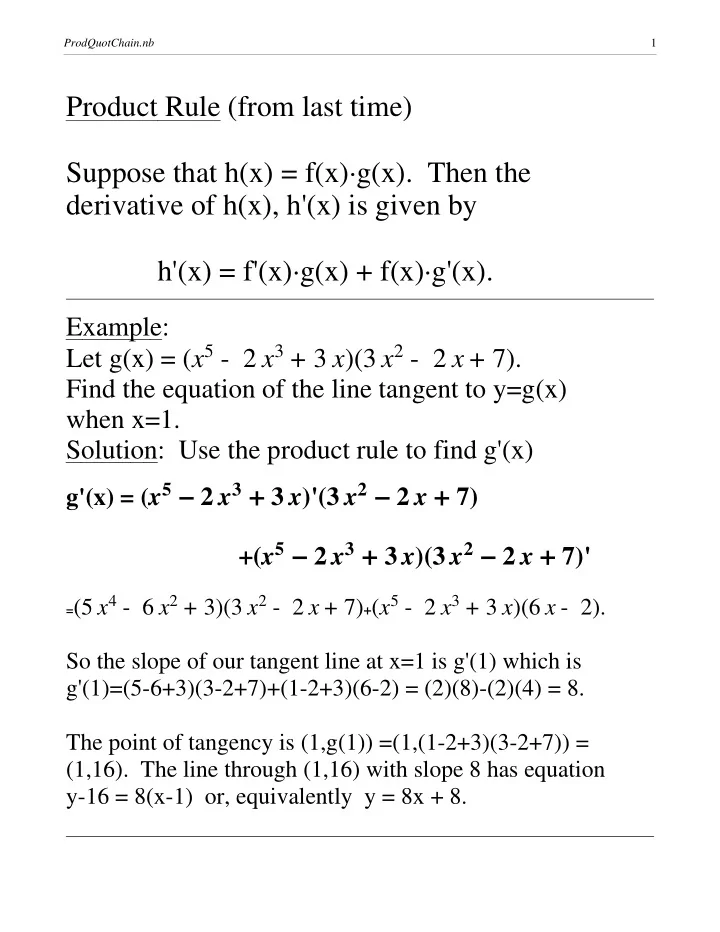
Product Rule (from last time) Suppose that h(x) = f(x)·g(x). Then the derivative of h(x), h'(x) is given by h'(x) = f'(x)·g(x) + f(x)·g'(x).

Example: Let g(x) = (x5 - 2 x3 + 3 x)(3 x2 - 2 x + 7). Find the equation of the line tangent to y=g(x) when x=1. Solution: Use the product rule to find g'(x)

g'(x) = (x5

2 x3 3 x)'(3 x2 2 x 7) +(x5 2 x3 3 x)(3 x2 2 x 7)'

=(5 x4 - 6 x2 + 3)(3 x2 - 2 x + 7)+(x5 - 2 x3 + 3 x)(6 x - 2).

So the slope of our tangent line at x=1 is g'(1) which is g'(1)=(5-6+3)(3-2+7)+(1-2+3)(6-2) = (2)(8)-(2)(4) = 8. The point of tangency is (1,g(1)) =(1,(1-2+3)(3-2+7)) = (1,16). The line through (1,16) with slope 8 has equation y-16 = 8(x-1) or, equivalently y = 8x + 8.

ProdQuotChain.nb 1

slide-2
SLIDE 2

Quotient Rule: Suppose that f(x) = pHxL Ä Ä Ä Ä Ä Ä Ä Ä Ä Ä Ä Ä

qHxL . Then the derivative

f'(x) = qHxL p' HxL

pHxL q' HxL HqHxLL2

. Find the derivative of f HxL = x10

x7

.

Example: The number of bacteria, N(t), in a certain culture t minutes after a certain bactericide is introduced obeys the rule N(t) = 10,000

Ä Ä Ä Ä Ä Ä Ä Ä Ä Ä Ä Ä Ä Ä

1+t2

+ 2000. Find the rate of change of the number of bacteria in the culture 1 minute and 2 minutes after the bactericide is introduced. What is the bacteria population at those instants?

ProdQuotChain.nb 2

slide-3
SLIDE 3

Solution: Use the quotient rule to find N'(t), and then find N'(1) and N'(2). N'(t) = H1 t2L H10000L'

H10000L H1 t2L' H1 t2L2

= H1 t2L H0L

H10000L H2 tL' H1 t2L2

=

20000 t H1 t2L2 .

This will provide the rate at which the size of the culture changes at any time t. N'(1) =

20000 H1L H1 H1L2L

2 =

20000 4

= -5000 bacteria/min. N'(2) =

20000 H2L H1 H2L2L

2 =

40000 25

= -1600 bact. / min. After 1 minute, there are N(1) = 10000

1 12 +2000 =

7000 bacteria in the culture and the culture is los- ing bacteria at a rate of 5000 bacteria per minute. After 2 minutes the bacteria population is N(2) =

10000 1 22 +2000 = 4000, and the loss rate is 1600

bacteria per minute.

ProdQuotChain.nb 3

slide-4
SLIDE 4

Composing two functions, p(x) and q(x) in both

  • rders.

(pÎq)(x) = p(q(x)) and (qÎp)(x) = q(p(x)) Suppose that p HxL è!!!!!!!!!!! x 3 and q HxL Hx

  • 7L2. Then

HpÎqL HxL p Hq HxLL p HHx 7L2L "####################### # Hx 7L2 3 "########################### x2 14 x 52. But in the other order we have HqÎpL HxL q Hp HxLL q Iè!!!!!!!!!!! x 3 M Iè!!!!!!!!!!! x 3 7M

2

Hx 3L 14 è!!!!!!!!!! ! x 3 49 x 14 è!!!!!!!!!! ! x 3 52 . So HpÎqL HxL "########################### x2 14 x 52 while HqÎpL HxL x 14 è!!!!!!!!!! ! x 3

  • 52. Not equal.

ProdQuotChain.nb 4

slide-5
SLIDE 5

Chain Rule (for differentiating function compositions): If h(x) = (fÎg)(x) = f(g(x)), then the derivative, h'(x) = f'(g(x)) · g'(x). Examples in class!

ProdQuotChain.nb 5