Producing Gender Statistics at Local Level: the Case of Mito-City - - PowerPoint PPT Presentation

producing gender statistics at local level the case of
SMART_READER_LITE
LIVE PREVIEW

Producing Gender Statistics at Local Level: the Case of Mito-City - - PowerPoint PPT Presentation

Producing Gender Statistics at Local Level: the Case of Mito-City Miya Ishitsuka and Yoshitaka Hojo Mito City Government Symbol Tower, Art Tower Mito (Photo: Shingo Miura 2017) Contents About Us Call for Gender

slide-1
SLIDE 1

水戸市

Producing Gender Statistics at Local Level: the Case of Mito-City

Miya Ishitsuka and Yoshitaka Hojo Mito City Government

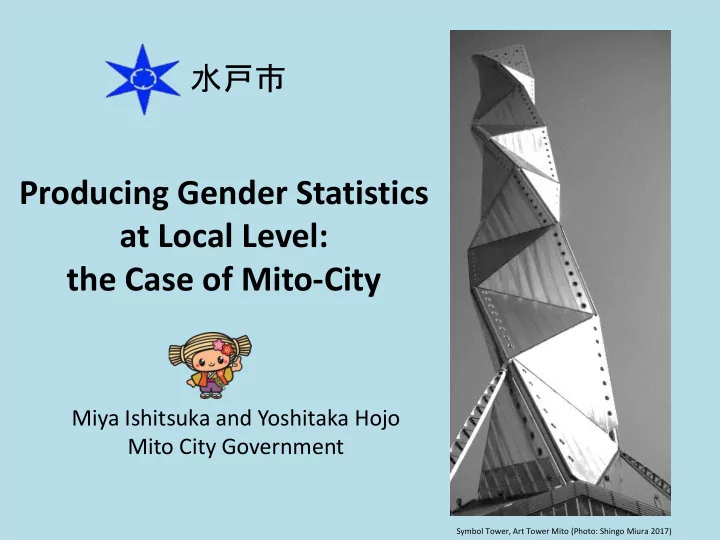
Symbol Tower, Art Tower Mito (Photo: Shingo Miura 2017)

slide-2
SLIDE 2

水戸市

Contents 1 About Us 2 Call for Gender Statistics at Mito-city 3 Results from Citizen Survey 4 Statistical Capacity of the City Government 5 The Way Forward 6 New Data Strategies

slide-3
SLIDE 3

水戸市

Population: 270,294

Area:217.43㎢

Capital of Ibaraki Prefecture Northeast of Tokyo

Kairakuen Park Kodo Kan Art Tower Mito

About Us

100km

slide-4
SLIDE 4

水戸市

Ca Call ll fo for G Gende der St Stat atis istic ics at at M Mit ito C Cit ity y (1 (1)

  • Achieving gender equality in a society has long been a policy

priority for Mito-city

  • 3rd city in Japan which adopted the Declaration on Gender

Equality at the City Council (in 1996)

  • In 2016, preparation for the 5th Plan which paid particular

attention to the promotion of women’s active participation in the workforce for the city first attempt to formulate evidence-based policy making

slide-5
SLIDE 5

水戸市

Ca Call ll fo for G Gende der S Stat atis istic ics at at M Mit ito C Cit ity y (2 (2)

  • Gender statistics were scarce, in particular, those related to

working lives of women.

  • Explored 17 sets of data collected by different Departments of

the city. But, none of them were adequate for gender analyses. For the 6th Plan, the Department of Civic Cooperation decided to gather own data through:

Interviews (2017) Citizen surveys (2018) Business Surveys (2018)

with particular focus on annual income, work-life balance and work patterns.

slide-6
SLIDE 6

6.8 2.2 5.5 1.9 2.0 1.6 0.0 2.0 4.0 6.0 8.0 Women(n=594) Men(n=501) Women, full-time employee (n=196) Men, full-time employee (n=363) Liberal men, full-time employee (n=186) Non-liberal men, full-time employee(n=127)

水戸市

Wome men spend far ar mo more re ti time me in u unpai aid dome mesti tic an and c car are w work rk

Figure 1. Average time spent in unpaid domestic and care work by sex

Results from Citizen Survey (1)

Note: Liberal men refer to those who are supportive of the idea that women will continue working after child birth.

(Unit:Time)

slide-7
SLIDE 7

水戸市 Low

  • w represe

sentation

  • n of
  • f wom
  • men in manage

gerial pos

  • sition
  • n !

Figure 2. Proportion of women and men in managerial position

Results from Citizen Survey (2)

50% 40% 30% 20% 10% 0% 60%

slide-8
SLIDE 8

水戸市

  • As seen in previous slides, the use of citizen survey showed the

importance of having city-owned statistics to inform local policies and plans.

  • It is ideal that such survey would be conducted annually at the

city level. However, ① Limited budget ② Additional workload to the office ③ Response burden of citizens What can we do?

slide-9
SLIDE 9

水戸市

* 59 Department-specific plans in 2018 * 17 citizen surveys being conducted * but only 6 surveys allow data classification by sex

In addition…..

* Data not shared among Departments * Raw data not accessible by other Departments

9

Waste of rich statistical resources !

Data do exist, but not gender sensitive Statistical Capacity of City Government

Figure Thematic plans formulated by Departments of the city Plan 59 Survey 17 Gender 7

slide-10
SLIDE 10

水戸市

10

Source:https://genderstats.un.org/#/data-availability

Local cities are left behind in gender data collection

Availability of UN Gender Statistics Minimum Set

National vs Mito city

Statistical Capacity of City Government

2 4 6 8 10 12 National MitoCity National MitoCity National MitoCity National MitoCity National MitoCity ⅠEconomic ⅡEducation ⅢHealth ⅣPublic life ⅤHuman rights

Mito has only a half of national data.

slide-11
SLIDE 11

水戸市

11

Towards a data driven policy making ! 1 Promote data sharing 2 Increase an access to data 3 Increase data literacy

Create a data hub at the city and facilitate data exchange

Allow an easy access to existing data, with necessary rules and procedures

Appoint a “data concierge”, to guide proper use and understanding of data

The Way Forward

slide-12
SLIDE 12

水戸市

12

Data Outreach

New Data Strategy

  • Use data as communication

tool

  • Discuss and design together

the future of Mito City

slide-13
SLIDE 13

水戸市

13

No Local Left Behind

  • A local government without data cannot depict its future.

Need of locally owned data which directly guide local policy making.

  • Promote fuller utilization of existing statistical resources.

Statistically empower data producers and users at the local level.

  • Data strategies of the local government should take into

account the global development framework, such as SDGs.

Think Globally, Act Locally

Summary and Conclusion

slide-14
SLIDE 14

水戸市

Thank you!

Team Mito

Shigeomi Shibata, Member, Code for Ibaraki Reiko Goto, Professor, Ibaraki University Keiko Osaki Tomita, Adjunct Professor, Tokyo University of Foreign Studies