Procedures on Live Animals Emily Mcivor Policy Director, Research - - PowerPoint PPT Presentation

procedures on live animals
SMART_READER_LITE
LIVE PREVIEW

Procedures on Live Animals Emily Mcivor Policy Director, Research - - PowerPoint PPT Presentation

Meeting the Objective: Full Replacement of Procedures on Live Animals Emily Mcivor Policy Director, Research & Toxicology Department Humane Society International emcivor@hsi.org | hsi.org About HSI and our affiliates Our global regulatory


slide-1
SLIDE 1

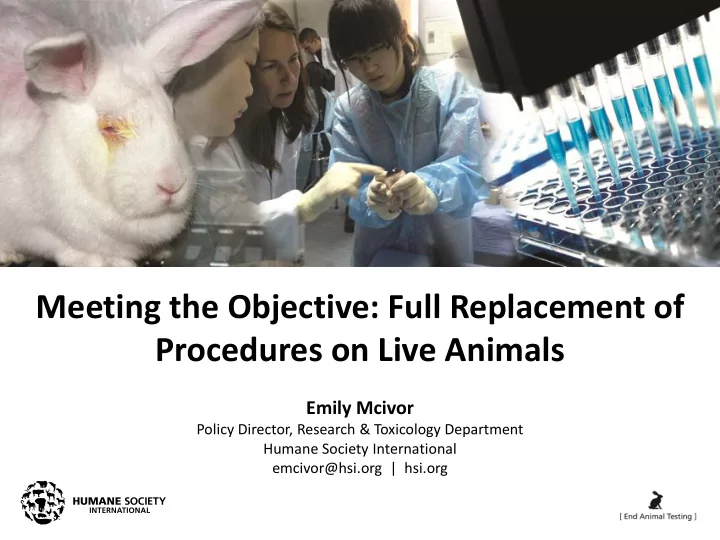
Meeting the Objective: Full Replacement of Procedures on Live Animals

Emily Mcivor

Policy Director, Research & Toxicology Department Humane Society International emcivor@hsi.org | hsi.org
slide-2
SLIDE 2

About HSI and our affiliates

Our global regulatory science team is actively engaged with:

  • OECD Test Guidelines, Chemicals & AOP development programs
  • EU Competent Authorities for REACH and Classification and Labelling
  • European Chemicals Agency Member State Committee, Endocrine

Disruptors Expert Group, etc.

  • USEPA Pesticide Program Workgroup on 21st Century Toxicology
  • USTR Trade and Environment Policy Committee & TTIP negotiations
  • Chinese Environmental Mutagen Society 21st Century Toxicology Group
  • NTP Scientific Advisory Committee on Alternative Toxicological Methods
  • European Union Reference Laboratory for Alternatives (EURL-ECVAM)
  • European Partnership for Alternative Approaches to Animal Testing
  • International Cooperation on Cosmetics Regulation & national laws
  • International Conference on Harmonization (via ICAPPP)
  • Human Toxicology Project Consortium
  • … and many others
slide-3
SLIDE 3

Replacement of animals used to test products/drugs

  • Significant progress in development and

validation of animal replacement, reduction & refinement (‘3R’) methods

  • Role of EU policy mandates as drivers
  • 1986 Animal Experiments Directive drove

the establishment of ECVAM validation center

  • 2003 Cosmetics Directive 7th Amendment

established phased-in restrictions on animal testing & sales, prompting >300 million € in public/private investments in non-animal health effects tests

  • 2006 ‘REACH’ chemicals regulation lists

‘promotion of alternative methods for assessment of hazards’ as one of three main objectives

slide-4
SLIDE 4

Need for replacement technologies in biomedical research?

  • Growing frustration with late-stage

failure of pharmaceuticals —

  • Animal models of disease:

questionable predictors of efficacy in humans

  • Costly, time-consuming, may

prevent beneficial compounds reaching the market

  • Rely on an outdated paradigm
  • Welfare costs to high for limited

success?

slide-5
SLIDE 5

Welfare cost v expected outcome: “Severe”

(i) use of metabolic cages involving severe restriction of movement over a prolonged period; (j) inescapable electric shock (e.g. to produce learned helplessness); (k) complete isolation for prolonged periods of social species e.g. dogs and non-human primates; (l) immobilisation stress to induce gastric ulcers or cardiac failure in rats; (m) forced swim or exercise tests with exhaustion as the end-point.

slide-6
SLIDE 6

“Final goal of full replacement of procedures

  • n live animals”
  • Regulatory data requirements need frequent updating to

keep pace with scientific progress

  • Use all tools available (Directive 2010/63 etc.) to push

biomedical animal replacement innovation

  • Create EU “Reduction Plan” to kick-start disease

model/efficacy paradigm shift

  • Truly EU-wide effort, international impact
  • Animal welfare is an EU value, and

full replacement an admirable goal

  • HSI objective: Establish processes for cross-

agency consensus: review, innovate, implement.

slide-7
SLIDE 7

Thank you for your attention

slide-8
SLIDE 8

Revision of EU REACH testing annexes VII-X

  • 1. Uptake of all applicable OECD 3R guideline methods, as well as other

scientifically-supported alternative testing strategies

  • 2. Move away from redundant in vivo testing
  • Multiple exposure routes (oral + dermal/inhalation)
  • Multiple species (rodent + rabbit)
  • 3. Encourage ‘thoughtful toxicology’
  • Examine 2 or more endpoints within a single test
  • Adopt more efficient & informative study designs
  • Waiving in vivo studies based on in vitro data
  • 4. With sufficient lead-time for implementation

by global industry ahead of 2018 registration deadline