PROCEDURES AND ISSUES TO CONSIDER FOR AN APPLICATION FOR A - - PDF document

procedures and issues to consider for an application for
SMART_READER_LITE
LIVE PREVIEW

PROCEDURES AND ISSUES TO CONSIDER FOR AN APPLICATION FOR A - - PDF document

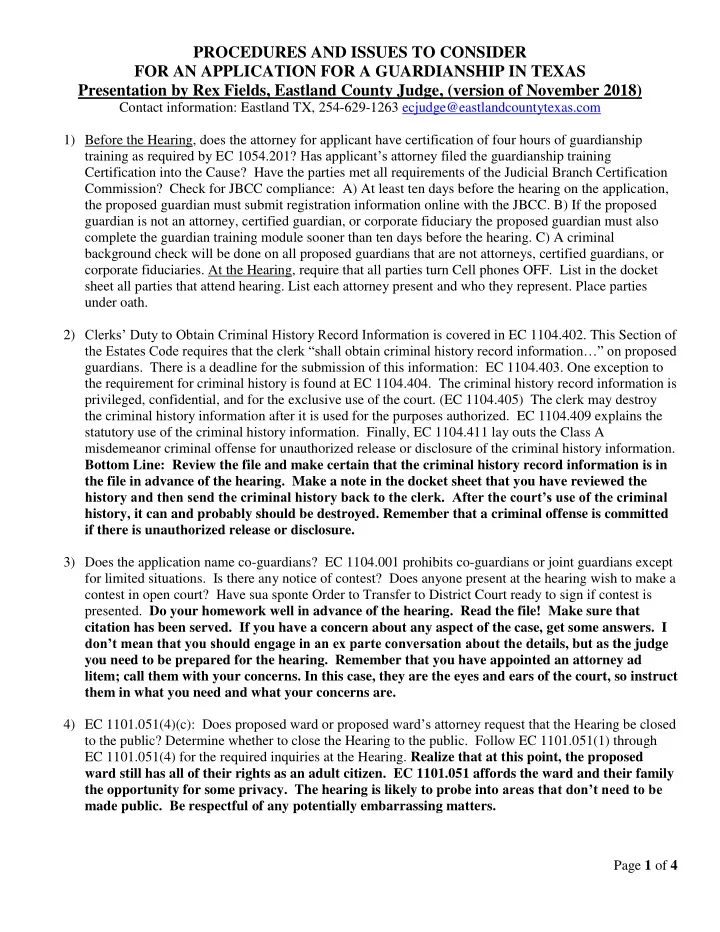
PROCEDURES AND ISSUES TO CONSIDER FOR AN APPLICATION FOR A GUARDIANSHIP IN TEXAS Presentation by Rex Fields, Eastland County Judge, (version of November 2018) Contact information: Eastland TX, 254-629-1263 ecjudge@eastlandcountytexas.com 1)


slide-1
SLIDE 1

Page 1 of 4

PROCEDURES AND ISSUES TO CONSIDER FOR AN APPLICATION FOR A GUARDIANSHIP IN TEXAS Presentation by Rex Fields, Eastland County Judge, (version of November 2018)

Contact information: Eastland TX, 254-629-1263 ecjudge@eastlandcountytexas.com 1) Before the Hearing, does the attorney for applicant have certification of four hours of guardianship training as required by EC 1054.201? Has applicant’s attorney filed the guardianship training Certification into the Cause? Have the parties met all requirements of the Judicial Branch Certification Commission? Check for JBCC compliance: A) At least ten days before the hearing on the application, the proposed guardian must submit registration information online with the JBCC. B) If the proposed guardian is not an attorney, certified guardian, or corporate fiduciary the proposed guardian must also complete the guardian training module sooner than ten days before the hearing. C) A criminal background check will be done on all proposed guardians that are not attorneys, certified guardians, or corporate fiduciaries. At the Hearing, require that all parties turn Cell phones OFF. List in the docket sheet all parties that attend hearing. List each attorney present and who they represent. Place parties under oath. 2) Clerks’ Duty to Obtain Criminal History Record Information is covered in EC 1104.402. This Section of the Estates Code requires that the clerk “shall obtain criminal history record information…” on proposed

  • guardians. There is a deadline for the submission of this information: EC 1104.403. One exception to

the requirement for criminal history is found at EC 1104.404. The criminal history record information is privileged, confidential, and for the exclusive use of the court. (EC 1104.405) The clerk may destroy the criminal history information after it is used for the purposes authorized. EC 1104.409 explains the statutory use of the criminal history information. Finally, EC 1104.411 lay outs the Class A misdemeanor criminal offense for unauthorized release or disclosure of the criminal history information. Bottom Line: Review the file and make certain that the criminal history record information is in the file in advance of the hearing. Make a note in the docket sheet that you have reviewed the history and then send the criminal history back to the clerk. After the court’s use of the criminal history, it can and probably should be destroyed. Remember that a criminal offense is committed if there is unauthorized release or disclosure. 3) Does the application name co-guardians? EC 1104.001 prohibits co-guardians or joint guardians except for limited situations. Is there any notice of contest? Does anyone present at the hearing wish to make a contest in open court? Have sua sponte Order to Transfer to District Court ready to sign if contest is

  • presented. Do your homework well in advance of the hearing. Read the file! Make sure that

citation has been served. If you have a concern about any aspect of the case, get some answers. I don’t mean that you should engage in an ex parte conversation about the details, but as the judge you need to be prepared for the hearing. Remember that you have appointed an attorney ad litem; call them with your concerns. In this case, they are the eyes and ears of the court, so instruct them in what you need and what your concerns are. 4) EC 1101.051(4)(c): Does proposed ward or proposed ward’s attorney request that the Hearing be closed to the public? Determine whether to close the Hearing to the public. Follow EC 1101.051(1) through EC 1101.051(4) for the required inquiries at the Hearing. Realize that at this point, the proposed ward still has all of their rights as an adult citizen. EC 1101.051 affords the ward and their family the opportunity for some privacy. The hearing is likely to probe into areas that don’t need to be made public. Be respectful of any potentially embarrassing matters.

slide-2
SLIDE 2

Page 2 of 4 5) EC 1101.051(b): Is proposed ward present? If not present, on the record, in the docket sheet, or in the Order, determine that the proposed ward’s personal appearance is not necessary. Make notes in the docket sheet or require that the language be included in the Order. 6) Review the physician’s filed statement of examination of physical and mental health. (EC 1101.103) Examination not to be earlier than 120 days before application was filed. (EC 1101.104) Be aware that Determination of Intellectual and Developmental Disability (DID) allows for a 24 month period for the DID to be valid. 7) Questions for proposed guardian: Has applicant ever been convicted of a felony or convicted of a misdemeanor involving moral turpitude such as theft? Unsuitability issues are at (EC 1104.352, EC 1104.353, and EC 1104.354) Situations to consider about proposed guardian; Age and experience of proposed guardian-beware of appointing someone that may develop issues of dementia or have a lack of accounting/fiduciary/business experience. Ask probative questions to gain an understanding of the level

  • f experience of the proposed guardian. Here is where spending a little more time now can prevent

the wheels on the guardianship from later getting wobbly. Carefully consider the age of the proposed guardian with the view of how they may function in ten or fifteen years. Should you really appoint an eighty-year old person today as the guardian? I have several active guardianships that have been in place for ten to fifteen years; after all, if you appoint an eighty year-old person today as the guardian, in ten years you will be dealing with a ninety-year old guardian. Carefully ask questions pertaining to the financial and business knowledge of the proposed

  • guardian. Listen closely to the answers to ascertain if this person can actually handle the duties of

what they are asking to be given. Realize that after the initial inventory, you will only receive information once a year as a report of the person and of the estate. Many issues can happen in a year’s time before the court is made aware of a problem. Drill down at the hearing to uncover any hesitancy, any inexperience, any doubts that the proposed guardian has so that you as the judge do not appoint the wrong person. Acid test: Would you want the proposed guardian to start managing your own personal affairs: financial, medical, place of residence, ability to drive a vehicle, and other living arrangements? 8) Review of current finances of proposed Ward: Source and monthly dollar amount? Is there an existing SSDI or SS Representative Payee? Who is named and how long has this entity been named as Rep Payee? 9) Where does the proposed Ward live now? What are the plans for future living arrangements for proposed Ward? 10) Provisions of the Bond (EC1105.151, et seq.) Specific amount of Bond (EC 1105.154) Corporate surety bond or personal surety bond? Avoid personal surety bonds except for de minimis estates (Beware of possible changes to value of the estate: Is proposed Ward likely to inherit or to benefit from wrongful death or injury lawsuit?) Options for fiduciary control of the estate: Registry of the court (LGC

  • Chpt. 117) and Safekeeping agreements with a financial institution. (Safekeeping is under EC

1105.155 and 1105.156.) The effectiveness of Safekeeping agreements rely strongly on the bank to

  • perate under the guidelines of the court Order. A simple personnel change at the bank can

endanger the agreement. While I have never had problems when using the Registry of the Court, I have had problems with safekeeping agreements. If you decide that it is in the ward’s best interest to use the registry of the court for part of the financial assets, you could consider a lower

slide-3
SLIDE 3

Page 3 of 4 bond amount for the estate that is left outside the Registry. Examples: the value of personal property such as furniture, livestock, jewelry, guns, and electronics. 11) Review proposed Powers to be granted to Guardian. What specific powers, duties, and limitations need to be granted to Guardian? (The reverse of this question is: What powers need to be removed from Ward for Permanent Guardianship?) Consider: ability to drive, vote, marry, and enter into a contract. 12) What are Attorney Ad Litem fees for Permanent Guardianship? Who pays fees: Paid by Estate of Ward

  • r Paid by County? Are these fees and source addressed in the proposed Order? OR does a separate

Order need to be drafted for the AAL fees and source? 13) At the hearing, make sure that proposed Guardian is aware that the Inventory for Permanent Guardianship is due 30 days after creation of same. THEN, an Annual Accounting of the Estate and Report on the Person for each year is required during guardianship’s existence. Review answers by proposed Guardian to Question 5 concerning their experience with accounting as a fiduciary for another party and for the Annual Report of the Person and Estate. Discuss annual bond renewal for next term if

  • applicable. Discuss Letters of Guardianship and annual renewal thereof.

14) Review proposed Order for Permanent Guardianship. Ask AAL if they have reviewed this proposed Order and if they have any concerns. Make sure that required language from EC 1101.151(c) is included in proposed Order. (See Paragraph 17 below) 15) Finding of the Court. (EST Code 1101.101) Findings and Proof: Find by CLEAR AND CONVINCING evidence that; A) The proposed Ward is an incapacitated person, B) It is in the Ward’s best interest to have the Court appoint a person as the proposed Ward’s guardian; C) The proposed Ward’s rights or property will be protected by the appointment of a guardian, D) Alternatives to guardianship that would avoid the need for the appointment of a guardian have been considered and determined not to be feasible; and E) supports and services available to the proposed ward that would avoid the need for the appointment of a guardian have been considered and determined not to be feasible; AND 16) Find by a PREPONDERANCE of the evidence that: (A) the Court has venue of the case, (B) the person to be appointed is eligible to act as guardian and is entitled to appointment. “The Court may not grant an application to create a guardianship unless the Applicant proves each element required by this title (EST Code 1101.101(b)).” I use a court-drafted Order for the Findings by Clear and Convincing evidence and include in this Order the language for Finding by a Preponderance of the evidence. 17) Review the proposed Order to Appoint Guardian. The attorneys may need to draft and agree upon a clean copy that contains the language that addresses the matters discussed in court. Make sure that the proposed Order contains the mandatory language required by EC 1101.151 or EC 1101.152 : “NOTICE TO ANY PEACE OFFICER…” 18) Flag the Court’s scheduling system to ensure that the 30 day inventory is timely filed. Likewise, flag the schedule for the annual report of the person and the estate. What can you as the judge do to enforce compliance for the inventory and other matters discussed in the original hearing and drafted into the Order that was signed into effect? I suggest that Show Cause hearings are a very good tool to get the guardian to comply. Their attorney and the AAL are going to be pushing the guardian into compliance so neither of these attorneys are “wasting” time in court. If the Show Cause hearing does not produce satisfactory results, removal of the guardian may become

  • necessary. EC 1203 is the Chapter of the Estates Code that addresses the resignation, removal, or
slide-4
SLIDE 4

Page 4 of 4 death of guardian. Specifically, EC 1203.102 gives the authority of the Court to appoint a successor guardian. And EC 1163.151 (Penalty for Failure to File Required Account, Exhibit, or Report) gives the Court authority to fine the guardian up to $1,000 and/or revoke the letters of

  • guardianship. Realize also that Texas Penal Code 32.45 affords criminal penalty for

misapplication of fiduciary property or the property of a financial institution. The criminal penalty punishment ranges from a class C misdemeanor up to and including a first degree felony, depending on the dollar amount of the property misapplied.