Problems Often you need the same behavior for different kind of - - PowerPoint PPT Presentation

problems
SMART_READER_LITE
LIVE PREVIEW

Problems Often you need the same behavior for different kind of - - PowerPoint PPT Presentation

Problems Often you need the same behavior for different kind of classes Use Object references to accommodate any object type Java Generics Java Generics Use Generic classes and Method The use of Object references induces


slide-1
SLIDE 1

Java Generics Java Generics

Version 1.0 Oct 2006

2

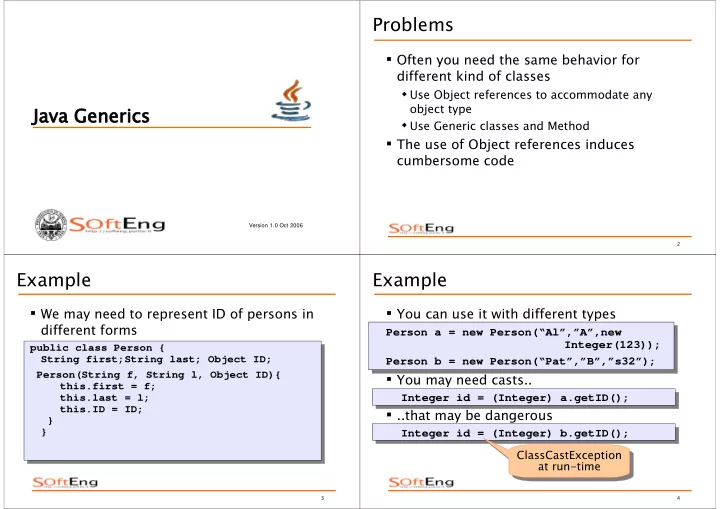
Problems

Often you need the same behavior for different kind of classes

Use Object references to accommodate any

  • bject type

Use Generic classes and Method

The use of Object references induces cumbersome code

3

Example

We may need to represent ID of persons in different forms

public class Person { String first;String last; Object ID; Person(String f, String l, Object ID){ this.first = f; this.last = l; this.ID = ID; } }

4

Example

You can use it with different types

Person a = new Person(“Al”,”A”,new Integer(123)); Person b = new Person(“Pat”,”B”,”s32”);

You may need casts..

Integer id = (Integer) a.getID();

..that may be dangerous

Integer id = (Integer) b.getID(); ClassCastException at run-time

slide-2
SLIDE 2

5

Generic class

public class Person<T> { String first; String last; T ID; Person(String first,String last,T ID){ this.first = first; this.last = last; this.ID = ID; } T getID(){ return ID; } }

6

Generics use

Declaration is longer but...

Person<Integer> a = new Person<Integer> ("Al","A",new Integer(123)); Person<String> b = new Person<String> ("Pat","B","s32");

..use is more compact and safer

Integer id1 = a.getID(); Integer id2 = b.getID(); String ids = b.getID(); Compiler error: type mismatch

7

Generic type declaration

Syntax: (class|interface) Name <P1 {,P2}> Parameters:

uppercase letter usually: T(ype), E(lement), K(ey), V(alue)

8

Generic collections

All collection interfaces and classes have been redefined as Generics Use of generics lead to code that is

safer more compact easier to understand equally performing

slide-3
SLIDE 3

9

Generic list - excerpt

public interface List<E>{ void add(E x); Iterator<E> iterator(); } public interface Iterator<E>{ E next(); boolean hasNext(); }

10

Example

Using a list of Integers W/o generics ( ArrayList list )

list.add(0, new Integer(42)); int n= ((Integer)(list.get(0))).intValue();

With generics ( ArrayList<Integer> list )

list.add(0, new Integer(42)); int n= ((Integer)(list.get(0))).intValue();

+ autoboxing ( ArrayList<Integer> list )

list.add(0,new Integer(42)); int total = list.get(0).intValue();

11

Example

A class representing a point with different precisions

public class Point<T> { T x; T y; public Point(T x, T y){ this.x = x; this.y = y; } }

12

Example

Computing distance from origin:

public double distance(){ return Math.sqrt( x.doubleValue()*x.toDouble() + y.doubleValue()*y.toDouble()); }

We need to bind T:

public class Point<T extends Number> {..} method undefined for type T

slide-4
SLIDE 4

13

Bounded types

Allow to express constraints when defining generic types class C<T extends B1 { & B2 } >

class C can be instantiated only with types derived from B1 (and B2 etc.)

14

Generics subtyping

We must be careful about inheritance when generic types are involved

String is a subtype of Object List<String> is not not s-t of List<Object> List<String> ls = new ArrayList<String>(); List<Object> lo = ls; lo.add(new Object()); String s = ls.get(0);

if this were legal then... .. we could end up assigning an Object to a String reference

15

Wildcard - example

An attempt to have a generic method:

void printAll(Collection<Object> c) { for (Object e: c) System.out.println(e); } won't work with e.g. Collection<String>

We ought to use a wildcard:

void printAll(Collection<?> c) { .. }

pronounced: Collection of unknown

16

Bounded wildcard - example

We need a generic sum function

List<Integer> list=new LinkedList<Integer>(); sum(list);

double sum(List<Number> list) not applicable to List<Integer> double sum(List<T extends Number> list) not a valid syntax, not defining a new type double sum(List<? extends Number> list) we need to use a bounded wildcard

slide-5
SLIDE 5

17

Wildcards

Allow to express (lack of) constraints when using generic types G<?>

G of unknown, unbounded

G<? extends B>

upper bound: only sub-types of B

G<? super D>

lower bound: only super-types of D

18

Lower bound - example

A sorted collection should contain elements that can be ordered

An element E can be order if it directly implements Comparable<E> interface SortedCollection <E extends Comparable<E>> but also if any of its super-classes implements the relative Comparable interface SortedCollection <E extends Comparable<? super E>>

19

Generic method declaration

Sytax: modifiers <T> ret_type name(pars) pars can be:

as usual T type<T>

20

Generic methods

A generic method can be declared both in a common or generic class

<T> T method(T t) <N extends Number> N method(List<N> t) <N extends Number> void method(List<N> t) void method(List<? extends Number> t) wilcards are more compact when a type parameter is used only once

slide-6
SLIDE 6

21

Generics classes

There is only one class generated (by the compiler) for each generic type declaration

Person<Integer> a = new Person<Integer> ("Al","A",new Integer(123)); Person<String> b = new Person<String> ("Pat","B","s32"); boolean same=(a.getClass()==b.getClass()); believe it or not same is true

22

Type erasure

Classes corresponding to generic types are generated by type erasure

The erasure of a generic class is a raw type

– where any reference to the parameters is substituted with the parameter erasure

Erasure of a parameter is the erasure of its first constraint

– If no constraint then erasure is Object

The erasure of a non-generic type is the type itself

23

Type erasure - examples

In: <T>

T ==> Object

In: <T extends Number>

T ==> Number

In: <T extends Number & Comparable>

T ==> Number

24

Type erasure – consequences I

Compiler makes control only when a generic type is used, not within it. Whenever a generic or a parameter is used a cast is added to its erasure instanceOf and .class cannot be used on generic types

valid for G<?> equivalent to the raw type

slide-7
SLIDE 7

25

Type erasure – consequences II

It is not possible to instantiate an object of the generic's parameter type

class G<T> { T[] toArray(){ T[] res = new T[n]; T t = new T(); }} It is not possible to substitute the erasure in an instantiation statement The compiler cannot instantiate these objects

26

Type erasure– consequences III

Overload and ovverride must be considered after type erasure

class Base<T> { void m(int x){} void m(T t){} void m(String s){} <N extends Number> void m(N x){} void m(List<?> l){} }

Object Number

27

Generics and inheritance

Inherintance together with generic types leads to several possibilities It is not possible to implement two generic interfaces instantiated with different types

class Value implements Comparable<Value> class Extended Value extends Value implements Comparable<ExtValue>