
SLIDE 1
Use of Generics
EECS3311 A & E: Software Design Fall 2020 CHEN-WEI WANG
Learning Objectives
Upon completing this lecture, you are expected to understand:
- 1. How to write a generic class (as a supplier)
- 2. How to use a generic class (as a client)
2 of 9
Generic Collection Class: Motivation (1)
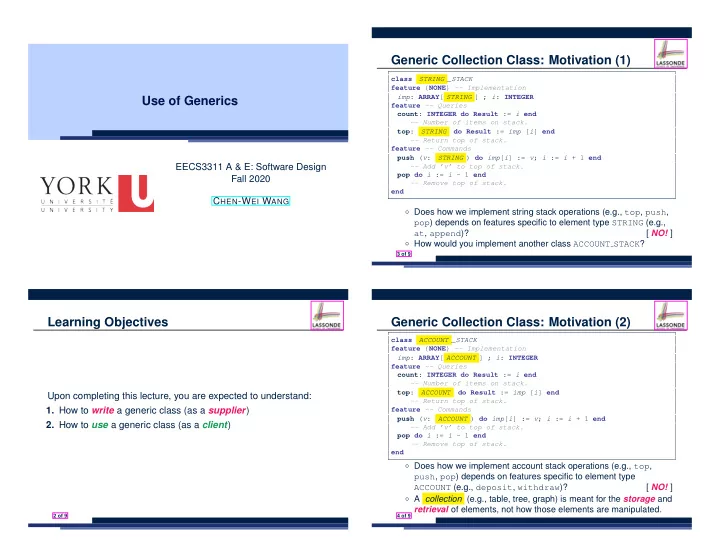
class STRING _STACK feature {NONE} -- Implementation imp: ARRAY[ STRING ] ; i: INTEGER feature -- Queries count: INTEGER do Result := i end
- - Number of items on stack.
top: STRING do Result := imp [i] end
- - Return top of stack.
feature -- Commands push (v: STRING ) do imp[i] := v; i := i + 1 end
- - Add ’v’ to top of stack.
pop do i := i - 1 end
- - Remove top of stack.
end
○ Does how we implement string stack operations (e.g., top, push, pop) depends on features specific to element type STRING (e.g., at, append)? [ NO! ] ○ How would you implement another class ACCOUNT STACK?
3 of 9
Generic Collection Class: Motivation (2)
class ACCOUNT _STACK feature {NONE} -- Implementation imp: ARRAY[ ACCOUNT ] ; i: INTEGER feature -- Queries count: INTEGER do Result := i end
- - Number of items on stack.
top: ACCOUNT do Result := imp [i] end
- - Return top of stack.
feature -- Commands push (v: ACCOUNT ) do imp[i] := v; i := i + 1 end
- - Add ’v’ to top of stack.
pop do i := i - 1 end
- - Remove top of stack.
end
○ Does how we implement account stack operations (e.g., top, push, pop) depends on features specific to element type ACCOUNT (e.g., deposit, withdraw)? [ NO! ] ○ A collection (e.g., table, tree, graph) is meant for the storage and retrieval of elements, not how those elements are manipulated.
4 of 9