Problem-Solving Treatment: Learning and Planning How to Act, Not - - PowerPoint PPT Presentation

problem solving treatment
SMART_READER_LITE
LIVE PREVIEW

Problem-Solving Treatment: Learning and Planning How to Act, Not - - PowerPoint PPT Presentation

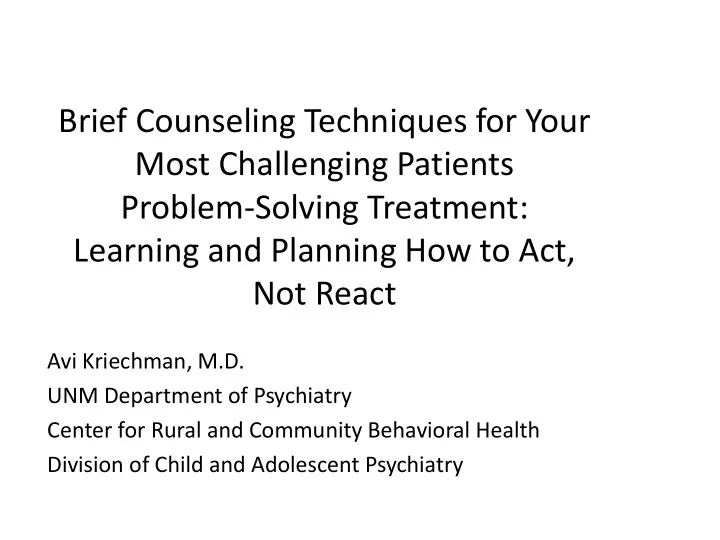
Brief Counseling Techniques for Your Most Challenging Patients Problem-Solving Treatment: Learning and Planning How to Act, Not React Avi Kriechman, M.D. UNM Department of Psychiatry Center for Rural and Community Behavioral Health Division


slide-1
SLIDE 1

Brief Counseling Techniques for Your Most Challenging Patients Problem-Solving Treatment: Learning and Planning How to Act, Not React

Avi Kriechman, M.D. UNM Department of Psychiatry Center for Rural and Community Behavioral Health Division of Child and Adolescent Psychiatry

slide-2
SLIDE 2

Objectives

  • Recognize the 7 steps of problem-solving
  • Learn ways to help patients set goals that are specific,

measurable, and achievable

  • Learn how to help patients brainstorm solutions, then

evaluate and compare them

  • Learn ways to help patients select a preferred solution,

implement an action plan, and evaluate the outcome

slide-3
SLIDE 3

Overview of Problem Solving

  • Take a problem identified by the patient and assist them in a

structured process to come up with an action plan to address the problem then evaluate the plan’s effectiveness

  • Once learned, problem solving skills can help prevent relapse
slide-4
SLIDE 4

Overview of Problem Solving*

  • Here-and-now focus
  • Emphasis on teaching skills
  • Structure that supports patient follow-through
  • Homework that incentivizes patient to act
slide-5
SLIDE 5

7 Steps

slide-6
SLIDE 6

7 Steps of Problem Solving

  • Define the Problem
  • Set Realistic, Achievable Goal
  • Generate Multiple Solutions: Brainstorming
  • Evaluate and Compare Solutions: Pros and Cons
  • Select the Preferred Solution
  • Implement the Solution: Action Plan
  • Evaluate the Outcome
slide-7
SLIDE 7

Define the Problem

  • Define the Problem
  • Set Realistic, Achievable Goal
  • Generate Multiple Solutions: Brainstorming
  • Evaluate and Compare Solutions: Pros and Cons
  • Select the Preferred Solution
  • Implement the Solution: Action Plan
  • Evaluate the Outcome
slide-8
SLIDE 8

Define the Problem*

Patient defines the problem which is

  • Current, specific, and do-able
  • Described in objective behavioral terms
  • Explored and clarified
  • Broken down into simpler parts
slide-9
SLIDE 9

Questions to Define the Problem

  • What makes this a problem?
  • When does the problem occur?
  • Where does the problem occur?
  • Who is involved in the problem?
  • How often does the problem occur?
  • What have you already tried to solve the problem?
  • Do you realistically have control over this problem?
slide-10
SLIDE 10

Break Down Large Problems into Smaller, More Manageable Parts

Example: a woman’s “problem with family relations” broke down into:

  • Resentment of husband for staying out four nights a week
  • Mother’s criticism about her patient’s child-rearing
  • Burden taking care of an ungrateful sister with a chronic

medical illness

slide-11
SLIDE 11

State Problem Clearly

State problem in a clear and objective way that specifies the exact behaviors needing change

“My daughter disrespects me” is vague and doesn’t provide information what needs to be changed vs. “My daughter tells me to ‘Shut Up!’ when I ask her to do something” is much more objective and describes more precisely what behaviors need to change

slide-12
SLIDE 12

Set Realistic, Achievable Goal

  • Define the Problem
  • Set Realistic, Achievable Goal
  • Generate Multiple Solutions: Brainstorming
  • Evaluate and Compare Solutions: Pros and Cons
  • Select the Preferred Solution
  • Implement the Solution: Action Plan
  • Evaluate the Outcome
slide-13
SLIDE 13

Set Realistic, Achievable Goal

  • Goal is objective
  • Goal is described in observable and

measurable behavioral terms

  • Goal is achievable with a reasonable amount
  • f time and effort
  • Goal is realistic: within the patient’s control
  • Goal directly follows problem statement
slide-14
SLIDE 14

Set Realistic, Achievable Goal*

“I will lose five pounds during the next week is stated in a way that is not within the patient’s control vs. “I will find ways to decrease my sugar consumption” or ‘I will increase my activity level’ are measurable and observable activities over which patient has direct personal control and provide signposts whether or not the goal has been met

slide-15
SLIDE 15

Generate Multiple Solutions: Brainstorming

  • Define the Problem
  • Set Realistic, Achievable Goal
  • Generate Multiple Solutions: Brainstorming
  • Evaluate and Compare Solutions: Pros and

Cons

  • Select the Preferred Solution
  • Implement the Solution: Action Plan
  • Evaluate the Outcome
slide-16
SLIDE 16

Brainstorming

slide-17
SLIDE 17

Generate Multiple Solutions: Brainstorming

  • The first idea is not always the best idea
  • The greater the number of potential solutions,

the greater the chances for successful problem resolution

  • Solutions come from patient
  • Encourage patient to generate as many solutions

as possible via brainstorming techniques

  • Help patient withhold judging ideas until

brainstorming is completed to avoid prematurely abandoning potential successful problem resolution

slide-18
SLIDE 18

Brainstorming More Ideas More Ideas on Brainstorming

  • If patient asks provider “what do you think”,

remind them they’re the best judge of what is right for them and their situation

  • If patient’s stumped generating ideas,

encourage them to think of how other people might respond to the problem

  • Encourage with statements like “have fun with

your ideas”, “think as free as you like”, “let’s play around with lots of possibilities”

slide-19
SLIDE 19

Evaluate and Compare Solutions: Pros and Cons

  • Define the Problem
  • Set Realistic, Achievable Goal
  • Generate Multiple Solutions: Brainstorming
  • Evaluate and Compare Solutions: Pros and

Cons

  • Select the Preferred Solution
  • Implement the Solution: Action Plan
  • Evaluate the Outcome
slide-20
SLIDE 20

Evaluate and Compare Solutions: Pros and Cons

Effective solutions not only solve problems but

minimize negative outcomes for self and others

  • Consider pros and cons (advantages and

disadvantages, feasibility and obstacles, benefits and challenges) for each solution

  • Consider pros and cons for self and others for

each solution

  • Compare solutions as they are reviewed
slide-21
SLIDE 21

Don’t Rush the Evaluation Process

Evaluating and selecting the solution represents the most important step in problem-solving toward developing critical thinking skills – the ability to carefully weigh the evidence and appropriately draw conclusions.

slide-22
SLIDE 22

7 Steps of Problem Solving*

  • Define the Problem
  • Set Realistic, Achievable Goal
  • Generate Multiple Solutions: Brainstorming
  • Evaluate and Compare Solutions: Pros and

Cons

  • Select the Preferred Solution
  • Implement the Solution: Action Plan
  • Evaluate the Outcome
slide-23
SLIDE 23

Select the Preferred Solution

  • Find middle way between tasks patient feels unprepared to

handle vs. discounting patient’s competency by supporting a solution that is barely relevant or clearly unsatisfactory for making progress

  • Solutions satisfy goals: Don’t emphasize do-ability over

likelihood of satisfying the goal  the easiest solution to implement is not always the preferred one

  • Solutions limit negative impact to self and others
slide-24
SLIDE 24

7 Steps of Problem Solving**

  • Define the Problem
  • Set Realistic, Achievable Goal
  • Generate Multiple Solutions: Brainstorming
  • Evaluate and Compare Solutions: Pros and

Cons

  • Select the Preferred Solution
  • Implement the Solution: Action Plan
  • Evaluate the Outcome
slide-25
SLIDE 25

Implement the Solution: Action Plan

  • Identify specific tasks
  • Tasks are relevant to solution
  • Set realistic behavior requirements
  • Break big tasks down into more simple ones
  • It may be helpful to rehearse task in the office
  • It may be helpful to use visualization, imagery
  • List clear set of tasks assigned for completion

between treatment sessions (“homework”)

slide-26
SLIDE 26

7 Steps of Problem Solving***

  • Define the Problem
  • Set Realistic, Achievable Goal
  • Generate Multiple Solutions: Brainstorming
  • Evaluate and Compare Solutions: Pros and

Cons

  • Select the Preferred Solution
  • Implement the Solution: Action Plan
  • Evaluate the Outcome
slide-27
SLIDE 27

Evaluate the Outcome: Review Homework

  • Review all homework tasks
  • Follow review by asking patient about their

sense of satisfaction with their effort and the impact of their success on their mood, behavior, relationships, etc.

slide-28
SLIDE 28

Evaluate the Outcome: Difficulties as Opportunities

Difficulties (not “failures”) result in useful information about the problem and how best to solve it

  • What did patient learn about situation that they did

not know for sure before?

  • Exactly what happened when they tried to

implement the solution?

slide-29
SLIDE 29

Evaluate the Outcome: Difficulties as Opportunities

Difficulties (not “failures”) result in useful information about the problem and how best to solve it

  • Should the goal be defined more clearly?
  • Are the goals unrealistic?
slide-30
SLIDE 30

Evaluate the Outcome:* Difficulties as (continued)

Difficulties (not “failures”) result in useful information about the problem and how best to solve it

  • Have new obstacles come up?
  • Are the action steps difficult? If so, why?
  • Does the patient feel truly committed to work on the

problem?

slide-31
SLIDE 31

Too Difficult to Tackle

A problem “too difficult to tackle” is usually due to the patient not having sufficient control over the source of the problem If a problem proves too difficult….

  • Go on to another problem or
  • Modify the goal to focus on aspects of the

problem over which the patient has more control

slide-32
SLIDE 32

7 Steps of Problem Solving****

  • Define the Problem
  • Set Realistic, Achievable Goal
  • Generate Multiple Solutions: Brainstorming
  • Evaluate and Compare Solutions: Pros and Cons
  • Select the Preferred Solution
  • Implement the Solution: Action Plan
  • Evaluate the Outcome
slide-33
SLIDE 33

Selected References

  • Training Residents in Problem-solving Treatment of

Depression: A Pilot Feasibility and Impact Study by Hegel, Dietrich, Seville & Jordan

  • Problem-Solving Treatment for Primary Care (PST-PC): A

Treatment Manual for Depression by Hegel & Arean

  • The Efficacy of Problem Solving Therapy in Reducing

Mental and Physical Health Problems: A Meta-Analysis by Mlouff, Thorsteinsson & Schutte