Problem Solving by Searching Russell and Norvig, chapter 3.1-3.3 - - PDF document

problem solving by searching
SMART_READER_LITE
LIVE PREVIEW

Problem Solving by Searching Russell and Norvig, chapter 3.1-3.3 - - PDF document

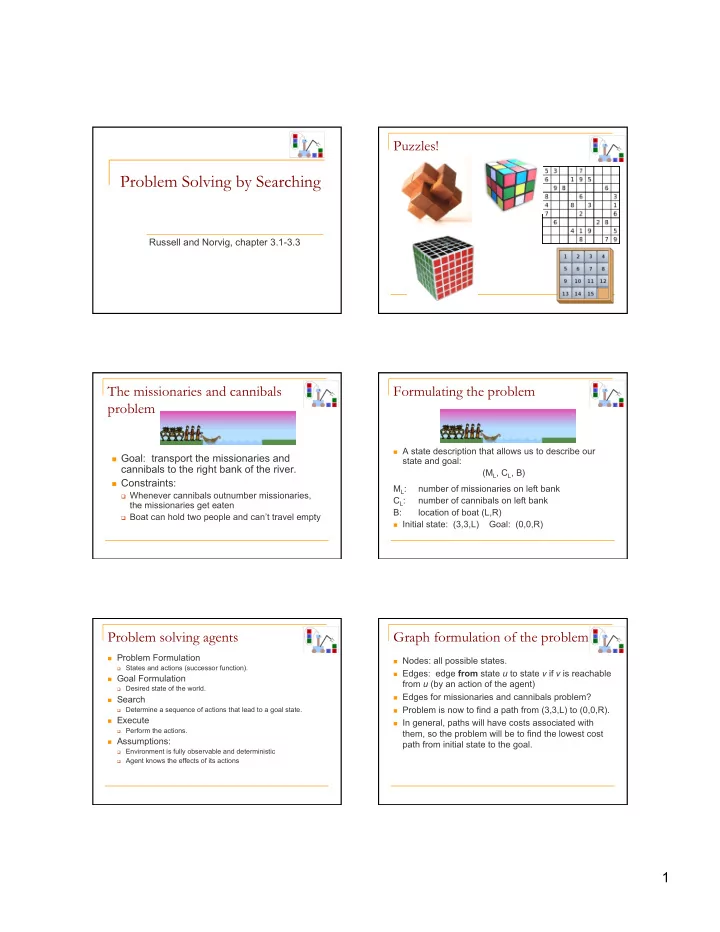
Puzzles! Problem Solving by Searching Russell and Norvig, chapter 3.1-3.3 The missionaries and cannibals Formulating the problem problem n A state description that allows us to describe our n Goal: transport the missionaries and state


slide-1
SLIDE 1

1

Problem Solving by Searching

Russell and Norvig, chapter 3.1-3.3

Puzzles! The missionaries and cannibals problem

n Goal: transport the missionaries and

cannibals to the right bank of the river.

n Constraints:

q Whenever cannibals outnumber missionaries,

the missionaries get eaten

q Boat can hold two people and can’t travel empty

Formulating the problem

n A state description that allows us to describe our

state and goal: (ML, CL, B) ML: number of missionaries on left bank CL: number of cannibals on left bank B: location of boat (L,R)

n Initial state: (3,3,L) Goal: (0,0,R)

Problem solving agents

n Problem Formulation

q States and actions (successor function).

n Goal Formulation

q Desired state of the world.

n Search

q Determine a sequence of actions that lead to a goal state.

n Execute

q Perform the actions.

n Assumptions:

q Environment is fully observable and deterministic q Agent knows the effects of its actions

Graph formulation of the problem

n Nodes: all possible states. n Edges: edge from state u to state v if v is reachable

from u (by an action of the agent)

n Edges for missionaries and cannibals problem? n Problem is now to find a path from (3,3,L) to (0,0,R). n In general, paths will have costs associated with

them, so the problem will be to find the lowest cost path from initial state to the goal.

slide-2
SLIDE 2

2 Formulating a search problem

7

§ State space S (nodes) § Successor function: the states you can move to by an action (edge) from the current state § Initial state § Goal test is a state x a goal? § Cost

S

1 3 2

33L 31R 32R 22R

CCR CR CMR

State: 33L three missionaries and three cannibals on left bank, boat is on left bank Actions (operators): CCR - transport two cannibals to the right bank MCL - transport a missionary and a cannibal to the left bank

Why no MMR transition from this state?

Back to our problem The (partially expanded) search tree

33L 31R 32R 22R 32L 33L 33L 32L 30R 31R 22R 21R 32L 31L

CCR CR CMR CL CCL CL ML CCR CR MR MCR CCL CR

Actions: CCR - transport two cannibals to the right bank MCL - transport a missionary and a cannibal to the left bank

Repeated states

33L 31R 32R 22R 32L 33L 33L 32L 30R 31R 22R 21R 32L 31L The search tree contains duplicate nodes, since the underlying graph in which we are searching is not a tree!

The state space graph

33L 31R 32R 22R 32L 30R 31L 11R To address this, need to track previously explored states

Aside: Searching the graph

function GRAPH-SEARCH(problem) returns a solution, or failure initialize the frontier using the initial state of problem initialize the explored set to be empty loop do if the frontier is empty then return failure choose a leaf node and remove it from the frontier if the node contains a goal state then return the corresponding solution add the node to the explored set expand the chosen node add the resulting nodes to the frontier only if not in the frontier or explored

12

The difference between BFS and DFS is in how the node is chosen and/or how it is added to the frontier: queue versus stack.

slide-3
SLIDE 3

3 Searching the state space

n Often it is not feasible (or too

expensive) to build a complete representation of the state graph

n A problem solver must

construct a solution by exploring a small portion of the graph

13

Searching the state space

14

Search tree

Searching the state space

15

Search tree

Searching the state space

16

Search tree

Searching the state space

17

Search tree

Searching the state space

18

Search tree

slide-4
SLIDE 4

4 Searching the state space

19

Search tree

The 8 puzzle

n States? n Initial state? n Actions? n Goal test? n Path cost?

The 8 puzzle

n States? Integer location of each tile. How many of them are there? n Initial state? Any state n Actions? (tile, direction)

where direction is one of {Left, Right, Up, Down}

n Goal test? Check whether goal configuration is reached n Path cost? Number of actions to reach goal n Is the search graph a tree?

(n2-1)-puzzle

22

1 2 3 4 5 6 7 8 12 15 11 14 10 13 9 5 6 7 8 4 3 2 1

....

The 15-puzzle

23

Sam Loyd offered $1,000 of his own money to the first person who would solve the following problem: 12 14 11 15 10 13 9 5 6 7 8 4 3 2 1 12 15 11 14 10 13 9 5 6 7 8 4 3 2 1

?

24

But no one ever won the prize !!

slide-5
SLIDE 5

5 Why?

25

Solution to the Search Problem

n A solution is a path connecting the initial

node to a goal node (any one)

26

I G

Solution to the Search Problem

n A solution is a path connecting the initial

node to a goal node (any one)

n The cost of a path is the sum of the edge

costs along this path

n An optimal solution is a solution path of

minimum cost

n There might be

no solution !

27

I G

Path Cost

n An edge cost is a positive number measuring

the “cost” of performing the action corresponding to the edge, e.g.:

q 1 in the 8-puzzle example

n We will assume that for any given problem

the cost c of an edge always satisfies: c ≥ ε > 0, where ε is a constant

q Why? Has to do with the cost of arbitrarily long

paths

28

Goal State

n It may be explicitly described: n or partially described: n or defined by a condition,

e.g., the sum of every row, of every column, and of every diagonal equals 30

29

1 2 3 4 5 6 7 8

11 14 5 13 6 3 8 4 10 9 7 12 2 1 15

1 5 8 a a a a a a

(“a” stands for “any”

  • ther than 1, 5, and 8)

Another example: the 8 queens problem

n Incremental vs. complete state formulation:

q Incremental formulation starts with an empty state and

involves operators that augment the state description

q A complete state formulation starts with all 8 queens on the

board and moves them around

slide-6
SLIDE 6

6 8 queens problem: representation is key

Incremental formulation

n

States? Any arrangement of 0 to 8 queens on the board

n

Initial state? No queens

n

Actions? Add queen in empty square

n

Goal test? 8 queens on board and none attacked

n

Path cost? None 64 x 63 x … 57 ~ 3 x 10¹⁴ states to investigate Is the search graph a tree?

A better representation

Another incremental formulation:

n

States? n (between 0 and 8) queens on the board, one in each of the n left-most columns; no queens attacking each other.

n

Initial state? No queens

n

Actions? Add queen in leftmost empty column such that it does not attack any of the queens already on the board.

n

Goal test? 8 queens on board 2057 possible sequences to investigate

8 queens solved

Animated gif from https://sites.google.com/a/lclark.edu/drake/courses/ai/search-and-n-queens

n-queens problem

n A solution is a goal node, not a path to this

node (typical of design problem)

n Number of states in state space:

q 8-queens à 2,057 q 100-queens à 1052

n But techniques exist to solve n-queens

problems efficiently for large values of n

34

Path planning

35

What is the state space?

Path planning

  • This path is the shortest in the discretized

This path is the shortest one in the discretized space, but not in the original space.

slide-7
SLIDE 7

7 An alternative formulation

Visibility graph

Cost of a step is the length of the step

An alternative formulation

The solution in this space is the same as in the continuous space!

Lozano-Pérez, Tomás; Wesley, Michael A. (1979), "An algorithm for planning collision-free paths among polyhedral obstacles", Communications of the ACM 22 (10): 560–570,

Assumptions in Basic Search

n The world is static n The world is discretizable n The world is fully observable n The actions are deterministic

39

Search remains an important tool even if not all these assumptions are satisfied

Search and AI

n Search methods are ubiquitous in AI systems. n An autonomous robot uses search to decide which

actions to take and which sensing operations to perform, to quickly anticipate collision, to plan trajectories,…

n Logistics companies use search to allocate resources,

plan routes, schedule employees…

n Agents or opponents in games use search to navigate,

select moves, anticipate other’s actions, and decide on their own actions.

40

Applications

n Search plays a key role in many applications,

e.g.:

q Route finding (google/mapquest, internet, airline) q VLSI Layout q Robot navigation. q Pharmaceutical drug design, protein design q Video games

41