Problem Failure-Oblivious Computing Memory Errors and Memory - - PowerPoint PPT Presentation

problem
SMART_READER_LITE
LIVE PREVIEW

Problem Failure-Oblivious Computing Memory Errors and Memory - - PowerPoint PPT Presentation

Enhancing Server Availability and Security Through Problem Failure-Oblivious Computing Memory Errors and Memory Corruption Buffer Overflow Out of Bounds Array Accesses Invalid Pointer Accesses Importance Martin Rinard,


slide-1
SLIDE 1

Michael Contreras

Enhancing Server Availability and Security Through Failure-Oblivious Computing

Martin Rinard, Cristian Cadar, Daniel Dumitran, Daniel M. Roy,Tudor Leu, and William S. Beebee, Jr.

Student presentation

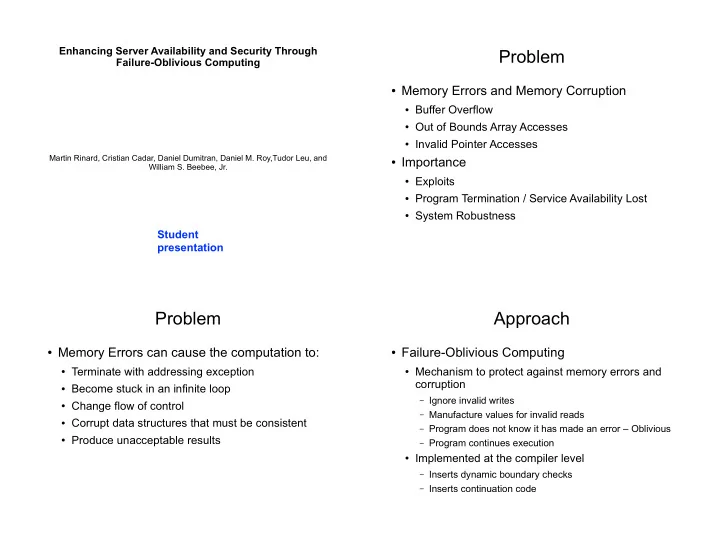
Problem

  • Memory Errors and Memory Corruption
  • Buffer Overflow
  • Out of Bounds Array Accesses
  • Invalid Pointer Accesses
  • Importance
  • Exploits
  • Program Termination / Service Availability Lost
  • System Robustness

Problem

  • Memory Errors can cause the computation to:
  • Terminate with addressing exception
  • Become stuck in an infinite loop
  • Change flow of control
  • Corrupt data structures that must be consistent
  • Produce unacceptable results

Approach

  • Failure-Oblivious Computing
  • Mechanism to protect against memory errors and

corruption

– Ignore invalid writes – Manufacture values for invalid reads – Program does not know it has made an error – Oblivious – Program continues execution

  • Implemented at the compiler level

– Inserts dynamic boundary checks – Inserts continuation code

slide-2
SLIDE 2

Evaluation

  • Assumptions
  • Tests limited to buffer overrun attacks
  • Servers tested have short error propagation

distances

  • Weaknesses
  • Unanticipated Execution Paths

– Manufactured results can lead the program down an

unexpected path leading to incorrect results

  • Bystander Effect

– Create dependency on the mechanism and overall

production quality is decreased

Evaluation

  • Strengths
  • Availability

– Program remains available after failure occurs

  • Security

– Program is invulnerable to common memory related

attacks

  • Minimal Adoption Cost

– Implemented by the compiler – No code modification

necessary

  • Reduced Administration Overhead

– Patches for the sole purpose of fixing memory related

security holes can be safely ignored

Evaluation

  • Testing
  • Evaluated impact on several widely used open-

source servers with known memory errors

– Pine, Apache, Sendmail, MC, Mutt

  • Three versions of each program

– Standard Compilation – CRED Compilation – Failure-Oblivious Compilation

  • Criteria

– Security and Resilience – Performance – Stability

Evaluation

  • Pine
  • Error

– Escaping “From” field into heap-allocated buffer

  • Security and Resilience

– Standard version results in a Segmentation Fault, CRED version

catches the error and terminates program

– Both leave pine unusable as the error occurs during initialization – Failure-Oblivious causes field to be truncated

  • Different execution path correctly parses field allowing successful

execution

  • Stability

– 25 messages a day interleaved with malicious input – Input of 100,000 messages

  • Performance
slide-3
SLIDE 3

Evaluation

  • Apache
  • Error

– URL re-write match pattern offsets saved into static buffer

  • Security and Resilience

– Standard version results in Segmentation Violation, CRED

catches error and terminates

– Apache starts a new child process to continue serving requests – Failure-Oblivious ignores the invalid writes, preventing the

attack and process termination

  • Stability

– 400 requests a day in addition to tens of thousands of requests

from local box, interleaved with malicious input

  • Performance

Evaluation

  • Sendmail
  • Error

– Translation of address into static buffer

  • Security and Resilience

– Standard version results in Segmentation Violation, CRED

catches error and terminates

– CRED version completely disabled by another memory error

during initialization

– Failure-Oblivious version ignores error, continues execution

  • Stability

– Used to send hundreds of thousands of messages, interleaved

with malicious input

  • Performance

Evaluation

  • Midnight Commander
  • Error

– Accessing uninitialized buffer when parsing links in tgz files

  • Security and Resilience

– Standard version results in Segmentation Violation, CRED

catches the error and terminates

– Failure-Oblivious allows program to continue and display results

  • Stability

– Daily use with interleaved accesses of problematic files

  • Performance

Evaluation

  • Mutt
  • Error

– Converting from UTF-8 to UTF-7 into heap-allocated buffer

  • Security and Resilience

– Standard version results in Segmentation Fault, CRED version

catches the error and terminates

– Failure-Oblivious version effectively truncates the name

  • Stability

– Daily use interleaved with malicious input – Processed 100,000 emails successfully

  • Performance
slide-4
SLIDE 4

Related Work

  • CRED
  • Safe-C compiler

– Terminates the program with an error message at first

memory error

– Similar to safe languages such as ML and Java which

throw exceptions

  • Acceptability-Oriented Computing
  • Acceptability Properties

– Must hold for program execution to remain acceptable

  • Acceptability Enforcement

– Built by programmer to ensure Acceptability Properties

hold

Related Work

  • Variants and Extensions
  • Boundless Memory Blocks

– Insert code to save invalid writes into table to retrieve

later

  • Redirected invalid access back at appropriate offset
  • Transactional Function Termination
  • Dynamically detect Buffer Overflows

– Terminate Execution of function immediately.

  • Static Analysis
  • Program Annotations
  • Heuristics

Related Work

  • Buffer-Overrun Detection Tools
  • StackGuard
  • StackShield
  • Rebooting
  • Manual Error Detection and Recovery
  • Failure Recovery Blocks and Exception Handlers

– Programmer anticipates error, provides recovery strategy

  • Data Structure Repair

– Programmer provides data structure consistency

specification

Result

  • Failure-Oblivious Computation
  • Enhances availability, resilience, and security

– Error does not corrupt address space and data structures

  • f the computation

– Continued execution through error – In many cases, converts unexpected or malicious input

into a predetermined error case

  • Possible solution to one of the main goals of

computer science

– Create robust, resilient software that handles unexpected

errors