
False discovery rate and model selection Elisabeth Gnatowski Definition of the FDR
Multiple Testing FDR and pFDR Controlling the FDR
Estimation of the FDR
Gene - specific FDR
Variable Selection A decision theoretic framework Simulation studies
p < n p > n
False discovery rate and model selection
Elisabeth Gnatowski 23.06.2006
False discovery rate and model selection Elisabeth Gnatowski Definition of the FDR
Multiple Testing FDR and pFDR Controlling the FDR
Estimation of the FDR
Gene - specific FDR
Variable Selection A decision theoretic framework Simulation studies
p < n p > n
Problem
find differentially expressed genes using DNA microarrays number of genes much larger than number of independent samples in study (p >> n) problem of testing multiple hypotheses simultaneously analysing microarray data requires control of type 1 errors including balance between finding too many false-positive results and too little significant results ⇒ FDR
False discovery rate and model selection Elisabeth Gnatowski Definition of the FDR
Multiple Testing FDR and pFDR Controlling the FDR
Estimation of the FDR
Gene - specific FDR
Variable Selection A decision theoretic framework Simulation studies
p < n p > n
1
Definition of the FDR Multiple Testing FDR and pFDR Controlling the FDR
2
Estimation of the FDR Gene - specific FDR
3
Variable Selection
4
A decision theoretic framework
5
Simulation studies p < n p > n
False discovery rate and model selection Elisabeth Gnatowski Definition of the FDR
Multiple Testing FDR and pFDR Controlling the FDR
Estimation of the FDR
Gene - specific FDR
Variable Selection A decision theoretic framework Simulation studies
p < n p > n
Multiple Testing
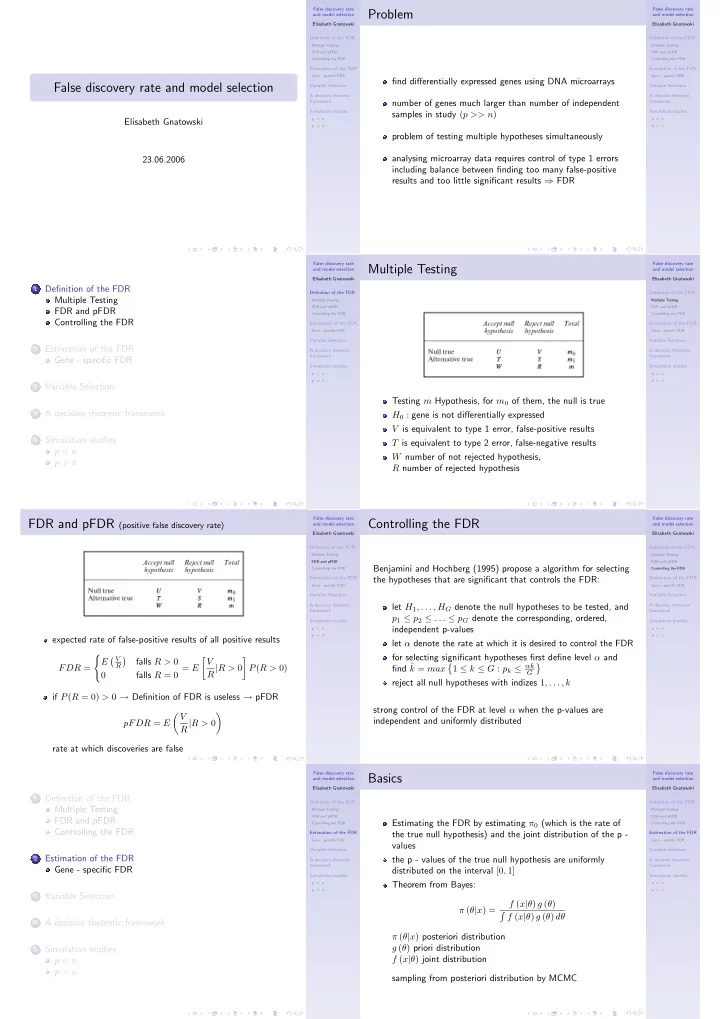
Testing m Hypothesis, for m0 of them, the null is true H0 : gene is not differentially expressed V is equivalent to type 1 error, false-positive results T is equivalent to type 2 error, false-negative results W number of not rejected hypothesis, R number of rejected hypothesis
False discovery rate and model selection Elisabeth Gnatowski Definition of the FDR
Multiple Testing FDR and pFDR Controlling the FDR
Estimation of the FDR
Gene - specific FDR
Variable Selection A decision theoretic framework Simulation studies
p < n p > n
FDR and pFDR (positive false discovery rate)
expected rate of false-positive results of all positive results FDR =
- E
V
R
- falls R > 0
falls R = 0 = E V R|R > 0
- P(R > 0)
if P(R = 0) > 0 → Definition of FDR is useless → pFDR pFDR = E V R|R > 0
- rate at which discoveries are false
False discovery rate and model selection Elisabeth Gnatowski Definition of the FDR
Multiple Testing FDR and pFDR Controlling the FDR
Estimation of the FDR
Gene - specific FDR
Variable Selection A decision theoretic framework Simulation studies
p < n p > n
Controlling the FDR
Benjamini and Hochberg (1995) propose a algorithm for selecting the hypotheses that are significant that controls the FDR: let H1, . . . , HG denote the null hypotheses to be tested, and p1 ≤ p2 ≤ . . . ≤ pG denote the corresponding, ordered, independent p-values let α denote the rate at which it is desired to control the FDR for selecting significant hypotheses first define level α and find ˆ k = max
- 1 ≤ k ≤ G : pk ≤ αk
G
- reject all null hypotheses with indizes 1, . . . , k
strong control of the FDR at level α when the p-values are independent and uniformly distributed
False discovery rate and model selection Elisabeth Gnatowski Definition of the FDR
Multiple Testing FDR and pFDR Controlling the FDR
Estimation of the FDR
Gene - specific FDR
Variable Selection A decision theoretic framework Simulation studies
p < n p > n
1
Definition of the FDR Multiple Testing FDR and pFDR Controlling the FDR
2
Estimation of the FDR Gene - specific FDR
3
Variable Selection
4
A decision theoretic framework
5
Simulation studies p < n p > n
False discovery rate and model selection Elisabeth Gnatowski Definition of the FDR
Multiple Testing FDR and pFDR Controlling the FDR
Estimation of the FDR
Gene - specific FDR
Variable Selection A decision theoretic framework Simulation studies
p < n p > n
Basics
Estimating the FDR by estimating π0 (which is the rate of the true null hypothesis) and the joint distribution of the p - values the p - values of the true null hypothesis are uniformly distributed on the interval [0, 1] Theorem from Bayes: π (θ|x) = f (x|θ) g (θ)
- f (x|θ) g (θ) dθ