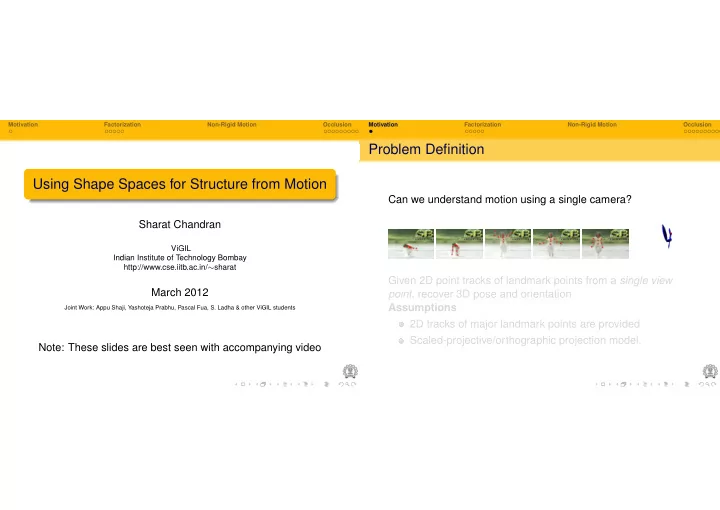
Problem Definition Using Shape Spaces for Structure from Motion Can - - PowerPoint PPT Presentation

problem definition using shape spaces for structure from
SMART_READER_LITE
LIVE PREVIEW

Problem Definition Using Shape Spaces for Structure from Motion Can - - PowerPoint PPT Presentation

Motivation Factorization Non-Rigid Motion Occlusion Motivation Factorization Non-Rigid Motion Occlusion Problem Definition Using Shape Spaces for Structure from Motion Can we understand motion using a single camera? Sharat Chandran ViGIL


slide-1
SLIDE 1

Motivation Factorization Non-Rigid Motion Occlusion

Using Shape Spaces for Structure from Motion

Sharat Chandran

ViGIL Indian Institute of Technology Bombay http://www.cse.iitb.ac.in/∼sharat

March 2012

Joint Work: Appu Shaji, Yashoteja Prabhu, Pascal Fua, S. Ladha & other ViGIL students

Note: These slides are best seen with accompanying video

Motivation Factorization Non-Rigid Motion Occlusion

Problem Definition

Can we understand motion using a single camera? Given 2D point tracks of landmark points from a single view point, recover 3D pose and orientation Assumptions 2D tracks of major landmark points are provided Scaled-projective/orthographic projection model.

slide-2
SLIDE 2

Motivation Factorization Non-Rigid Motion Occlusion

Problem Definition

Can we understand motion using a single camera? Given 2D point tracks of landmark points from a single view point, recover 3D pose and orientation Assumptions 2D tracks of major landmark points are provided Scaled-projective/orthographic projection model.

Motivation Factorization Non-Rigid Motion Occlusion

Problem Definition

Can we understand motion using a single camera? Given 2D point tracks of landmark points from a single view point, recover 3D pose and orientation Assumptions 2D tracks of major landmark points are provided Scaled-projective/orthographic projection model.

slide-3
SLIDE 3

Motivation Factorization Non-Rigid Motion Occlusion

Rigid Body Geometry and Motion

Object centroid based World Co-ordinate System (WCS)

Motivation Factorization Non-Rigid Motion Occlusion

Rank Theorem

Define ˜ xij = xij − ¯ xi and ˜ yij = yij − ¯ yi where the bar notation refers to the centroid of the points in the ith frame. We have the measurement matrix ¯ W2F×P =        ˜ x11 · · · ˜ x1p y11 · · · y1p . . . . . . . . . ˜ xf1 · · · ˜ xfp yf1 · · · yfp        The matrix ¯ W has rank 3

slide-4
SLIDE 4

Motivation Factorization Non-Rigid Motion Occlusion

Rank Theorem

Define ˜ xij = xij − ¯ xi and ˜ yij = yij − ¯ yi where the bar notation refers to the centroid of the points in the ith frame. We have the measurement matrix ¯ W2F×P =        ˜ x11 · · · ˜ x1p y11 · · · y1p . . . . . . . . . ˜ xf1 · · · ˜ xfp yf1 · · · yfp        The matrix ¯ W has rank 3

Motivation Factorization Non-Rigid Motion Occlusion

Rank Theorem Proof

xij = iT

i (Pj − Ti),

yij = jT

i (Pj − Ti),

1 n

n

  • j=1

Pj = 0 ˜ xij = iT

i (Pj − Ti) − 1

n

n

  • m=1

iT

i (Pm − Ti)

˜ yij = jT

i (Pj − Ti) − 1

n

n

  • m=1

jT

i (Pm − Ti)

˜ xij = iT

i Pj

˜ yij = jT

i Pj

¯ W = RS R =       iT

1

jT

1

. . . iT

N

jT

N

      S =

  • P1

P2 . . . PN

slide-5
SLIDE 5

Motivation Factorization Non-Rigid Motion Occlusion

Rigid Body Geometry and Motion

Without noise W is atmost of rank three Using SVD, W = O1ΣO2 where, O1, O2 are column orthogonal matrices and Σ is a diagonal matrix with singular values in non-decreasing order O1ΣO2 = O

′O ′

2 + O

′′

′′O ′′

2 where,

O

1 has first three columns of O1, O

2 has first three rows of

O2 and Σ

′ is 3×3 matrix with 3 largest non-singular values.

The second term is completely due to noise and can be eliminated ˆ R = O

1

  • Σ

′1/2

and ˆ S =

  • Σ

′1/2

O

2

Motivation Factorization Non-Rigid Motion Occlusion

Rigid Body Geometry and Motion

Without noise W is atmost of rank three Using SVD, W = O1ΣO2 where, O1, O2 are column orthogonal matrices and Σ is a diagonal matrix with singular values in non-decreasing order O1ΣO2 = O

′O ′

2 + O

′′

′′O ′′

2 where,

O

1 has first three columns of O1, O

2 has first three rows of

O2 and Σ

′ is 3×3 matrix with 3 largest non-singular values.

The second term is completely due to noise and can be eliminated ˆ R = O

1

  • Σ

′1/2

and ˆ S =

  • Σ

′1/2

O

2

slide-6
SLIDE 6

Motivation Factorization Non-Rigid Motion Occlusion

Rigid Body Geometry and Motion

Without noise W is atmost of rank three Using SVD, W = O1ΣO2 where, O1, O2 are column orthogonal matrices and Σ is a diagonal matrix with singular values in non-decreasing order O1ΣO2 = O

′O ′

2 + O

′′

′′O ′′

2 where,

O

1 has first three columns of O1, O

2 has first three rows of

O2 and Σ

′ is 3×3 matrix with 3 largest non-singular values.

The second term is completely due to noise and can be eliminated ˆ R = O

1

  • Σ

′1/2

and ˆ S =

  • Σ

′1/2

O

2

Motivation Factorization Non-Rigid Motion Occlusion

Rigid Body Geometry and Motion

Without noise W is atmost of rank three Using SVD, W = O1ΣO2 where, O1, O2 are column orthogonal matrices and Σ is a diagonal matrix with singular values in non-decreasing order O1ΣO2 = O

′O ′

2 + O

′′

′′O ′′

2 where,

O

1 has first three columns of O1, O

2 has first three rows of

O2 and Σ

′ is 3×3 matrix with 3 largest non-singular values.

The second term is completely due to noise and can be eliminated ˆ R = O

1

  • Σ

′1/2

and ˆ S =

  • Σ

′1/2

O

2

slide-7
SLIDE 7

Motivation Factorization Non-Rigid Motion Occlusion

Rigid Body Geometry and Motion

Without noise W is atmost of rank three Using SVD, W = O1ΣO2 where, O1, O2 are column orthogonal matrices and Σ is a diagonal matrix with singular values in non-decreasing order O1ΣO2 = O

′O ′

2 + O

′′

′′O ′′

2 where,

O

1 has first three columns of O1, O

2 has first three rows of

O2 and Σ

′ is 3×3 matrix with 3 largest non-singular values.

The second term is completely due to noise and can be eliminated ˆ R = O

1

  • Σ

′1/2

and ˆ S =

  • Σ

′1/2

O

2

Motivation Factorization Non-Rigid Motion Occlusion

Rigid Body Geometry and Motion

Solution is not unique any invertible 3 × 3, Q matrix can be written as R = (ˆ RQ) and S = (Q−1ˆ S) ˆ R is a linear transformation of R, similarly ˆ S is a linear transformation of S. Using the following orthonormality constraints we can find R and S ˆ iT

f QQTˆ

if = 1 ˆ jT

f QQTˆ

jf = 1 ˆ iT

f QQTˆ

jf = 0 (1)

slide-8
SLIDE 8

Motivation Factorization Non-Rigid Motion Occlusion

Rigid Body Geometry and Motion

Solution is not unique any invertible 3 × 3, Q matrix can be written as R = (ˆ RQ) and S = (Q−1ˆ S) ˆ R is a linear transformation of R, similarly ˆ S is a linear transformation of S. Using the following orthonormality constraints we can find R and S ˆ iT

f QQTˆ

if = 1 ˆ jT

f QQTˆ

jf = 1 ˆ iT

f QQTˆ

jf = 0 (1)

Tomasi Kanade Factorisation (Recap)

. . .

slide-9
SLIDE 9

Tomasi Kanade Factorisation (Recap)

. . .

              27 61 · · · 96 97 53 · · · 122 28 62 · · · 97 97 53 · · · 122 . . . . . . . . . . . . . . . . . . . . . . . . 94 ? · · · 131 109 ? · · · 135              

W

Tomasi Kanade Factorisation (Recap)

. . .

              27 61 · · · 96 97 53 · · · 122 28 62 · · · 97 97 53 · · · 122 . . . . . . . . . . . . . . . . . . . . . . . . 94 ? · · · 131 109 ? · · · 135              

W

slide-10
SLIDE 10

Tomasi Kanade Factorisation (Recap)

. . .

              27 61 · · · 96 97 53 · · · 122 28 62 · · · 97 97 53 · · · 122 . . . . . . . . . . . . . . . . . . . . . . . . 94 ? · · · 131 109 ? · · · 135              

W

Tomasi Kanade Factorisation (Recap)

. . .

              27 61 · · · 96 97 53 · · · 122 28 62 · · · 97 97 53 · · · 122 . . . . . . . . . . . . . . . . . . . . . . . . 94 ? · · · 131 109 ? · · · 135              

W

slide-11
SLIDE 11

Tomasi Kanade Factorisation (Recap)

. . .

              27 61 · · · 96 97 53 · · · 122 28 62 · · · 97 97 53 · · · 122 . . . . . . . . . . . . . . . . . . . . . . . . 94 ? · · · 131 109 ? · · · 135              

W

Tomasi Kanade Factorisation (Recap)

. . .

              27 61 · · · 96 97 53 · · · 122 28 62 · · · 97 97 53 · · · 122 . . . . . . . . . . . . . . . . . . . . . . . . 94 ? · · · 131 109 ? · · · 135              

W

slide-12
SLIDE 12

Tomasi Kanade Factorisation (Recap)

. . .

              27 61 · · · 96 97 53 · · · 122 28 62 · · · 97 97 53 · · · 122 . . . . . . . . . . . . . . . . . . . . . . . . 94 ? · · · 131 109 ? · · · 135              

Central Observation: This matrix is rank-limited. If the object motion is rigid the observation matrix (discounting noise) will have a maximum rank of 4

W

Tomasi Kanade Factorisation (Recap)

. . .

              27 61 · · · 96 97 53 · · · 122 28 62 · · · 97 97 53 · · · 122 . . . . . . . . . . . . . . . . . . . . . . . . 94 ? · · · 131 109 ? · · · 135              

=

Shape

Central Observation: This matrix is rank-limited. If the object motion is rigid the observation matrix (discounting noise) will have a maximum rank of 4

R1 R2 RN

. . .

R S W

slide-13
SLIDE 13

Tomasi Kanade Factorisation (Recap)

. . .

              27 61 · · · 96 97 53 · · · 122 28 62 · · · 97 97 53 · · · 122 . . . . . . . . . . . . . . . . . . . . . . . . 94 ? · · · 131 109 ? · · · 135              

=

Shape

Central Observation: This matrix is rank-limited. If the object motion is rigid the observation matrix (discounting noise) will have a maximum rank of 4

Orthographic Camera Model Single Object in FOV of camera Object undergoes rigid motion All the points are visible throughout the sequence Assumptions

R1 R2 RN

. . .

R S W

Tomasi Kanade Factorisation (Recap)

. . .

              27 61 · · · 96 97 53 · · · 122 28 62 · · · 97 97 53 · · · 122 . . . . . . . . . . . . . . . . . . . . . . . . 94 ? · · · 131 109 ? · · · 135              

=

Shape

Central Observation: This matrix is rank-limited. If the object motion is rigid the observation matrix (discounting noise) will have a maximum rank of 4

Orthographic Camera Model Single Object in FOV of camera Object undergoes rigid motion All the points are visible throughout the sequence Assumptions

R1 R2 RN

. . .

R S W

slide-14
SLIDE 14

Motivation Factorization Non-Rigid Motion Occlusion

Non-Rigid Motion

Many objects are non-rigid The parametrisation S3×P is no longer valid. However, deformable bodies (like human body, face) can be represented using a linear combination of basis shapes Smorph =

K

  • i=1

ciSi Smorph, Si ∈ R3×P, ci ∈ R where Si’s are the bases, and ci are the deformation weights.

Motivation Factorization Non-Rigid Motion Occlusion

Non-Rigid Motion

Many objects are non-rigid The parametrisation S3×P is no longer valid. However, deformable bodies (like human body, face) can be represented using a linear combination of basis shapes Smorph =

K

  • i=1

ciSi Smorph, Si ∈ R3×P, ci ∈ R where Si’s are the bases, and ci are the deformation weights.

slide-15
SLIDE 15

Morphable Models

Smorph =

K

X

i=1

ciSi Smorph, Si ∈ R3×P, ci ∈ R

+ + =

  • R

One popular generalisation (used for human faces): linear combination of shapes

Motivation Factorization Non-Rigid Motion Occlusion

Non-Rigid Framework

Assume that there are K shape bases {Bi | i = 1, ..., K} The 3D coordinate of point p on frame f is given as, Xfp = (x, y, z)T

fp = K

  • i=1

cfibip f = 1, ..., F, p = 1, ...N (2) Image coordinate of Xfp under weak perspective projection model is, xfp = (u, v)T

fp = sf(Rf · Xfp + tf)

(3) xfp =

  • cf1Rf

. . . cfKRf

  • ·

   b1p . . . bKp    + tf (4)

slide-16
SLIDE 16

Motivation Factorization Non-Rigid Motion Occlusion

The Specific Problem

!"#$%&'()$*$+,$-./0 !1#$%&'()$*$2344./5367.68./$39$:.";<4.$'3=6;/

Input/Output:

1

A 3D mesh structure of a deformable object;

2

Location of feature points in a video sequence

3

Recover the object 3D shape for all frames.

Motivation Factorization Non-Rigid Motion Occlusion

The Specific Problem

!"#$%&'()$*$+,$-./0 !1#$%&'()$*$2344./5367.68./$39$:.";<4.$'3=6;/

Input/Output:

1

A 3D mesh structure of a deformable object;

2

Location of feature points in a video sequence

3

Recover the object 3D shape for all frames.

slide-17
SLIDE 17

Motivation Factorization Non-Rigid Motion Occlusion

However ...

Feature points may be partially missing due to occlusions, specular effects, etc. . . . Reconstruction under occlusions is very troublesome[6] and state-of-the-art algorithms are inadequate.

Motivation Factorization Non-Rigid Motion Occlusion

However ...

Feature points may be partially missing due to occlusions, specular effects, etc. . . . Reconstruction under occlusions is very troublesome[6] and state-of-the-art algorithms are inadequate.

slide-18
SLIDE 18

Motivation Factorization Non-Rigid Motion Occlusion

Intuition and Idea

Intuition It should be possible to solve for the missing region in a specific frame, based on the data available in the current, previous and subsequent frames. Idea We assume that the surface is inelastic and deformations should preserve the length of every edge in the mesh. We want to find a shape that is consistent with temporal constraints, the deformation model, and one that minimizes the reprojection error. This is formulated as an optimization problem on the Riemannian Shape Space.

Motivation Factorization Non-Rigid Motion Occlusion

Intuition and Idea

Intuition It should be possible to solve for the missing region in a specific frame, based on the data available in the current, previous and subsequent frames. Idea We assume that the surface is inelastic and deformations should preserve the length of every edge in the mesh. We want to find a shape that is consistent with temporal constraints, the deformation model, and one that minimizes the reprojection error. This is formulated as an optimization problem on the Riemannian Shape Space.

slide-19
SLIDE 19

Motivation Factorization Non-Rigid Motion Occlusion

Shape Spaces

Every point on this space is a 3D mesh. A time varying curve in this space corresponds to a deforming shape. Technicality: The local distance between two neighbouring points is given by the difference in edge lengths of the two meshes.

Motivation Factorization Non-Rigid Motion Occlusion

Shape Spaces

Every point on this space is a 3D mesh. A time varying curve in this space corresponds to a deforming shape. Technicality: The local distance between two neighbouring points is given by the difference in edge lengths of the two meshes.

slide-20
SLIDE 20

Motivation Factorization Non-Rigid Motion Occlusion

Riemannian Metric

Sp Sq Vq Vp

∀ Edge (p, q) ∈ Mesh, Sp − Sq2 = const (5) ∀ Edge (p, q) ∈ Mesh, Vp − Vq, Sp − Sq = 0 (6) where Sp and Sq are the 3D positions and Vp and Vq are the velocities of vertices p and q respectively. VIso =

  • (p,q)∈Mesh

Vp − Vq, Sp − Sq A vanishing norm indicates an isometric deformation.

Motivation Factorization Non-Rigid Motion Occlusion

Riemannian Metric

Sp Sq Vq Vp

∀ Edge (p, q) ∈ Mesh, Sp − Sq2 = const (5) ∀ Edge (p, q) ∈ Mesh, Vp − Vq, Sp − Sq = 0 (6) where Sp and Sq are the 3D positions and Vp and Vq are the velocities of vertices p and q respectively. VIso =

  • (p,q)∈Mesh

Vp − Vq, Sp − Sq A vanishing norm indicates an isometric deformation.

slide-21
SLIDE 21

Motivation Factorization Non-Rigid Motion Occlusion

Introducing Vision: Reprojection Error

The 3D coordinates Fj

i of a feature point j in frame i are

given by: Fj

i = ajSj1 i + bjSj2 i + cjSj3 i

(7) where aj, bj, cj are the barycentric coordinates of point j in triangle formed by vertices Sj1

i , Sj2 i , and Sj3 i .

We have: fj

i = 1 wj

i

.C.Fj

i, with fj i the 2D location of feature

point j, and C the perspective projection matrix. We can rewrite this equation using Eq. (7) as: mj

i.Si = 0

By stacking such equation for all feature points, we get the linear system: Mi.Si = 0 Therefore, the desired shape Si belongs to the null space

  • f Mi.

Motivation Factorization Non-Rigid Motion Occlusion

Introducing Vision: Reprojection Error

The 3D coordinates Fj

i of a feature point j in frame i are

given by: Fj

i = ajSj1 i + bjSj2 i + cjSj3 i

(7) where aj, bj, cj are the barycentric coordinates of point j in triangle formed by vertices Sj1

i , Sj2 i , and Sj3 i .

We have: fj

i = 1 wj

i

.C.Fj

i, with fj i the 2D location of feature

point j, and C the perspective projection matrix. We can rewrite this equation using Eq. (7) as: mj

i.Si = 0

By stacking such equation for all feature points, we get the linear system: Mi.Si = 0 Therefore, the desired shape Si belongs to the null space

  • f Mi.
slide-22
SLIDE 22

Motivation Factorization Non-Rigid Motion Occlusion

Introducing Vision: Reprojection Error

The 3D coordinates Fj

i of a feature point j in frame i are

given by: Fj

i = ajSj1 i + bjSj2 i + cjSj3 i

(7) where aj, bj, cj are the barycentric coordinates of point j in triangle formed by vertices Sj1

i , Sj2 i , and Sj3 i .

We have: fj

i = 1 wj

i

.C.Fj

i, with fj i the 2D location of feature

point j, and C the perspective projection matrix. We can rewrite this equation using Eq. (7) as: mj

i.Si = 0

By stacking such equation for all feature points, we get the linear system: Mi.Si = 0 Therefore, the desired shape Si belongs to the null space

  • f Mi.

Motivation Factorization Non-Rigid Motion Occlusion

Formulation

The goal is to fit a curve {Si} in the shape space for the input video sequence. The curve should be a geodesic curve to respect the edge length constraint; The points on curve should belong to the null space of the Mi matrices.

slide-23
SLIDE 23

Motivation Factorization Non-Rigid Motion Occlusion

Computer Vision Approach: Energies

Deformation Error: ED measures the non-isometricity in a deformation sequence. EDeform =

F

  • i=1
  • (Sp,Sq)∈Mesh

< ˙ Sp − ˙ Sq, Sp − Sq >2 Reprojection Error: EReproj =

F

  • j=1

MiSi2

2

Optional Temporal Smoothness Error: ETemporal =

F−2

  • i=1
  • Vj

i∈Vertices

||Vj

i + Vj i+2 − 2Vj i+1||2

Motivation Factorization Non-Rigid Motion Occlusion

Formulation

Cumulative Cost Function We minimize the following non-convex error term: min

s1···sF EDeform + λ1EReproj + λ2ETemporal

Many commercial softwares can be used, e.g., ‘fminunc’ function in matlab. However, due to high dimensionality and non-convex nature of problem, we require a reasonable initialization point for the optimization. Good initialization leads to faster and better convergence.

slide-24
SLIDE 24

Motivation Factorization Non-Rigid Motion Occlusion

Initialization - Stage 1

We first recover the 2D projection of the mesh vertices using weak perspective projection assumption

Motivation Factorization Non-Rigid Motion Occlusion

Initialization - Stage II

By enforcing mesh length constraints, we recover a maximum of 4 possible shapes for every mesh triangle1.

1

  • M. Fischler and R. Bolles. Random Sample Consensus: A Paradigm for

Model Fitting With Applications to Image Analysis and Automated

  • Cartography. Communications ACM, 24(6):381-395, 1981.
slide-25
SLIDE 25

Motivation Factorization Non-Rigid Motion Occlusion

Picking the right triangle

We pick the solution that is the most consistent with its neighbours and minimizes the reprojection error. This can be expressed by the following quadratic program : min

αi,βi,γi,δi,sk,k∈{1···Nv}

λ1.

  • i∈T (Sj)

 

Nv

  • j=1

T ∗

i (Sj) − Sj2

  + λ2.M.S2 subject to : T ∗

i = αiT (1) i

+ βiT (2)

i

+ γiT (3)

i

+ δiT (4)

i

αi + βi + γi + δi = 1, with αi, βi, γi, δi ∈ [0, 1] ∀ i ∈ {1, Nfacets} where T (Sj) is the list of facets to which Vertex Sj can belong. In practice we relax the integer constraints on α, β, γ and δ to a linear one, and change the equality constraint into an inequality

  • ne: αi, βi, γi, δi ≤ 1

Motivation Factorization Non-Rigid Motion Occlusion

Picking the right triangle

We pick the solution that is the most consistent with its neighbours and minimizes the reprojection error. This can be expressed by the following quadratic program : min

αi,βi,γi,δi,sk,k∈{1···Nv}

λ1.

  • i∈T (Sj)

 

Nv

  • j=1

T ∗

i (Sj) − Sj2

  + λ2.M.S2 subject to : T ∗

i = αiT (1) i

+ βiT (2)

i

+ γiT (3)

i

+ δiT (4)

i

αi + βi + γi + δi = 1, with αi, βi, γi, δi ∈ [0, 1] ∀ i ∈ {1, Nfacets} where T (Sj) is the list of facets to which Vertex Sj can belong. In practice we relax the integer constraints on α, β, γ and δ to a linear one, and change the equality constraint into an inequality

  • ne: αi, βi, γi, δi ≤ 1
slide-26
SLIDE 26

Motivation Factorization Non-Rigid Motion Occlusion

Picking the right triangle

We pick the solution that is the most consistent with its neighbours and minimizes the reprojection error. This can be expressed by the following quadratic program : min

αi,βi,γi,δi,sk,k∈{1···Nv}

λ1.

  • i∈T (Sj)

 

Nv

  • j=1

T ∗

i (Sj) − Sj2

  + λ2.M.S2 subject to : T ∗

i = αiT (1) i

+ βiT (2)

i

+ γiT (3)

i

+ δiT (4)

i

αi + βi + γi + δi = 1, with αi, βi, γi, δi ∈ [0, 1] ∀ i ∈ {1, Nfacets} where T (Sj) is the list of facets to which Vertex Sj can belong. In practice we relax the integer constraints on α, β, γ and δ to a linear one, and change the equality constraint into an inequality

  • ne: αi, βi, γi, δi ≤ 1

Motivation Factorization Non-Rigid Motion Occlusion

Picking the right triangle: Example

Set of potential triangles Retrieved (initial) shape

slide-27
SLIDE 27

Motivation Factorization Non-Rigid Motion Occlusion

Overall

Motivation Factorization Non-Rigid Motion Occlusion

For Further Reading I

  • G. Golub and A. Loan

Matrix Computations John Hopkins U. Press, 1996

  • C. Tomasi and T. Kanade

Shape and motion from image stream: A factorization method Image of Science: Science of Images, 90:9795–9802,1993

  • J. Xiao and J. Chai and T. Kanade

A Closed-Form Solution to Non-Rigid Shape and Motion Recovery ECCV 2004

slide-28
SLIDE 28

Motivation Factorization Non-Rigid Motion Occlusion

For Further Reading II

  • C. Bregler and A. Hertzmann and H. Biermann

Recovering Non-Rigid 3D Shape from Image Streams CVPR, 2000

  • M. Brand

Morphable 3D Models from Video CVPR, 2001 Appu Shaji and Aydin Varol and Pascal Fua and Yashoteja and Ankush Jain and Sharat Chandran Resolving Occlusion in Multiframe Reconstruction of Deformable Surfaces NORDIA, CVPRW, 2011

  • M. Kilian, N. Mitra and H. Pottmann. Geometric Modeling in

Shape Space. Siggraph, 2008.