Problem 1(a) Suppose car license plates have 3 letters followed by - - PowerPoint PPT Presentation

problem 1 a
SMART_READER_LITE
LIVE PREVIEW

Problem 1(a) Suppose car license plates have 3 letters followed by - - PowerPoint PPT Presentation

Problem 1(a) Suppose car license plates have 3 letters followed by 3 numbers, chosen uniformly at random. What is the probability of getting the license plate, ABC123 ? (1/26)*(1/26)*(1/26)*(1/10)*(1/10)*(1/10) Problem 1(b) Suppose car


slide-1
SLIDE 1

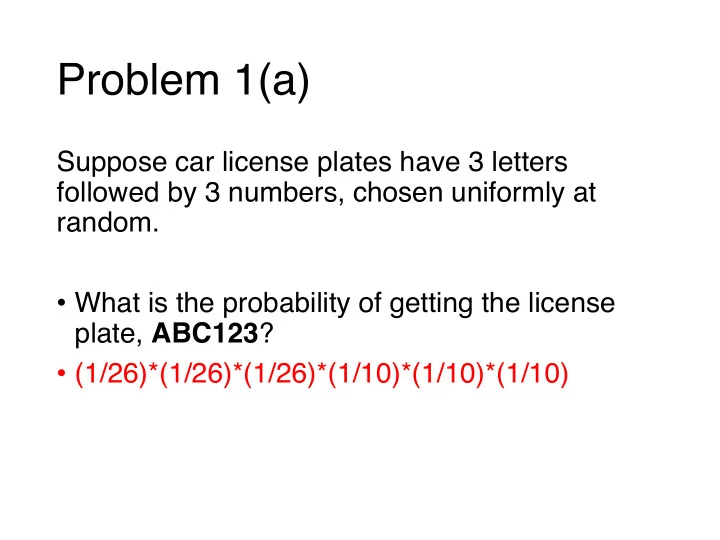
Problem 1(a)

Suppose car license plates have 3 letters followed by 3 numbers, chosen uniformly at random.

  • What is the probability of getting the license

plate, ABC123?

  • (1/26)*(1/26)*(1/26)*(1/10)*(1/10)*(1/10)
slide-2
SLIDE 2

Problem 1(b)

Suppose car license plates have 3 letters followed by 3 numbers, chosen uniformly at random.

  • What is the probability that the first letter is A?
  • 1/26
slide-3
SLIDE 3

Problem 1(c)

Suppose car license plates have 3 letters followed by 3 numbers, chosen uniformly at random.

  • What is the probability that the third letter is A?
  • 1/26
slide-4
SLIDE 4

Problem 1(d)

Suppose car license plates have 3 letters followed by 3 numbers, chosen uniformly at random.

  • What is the probability that the last two digits

are 35?

  • (1/10)*(1/10)
slide-5
SLIDE 5

Problem 1(e)

Suppose car license plates have 3 letters followed by 3 numbers, chosen uniformly at random.

  • What is the probability that the license plate

does not start with an A?

  • 1 – 1/26 = 25/26
slide-6
SLIDE 6

Problem 1(f)

Suppose car license plates have 3 letters followed by 3 numbers, chosen uniformly at random.

  • What is the probability that the license plate

does not contain an A?

  • (25/26)*(25/26)*(25/26)
  • P(1st letter ≠ A AND 2nd letter ≠ A AND

3rd letter ≠ A)

slide-7
SLIDE 7

Problem 1(g)

Suppose car license plates have 3 letters followed by 3 numbers, chosen uniformly at random.

  • What is the probability that the first letter is A or

the second letter is A?

  • 1/26 + 1/26 – (1/26)2
  • P(1st letter = A OR 2nd letter = A) =

P(1st letter = A) + P(2nd letter = A) – P(1st letter = A AND 2nd letter = A)

slide-8
SLIDE 8

Problem 1(h)

Suppose car license plates have 3 letters followed by 3 numbers, chosen uniformly at random.

  • What is the probability that the license plate

contains an A?

  • 1/26 + 1/26 + 1/26 – 3*(1/26)2 + (1/26)3
  • P(1st = A OR 2nd = A OR 3rd = A)

= P(1st = A) + P(2nd = A) + P(3rd= A) – P(1st=A AND 2nd=A) – P(1st=A AND 3rd=A) – P(2nd=A AND 3rd=A) + P(1st = A AND 2nd = A AND 3rd = A)

slide-9
SLIDE 9

Problem 2(a)

Suppose car license plates have 3 letters followed by 3 numbers. The letter Z is not used and the number 0 is not used. The letter A is twice as likely as all other letters, and the number 0 is twice as likely as all other numbers.

  • What is the probability of getting the license

plate, ABC123?

  • (2/26)*(1/26)*(1/26)*(2/10)*(1/10)*(1/10)
slide-10
SLIDE 10

Problem 2(b)

Suppose car license plates have 3 letters followed by 3 numbers. The letter Z is not used and the number 0 is not used. The letter A is twice as likely as all other letters, and the number 1 is twice as likely as all other numbers.

  • What is the probability of getting the license

plate, XYZ123?

slide-11
SLIDE 11

Problem 3(a)

A student must choose exactly two out of three electives: art, French, and mathematics. They choose art with probability 5/8, French with probability 5/8, and art and French together with probability 1/4.

  • What is the probability that they choose

mathematics?

  • P(NOT (Art AND French)) = 1 – 1/4
  • = 3/4
slide-12
SLIDE 12

Problem 3(b)

A student must choose exactly two out of three electives: art, French, and mathematics. They choose art with probability 5/8, French with probability 5/8, and art and French together with probability 1/4.

  • What is the probability that they choose either

art or French?

  • P(Art OR French)

= P(Art) + P(French) – P(Art AND French) = 5/8 + 5/8 – 1/4 = 1

slide-13
SLIDE 13

Problem 4

A local club plans to invest $10000 to host a baseball game. They expect to sell tickets worth $15000. But if it rains on the day of game, they won't sell any tickets and the club will lose all the money invested.

  • What is the expected value of the profit if there

is a 20% chance of rain?

  • 5000*0.8 – 10000*0.2 = $2000
slide-14
SLIDE 14

Problem 5

The probability of owning a dog is 0.44. The probability of owning a cat is 0.29. The probability of owning both is 0.17.

  • Is owning a cat independent from owning a

dog?

  • No.
  • 0.44*0.29 = 0.128
  • P(dog AND cat) ≠ P(dog)*P(cat)