Probing the Higgs Potential with di-Higgs Production Measuring the - - PowerPoint PPT Presentation

probing the higgs potential with di higgs production
SMART_READER_LITE
LIVE PREVIEW

Probing the Higgs Potential with di-Higgs Production Measuring the - - PowerPoint PPT Presentation

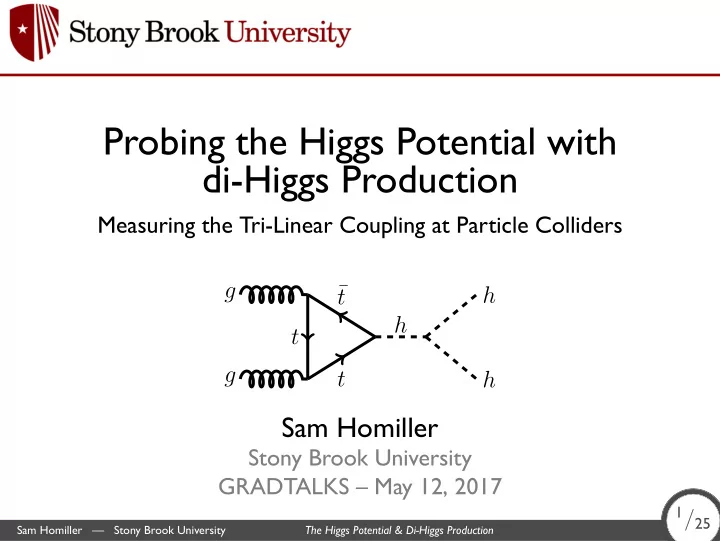
Probing the Higgs Potential with di-Higgs Production Measuring the Tri-Linear Coupling at Particle Colliders g h t h t g t h Sam Homiller Stony Brook University GRADTALKS May 12, 2017 1 / 25 Sam Homiller Stony Brook


slide-1
SLIDE 1

Probing the Higgs Potential with di-Higgs Production

Measuring the Tri-Linear Coupling at Particle Colliders t g g t ¯ t h h h

Sam Homiller

Stony Brook University GRADTALKS – May 12, 2017

Sam Homiller — Stony Brook University The Higgs Potential & Di-Higgs Production 1/25

1/25

slide-2
SLIDE 2

Outline

  • The Standard Model Higgs.

The Standard Model, the Higgs potential, spontaneous symmetry breaking, and Higgs interactions.

  • The Electroweak Phase Transition.

The finite temperature Higgs potential, behavior of the phase transition, and implications for baryogenesis.

  • Measuring di-Higgs production at colliders.

Higgs decays and detection, LHC phenomenology, and prospects at colliders

Sam Homiller — Stony Brook University The Higgs Potential & Di-Higgs Production 2/25

2/25

slide-3
SLIDE 3

The Standard Model

Sam Homiller — Stony Brook University The Higgs Potential & Di-Higgs Production 3/25

3/25

slide-4
SLIDE 4

The Standard Electroweak Theory

The Standard Model is a Gauge Theory GSM = SU(3)c × SU(2)L × U(1)Y Describes electroweak interactions (e.g., β decay!) d u W − e ¯ νe e e Z νe νe But W ±, Z boson masses are forbidden by gauge symmetry... = ⇒ spontaneous symmetry breaking!

Sam Homiller — Stony Brook University The Higgs Potential & Di-Higgs Production 4/25

4/25

slide-5
SLIDE 5

The Higgs Potential

Mexican Hats!

In the Standard Model, the Higgs potential takes a simple form: V (ϕ) = −µ2ϕ†ϕ + λ(ϕ†ϕ)2 where ϕ(x) =

(

w+

1 √ 2 (v + h + iw0)

)

and v =

µ2/2λ.

quantum-bits.org

Sam Homiller — Stony Brook University The Higgs Potential & Di-Higgs Production 5/25

5/25

slide-6
SLIDE 6

Higgs Potential in “Unitary Gauge”

In unitary gauge, w±, w0 become the longitudinal polarizations of W ±, Z. ϕ(x) = 1 √ 2

(

v + h(x)

)

The Higgs potential becomes: V (h) = −1 2m2

hh2 − λ

2mhh3 − 1 4λh4 where mh = √ 2µ = √ 2λv.

Note:

There are only two free parameters: mh = 125 GeV and v = 246 ∼ GeV, both have been measured!

Sam Homiller — Stony Brook University The Higgs Potential & Di-Higgs Production 6/25

6/25

slide-7
SLIDE 7

Higgs Interactions

What’s the Big Deal with Scalars?

The Higgs is the only particle with self-interactions: Vint(h) = λ3 3! h3 + λ4 4! h4 where in the SM, λ3 = 3m2

h/v,

λ4 = 3m2

h/v2.

λ3 λ4

Sam Homiller — Stony Brook University The Higgs Potential & Di-Higgs Production 7/25

7/25

slide-8
SLIDE 8

The Higgs and Cosmology

ctc.cam.ac.uk CMB Measurements (Planck, etc.) T ∼ 1 eV Light Element Abundances (He fraction, etc.) T ∼ 1 MeV EWPT (Particle Colliders!) T ∼ 100 GeV

Sam Homiller — Stony Brook University The Higgs Potential & Di-Higgs Production 8/25

8/25

slide-9
SLIDE 9

The Electroweak Phase Transition

In the early universe interactions with the plasma give the Higgs an effective potential: Veff(h, T) ≊ 1 2c(T 2 − T 2

c )h2 − eT

12π

(

h2)3/2 + λ 4h4 Note that at T > Tc, the mass term is positive: SU(2)L × U(1)Y is unbroken. We therefore expect a phase transition at high temperatures in the early universe.

Sam Homiller — Stony Brook University The Higgs Potential & Di-Higgs Production 9/25

9/25

slide-10
SLIDE 10

The Electroweak Phase Transition

The phase transition can be second order (driven by thermal fluctuations) or first order (starts with tunneling).

second order first order

The barrier between phases is created by other particles coupled to the Higgs!

Credit: A. Banerjee

Sam Homiller — Stony Brook University The Higgs Potential & Di-Higgs Production 10/25

10/25

slide-11
SLIDE 11

Baryogenesis at the Electroweak Phase Transition

For a strong first order transition tunneling nucleates bubbles that expand faster than the Hubble rate. Processes at the bubble wall can lead to CP and Baryon number violation – potentially the source of the baryon asymmetry!

arXiv:0205279

Sam Homiller — Stony Brook University The Higgs Potential & Di-Higgs Production 11/25

11/25

slide-12
SLIDE 12

Probing Baryogenesis via the Higgs Potential

The strength of the transition is determined by the shape of the potential, with the order parameter given by ∼ h3 term v(Tc) Tc ≊ (e/4π) λ Fixed to SM value which is large enough only for mh ≲ 48 GeV. To get a strong first order EWPT, we need additional contributions to the Higgs potential – these can be explored via colliders!

Sam Homiller — Stony Brook University The Higgs Potential & Di-Higgs Production 12/25

12/25

slide-13
SLIDE 13

Probing the Higgs Potential

The Trillion Dollar Argument

Clearly we need to understand the Higgs potential beyond the mass term. The only way to do this is to look for Higgs couplings to itself = ⇒ di-Higgs Production!

We could also look for h → hhh, but this is much harder.

How do we look for di-Higgs production at colliders?

Sam Homiller — Stony Brook University The Higgs Potential & Di-Higgs Production 13/25

13/25

slide-14
SLIDE 14

Di-Higgs Production

The λ3 vertex contributes to di-Higgs production: t g g t ¯ t h h h There’s also an interference term: t g g t t t h h

Sam Homiller — Stony Brook University The Higgs Potential & Di-Higgs Production 14/25

14/25

slide-15
SLIDE 15

Higgs Decay Modes

Higgs couples to particles proportional to their mass. Final State Branching Ratio b¯ b 0.58 W +W − 0.215 gg 0.09 τ +τ − 0.06 ZZ 0.026 γγ 0.00228

Table: Branching ratios of various decay modes for a 125 GeV Higgs boson.

Sam Homiller — Stony Brook University The Higgs Potential & Di-Higgs Production 15/25

15/25

slide-16
SLIDE 16

Higgs Decay Modes

Loop induced couplings (H → gg, H → γγ) are also important. Diphoton channel has incredibly tiny branching ratio – 0.228% of decays! But photon mass resolution is extremely good – the diphoton channel was essential to the original Higgs discovery. h γ γ h γ γ h γ γ

Sam Homiller — Stony Brook University The Higgs Potential & Di-Higgs Production 16/25

16/25

slide-17
SLIDE 17

Some LHC Phenomenology

(A Theorist’s Understanding) atlasexperiment.org Muon Spectrometer Hadronic Calorimeter (Jets, etc.) Electronic Calorimeter (Photons & Electrons) Tracker (Four-Momenta via Magnets) Pixel Detector (Interaction Pts., Vertices)

Sam Homiller — Stony Brook University The Higgs Potential & Di-Higgs Production 17/25

17/25

slide-18
SLIDE 18

B-Tagging

Making Sense of QCD Madness Credit: Nazar Bartosik

b / ¯ b quarks form B-mesons, which have lifetimes ∼ 10−12 s

Travel a few millimeters before decaying!

Tagging efficiency roughly 75%, changes with pT and η.

c-jets and light jets can sometimes be mis-tagged!

Sam Homiller — Stony Brook University The Higgs Potential & Di-Higgs Production 18/25

18/25

slide-19
SLIDE 19

How do we search for two Higgs?

If One Wasn’t Hard Enough

Two Higgs bosons have a variety of possible decay combinations:

  • hh → b¯

bb¯ b

Dominant decay mode – 1/3 of events! Poor mass resolution – difficult to distinguish from ZZ

  • hh → γγγγ

Great mass resolution. BR ∼ 8 × 10⁻⁶! Not even one will be produced at the LHC.

hh → b¯ bγγ

Best combination of mass resolution and large branching ratio! The “golden channel”.

Other Possibilities: hh → (b¯ b)(ZZ∗) → (b¯ b)(ℓ+ℓ−ℓ+ℓ−), hh → (b¯ b)(µ+µ−) hh → (b¯ b)(τ +τ −/W +W −), hh → (b¯ b)(Zγ)

Sam Homiller — Stony Brook University The Higgs Potential & Di-Higgs Production 19/25

19/25

slide-20
SLIDE 20

Search Strategy

Backgrounds

Now that we’ve chosen a decay channel, have to tabulate backgrounds. What other processes lead to b¯ bγγ?

bγγ

  • Z(→ b¯

b) + H(→ γγ)

b + H(→ γγ)

t(→ b¯ b + X) + H(→ γγ)

Note:

Ordinary single Higgs production is now a background! Also other backgrounds from mistagging jets as b-jets, jets faking photons...

g g h ¯ b b

Sam Homiller — Stony Brook University The Higgs Potential & Di-Higgs Production 20/25

20/25

slide-21
SLIDE 21

Search Strategy

Cut and Count..

Now that we’ve identified all the backgrounds, we have to play a game of statistics. Come up with a set of cuts: which events do we want to count? Once you’ve chosen cuts, count number of signal events you expect (S) and number of backgrounds (B).

The “significance” is then σ = S/ √ S + B

Goal: Come up with set of cuts that optimizes signal / background.

Sam Homiller — Stony Brook University The Higgs Potential & Di-Higgs Production 21/25

21/25

slide-22
SLIDE 22

Simulations!

All the ROOT Plots

(GeV/c^2)

γ γ

M 50 100 150 200 250 0.1 0.2 0.3 0.4 0.5 ) γ γ )h( b h(b ) γ γ h( t t ) γ γ h( b b γ γ b b (GeV/c^2)

b b

M 50 100 150 200 250 0.02 0.04 0.06 0.08 0.1 0.12 0.14 0.16 0.18 ) γ γ )h( b h(b ) γ γ h( t t ) γ γ h( b b γ γ b b (GeV/c)

T

Jet Pair P 50 100 150 200 250 300 350 400 450 500 0.01 0.02 0.03 0.04 0.05 0.06 0.07 ) γ γ )h( b h(b ) γ γ h( t t ) γ γ h( b b γ γ b b

H

θ cos 1 − 0.8 − 0.6 − 0.4 − 0.2 − 0.2 0.4 0.6 0.8 1 0.01 0.02 0.03 0.04 0.05 0.06 0.07 0.08 ) γ γ )h( b h(b ) γ γ h( t t ) γ γ h( b b γ γ b b

Sam Homiller — Stony Brook University The Higgs Potential & Di-Higgs Production 22/25

22/25

slide-23
SLIDE 23

Extracting λ3

arXiv:1401.7340

Sam Homiller — Stony Brook University The Higgs Potential & Di-Higgs Production 23/25

23/25

slide-24
SLIDE 24

ATLAS Prospects at the HL-LHC

ATL-PHYS-PUB-2017-001 Expected constraint: −0.8 < λ3/λ3,SM < 7.7

We need a higher energy collider! The FCC-hh is projected to improve this to 0.95 ≲ λ3/λ3,SM ≲ 1.05.

Sam Homiller — Stony Brook University The Higgs Potential & Di-Higgs Production 24/25

24/25

slide-25
SLIDE 25

Conclusions

  • Measuring the Higgs trilinear coupling is an important probe of

the consistency of the Standard Model.

  • Understanding the Higgs sector gives us insight into the

electroweak phase transition and cosmology at high temperatures.

  • Precision measurements of λ3 can be made by studying

gg → hh → b¯ bγγ at high energy colliders.

Sam Homiller — Stony Brook University The Higgs Potential & Di-Higgs Production 25/25

25/25