Probing 13 With The Daya Bay Antineutrino Detectors Bryce - - PowerPoint PPT Presentation

probing 13 with the daya bay antineutrino detectors
SMART_READER_LITE
LIVE PREVIEW

Probing 13 With The Daya Bay Antineutrino Detectors Bryce - - PowerPoint PPT Presentation

Probing 13 With The Daya Bay Antineutrino Detectors Bryce Littlejohn, on behalf of the Daya Bay Collaboration 5/11/10 May 11, 2010 Littlejohn 1 The Daya Bay Experiment Aims to measure reactor e disappearance: 6 reactor cores,


slide-1
SLIDE 1

Littlejohn May 11, 2010

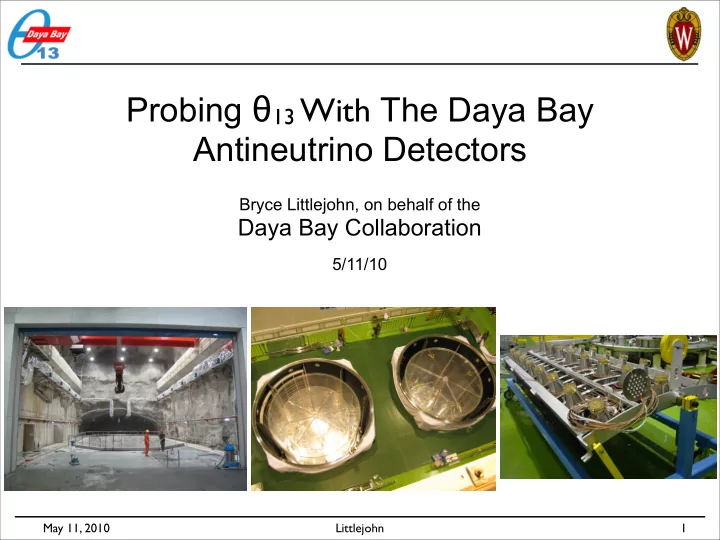
Probing θ13 With The Daya Bay Antineutrino Detectors

Bryce Littlejohn, on behalf of the

Daya Bay Collaboration

5/11/10

1
slide-2
SLIDE 2

Bryce Littlejohn May 11, 2010

The Daya Bay Experiment

2

  • Aims to measure reactor νe disappearance:
  • 6 reactor cores, 3 sites
  • 4 near detectors, 2 sites, ~900 evts/day/det
  • 4 far detectors, 1 site, ~90 evts/day/det
  • Significant overburden
  • RPC, Muon water veto

DYB Site LA Site Far Site Depth (m rock) 98 112 350 Bkg/Sig 0.3% 0.2% 0.2%

slide-3
SLIDE 3

Bryce Littlejohn May 11, 2010

How does Daya Bay probe θ13?

3

  • Detect short-baseline reactor antineutrino disappearance:
  • A “clean” measurement of θ13
slide-4
SLIDE 4

Bryce Littlejohn May 11, 2010

Detection Method

4

  • 0.1% Gd-doped liquid scintillator as an inverse-beta target:

Daya Bay Monte Carlo Data 6MeV Energy Cut

slide-5
SLIDE 5

Bryce Littlejohn May 11, 2010

Daya Bay νe Detectors (ADs)

5

  • 8 ‘identical’ 3-zone detectors:
  • 0.1% Gd-doped LS

LS Mineral Oil

Calibration Box Acrylic Vessels Steel Vessel 192 - 8” PMTs

Target Mass: 20 tons Energy Resolution: 12%/√E Light Yield: ~120 photoelectrons/MeV

Top/Bottom Reflectors

slide-6
SLIDE 6

Bryce Littlejohn May 11, 2010

ADs: Current Status

6

  • First 2 ADs being assembled:
  • SSV, bottom reflector: Installed, surveyed
  • Outer acrylic vessels installed, 1 inner vessel installed
  • PMT ladders being populated, installed late May, June
  • Next few months:
  • Close stainless steel lids: June, July
  • Attach calibration boxes and overflow tanks: June, July
  • Dry-run data taking in July
slide-7
SLIDE 7

Bryce Littlejohn May 11, 2010

AD Liquids: Description and Status

7

GdCl3 TMHA Gd-TMHA

Add LAB Scintillator

0.5% Gd-LAB LAB PPO-MSB-LAB 0.1% Gd-LS

Organic ligand Inorganic salt

Fluor, wavelength-shifter

Prototype GdLS Emission Spectrum Daya Bay LS Hall

slide-8
SLIDE 8

Bryce Littlejohn May 11, 2010

Measurement Method

8

ν ν ν

Distance Lf ~1.5 km

Proton (H) Number Ratio Relative Detection Efficiencies

Sin22θ13

Event Rate Ratio Calibration Mass Measurement

slide-9
SLIDE 9

Bryce Littlejohn May 11, 2010

Detector Systematics

9

  • Daya Bay is a systematics-limited experiment
  • With near-far ratio measurement, detector systematics become dominant:
  • Largest: number of protons and 6MeV energy cut efficiency
  • Working hard to minimize these dominant uncertainties
slide-10
SLIDE 10

Bryce Littlejohn May 11, 2010

filling platform with clean room ISO Gd-LS weighing tank

pump stations

detector

Improving Systematics: # of Protons

10

200-ton Gd-LS reservoir

20-ton ISO tank

Coriolis mass flowmeters < 0.1%

load cell accuracy < 0.02%

filling “pairs” of detectors

  • To beat systematics goal:
  • Redundant mass measurement systems
  • Measure mass to 0.02%: +/- 4 kg out of 20 tons
  • Filling detectors in pairs from a common GdLS reservoir
  • Reduce differences between detector liquids
slide-11
SLIDE 11

Bryce Littlejohn May 11, 2010

Understanding Systematics: Identicalness

11

  • In practice, detectors will not be physically identical
  • Real question: are they identical enough to have similar physics response?
  • Characterize as-built detectors - identify differences
  • Use MC simulation to see if differences affect physics performance

Wavelength (nm) 200 300 400 500 600 Renormalized Transmittance (%) 20 40 60 80 100

Reynolds ACP-10: 18 mm Polycast: 15 mm PoSiang: 15 mm

Variations In Acrylic Vessel Transmittance Variations In acrylic vessel thickness, i.e. non-scintillating (dead) volume

Increasing AV Thickness Displacing LS With Acrylic Block

slide-12
SLIDE 12

Bryce Littlejohn May 11, 2010

Schedule and Sensitivity

12

  • Spring 2011: Near site turn-on
  • Reactor flux studies
  • Comparison of near site detectors and evaluation of systematics
  • Spring 2012: Far site turn-on
  • Should achieve our goal sensitivity of sin22θ13 < 0.01 at 90% CL
slide-13
SLIDE 13

Bryce Littlejohn May 11, 2010

Conclusions

13

  • AD 1,2 assembly is well underway; done by Summer 2010
  • R&D has shown that we can meet or exceed goal systematics
  • Detector construction and filling in pairs
  • Mass Measurement R&D
  • Spring 2011: Data taking at the near hall will start
  • Spring 2012: Full data taking start
  • Can reach sin22θ13 < 0.01
  • Chris White will provide

more details next

  • Questions?
slide-14
SLIDE 14

Bryce Littlejohn March 9, 2009

End

  • Thanks!

14

slide-15
SLIDE 15

Bryce Littlejohn March 9, 2009

Neutrinos: Present Status

15

  • Current limits on θ13 set by:
  • MINOS: accelerator νe appearance
  • CHOOZ: reactor νe disappearance