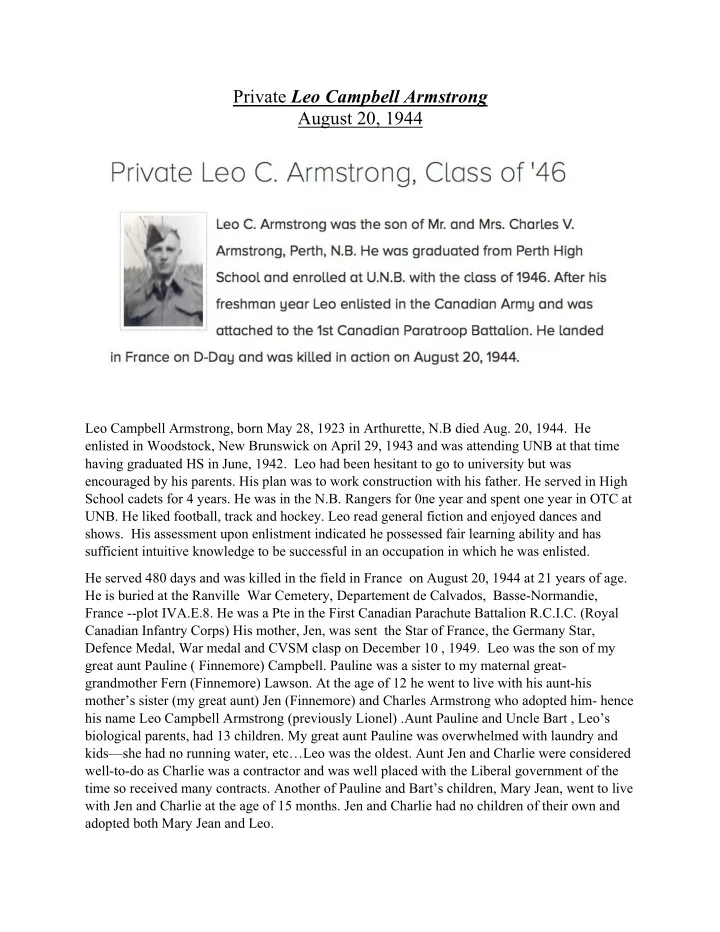
Private Leo Campbell Armstrong August 20, 1944 Leo Campbell - - PDF document

private leo campbell armstrong august 20 1944
SMART_READER_LITE
LIVE PREVIEW

Private Leo Campbell Armstrong August 20, 1944 Leo Campbell - - PDF document

Private Leo Campbell Armstrong August 20, 1944 Leo Campbell Armstrong, born May 28, 1923 in Arthurette, N.B died Aug. 20, 1944. He enlisted in Woodstock, New Brunswick on April 29, 1943 and was attending UNB at that time having graduated HS in


slide-1
SLIDE 1

Private Leo Campbell Armstrong August 20, 1944

Leo Campbell Armstrong, born May 28, 1923 in Arthurette, N.B died Aug. 20, 1944. He enlisted in Woodstock, New Brunswick on April 29, 1943 and was attending UNB at that time having graduated HS in June, 1942. Leo had been hesitant to go to university but was encouraged by his parents. His plan was to work construction with his father. He served in High School cadets for 4 years. He was in the N.B. Rangers for 0ne year and spent one year in OTC at

  • UNB. He liked football, track and hockey. Leo read general fiction and enjoyed dances and
  • shows. His assessment upon enlistment indicated he possessed fair learning ability and has

sufficient intuitive knowledge to be successful in an occupation in which he was enlisted. He served 480 days and was killed in the field in France on August 20, 1944 at 21 years of age. He is buried at the Ranville War Cemetery, Departement de Calvados, Basse-Normandie, France --plot IVA.E.8. He was a Pte in the First Canadian Parachute Battalion R.C.I.C. (Royal Canadian Infantry Corps) His mother, Jen, was sent the Star of France, the Germany Star, Defence Medal, War medal and CVSM clasp on December 10 , 1949. Leo was the son of my great aunt Pauline ( Finnemore) Campbell. Pauline was a sister to my maternal great- grandmother Fern (Finnemore) Lawson. At the age of 12 he went to live with his aunt-his mother’s sister (my great aunt) Jen (Finnemore) and Charles Armstrong who adopted him- hence his name Leo Campbell Armstrong (previously Lionel) .Aunt Pauline and Uncle Bart , Leo’s biological parents, had 13 children. My great aunt Pauline was overwhelmed with laundry and kids—she had no running water, etc…Leo was the oldest. Aunt Jen and Charlie were considered well-to-do as Charlie was a contractor and was well placed with the Liberal government of the time so received many contracts. Another of Pauline and Bart’s children, Mary Jean, went to live with Jen and Charlie at the age of 15 months. Jen and Charlie had no children of their own and adopted both Mary Jean and Leo.

slide-2
SLIDE 2

When Leo enlisted his biological sister Mary Jean was 5 , his adoptive mother Jen, was 36 and his father , Charlie was 53. On October 18, 1943 Leo qualified as a Parachutist and was entitled to wear the badge as such. He embarked at the U.K. on June 5, 1944 and disembarked at France on June 6, 1944. The documents which refer to Further Information and Follow-up reveal a high esteem for Leo

  • n the part of those who assessed him. He is referred to as a “smart soldier, very good in basic

training having had previous military training. He is bright and alert and seems expressive and

  • daring. His ambition is to join the paratroops and he seems to have necessary qualifications. M.
  • O. reports he is “ fit” for paratroops. He was re-allocated -1st Can. Parachute Battalion

(Edmundston, NB June 23, 1943) Leo completed basic after 2 months “Good military efficiency and conduct, NCO material. Liked the Bren gun best. He had planned to join the RCAF as a pilot as he liked mechanics. Choses C.A.C. as he liked mechanics. Leo believed he had stamina and worked on the “worst jobs” with his father’s construction company. He played football at University and had climbed towers as high as 150 ft. Parents gave consent. He used to bite his nails but claimed it was a habit when he had nothing to do. Appeared stable. Leo is referred to as having been a manly youth who would take responsibility. Psychiatrist stated “ A husky , stable boy. Good motivation. Recommendation Paratrooper.” It is interesting that Leo was born the same year as my maternal grandmother. I have many memories of Leo’s two families (Aunt Jen and Aunt Pauline) and find the adoption issue to be very intriguing. I had known that Mary Jean had been adopted by Aunt Jen but knew nothing of Leo until my Mom suggested I research him when I explained to her the details of this tour. I discussed with my Mom how hard it must have been for P and B to have let their children go but that really they had few options and knew their children would be afforded so many more

  • pportunities than they could provide. And I learned this was indeed the case for Leo. (finishing

HS,university, working construction) At the time boys went to work (especially those from poor families) and had few options to better themselves. (difficult to let them go) My mother tells me about going to Aunt Jen’s house and how Mary Jean had a room “ to scale” and she said that she wanted to stay there!! So nice, beautiful, affluent…..lots of good food, fun times, love too! From what I have learned from Primary Sources (my mother and Leo’s sister Betty, age 87, my third cousin)The socio-economic circumstances between the two families, the lack of resources and stress were the motivation for the two adoptions. When pondering the Historical Significance of Leo’s experience (in his 21 years) in my mind I place him in a row in a cemetery….I see him as one of thousands of 20 something young men who were killed in 1944. Hs death as an individual does not meet the criteria for the first guidepost, per se…but rather it is the collective that we look at here. And in doing that we can see the individuals.in this case Leo Campbell Armstrong. We certainly know the historical significance of the loss of a generation of youth. Leo’s life reveals the differences which existed between two sisters’ (his two mothers) lives (socio-economically) at the time. Aunt Jen married well…whereas Aunt Pauline lived in rural

slide-3
SLIDE 3
  • poverty. Uncle Bart worked for his brother-in-law (who became Leo’s father). Pauline and Bart

knew their son would have better chances living with Charlie and Jen. I cannot imagine the sadness and heartbreak, however, they must have felt when letting him go. (The same with Mary Jean) I know from conversations with my mom that her sense was that Mary Jean (she and my mom are a year apart in age) was always troubled by the secrecy of her circumstances (the adoption was kept secret and she was shipped off as a teenager to avoid hearing the town gossip about her). Reading the records I learned that Leo’s adoptive parents (Aunt Jen and Charlie) had high hopes for him. They wanted the best for him. He completed most of his first year at UNB. I think of their perspective on his future….and how the times dictated what he was to do and be. In speaking to his sister Betty (primary source) I was able to verify Leo’s self- analysis as well as those of the military personnel. Betty describes Leo as an agile, fit, engaged young man, Issues of class, status and privilege emerged in this research. As stated above Leo “moved” into better circumstances. His status as “Charlie Armstrong’ s son” meant that he enjoyed a rich, abundant lifestyle and his youth was spent working (if he wanted to) and doing what he wanted to do (with respect to social and leisure activities). These issues hold the same significance

  • today. As a teacher, I see students (children) who are held in a certain esteem by others simply

because of “ who they are”. These children have advantages and opportunities beyond those who have different “names” and circumstances. With Leo, it was “who he was” and “ who he became” which certainly contributed to his development as a person and as a soldier. I have not been able to determine if he was consciously aware of his good fortune but I think we can assume that at some level, he was. When I pondered continuity and change with respect to my study of Leo I asked myself what has changed and what has remained the same for 19 year old men? Issues facing today’s young men are much as they were in 1943. Success, work, appearance. There is still much pressure on young men to achieve, get a good job and to provide. What I notice that has changed, however, is the sense of entitlement we see so often . In Leo’s time the youth naturally moved into the work force with no expectation of anything being there for the

  • taking. In Leo’s circumstance I find this particularly interesting given that he was adopted by a

wealthy family. I learned from his sister that Leo seemed very humble about his situation and expected nothing from his well-to-do aunt and Uncle. In thinking about cause and consequence I asked myself to construct a counterfactual to the effect that If Leo had not enlisted…. What motivated him? Was it to be brave and valourous, to be side by side with his brother Roland who was also a paratrooper, was it because he did not (according to evidence gathered from him upon enlistment) like school (UNB) and would rather have been working for his father? Was he fearful to disappoint his parents because he did not want to study further? If he had chosen not to enlist what would his life have been like? Was he so worried about the possibility of not being able to make choices for himself that this was an option he felt he must take?

slide-4
SLIDE 4

Trying to understand the historical perspective of Leo’s life choices and those of his birth parents (Pauline and Bart) proved challenging. As I just mentioned I found myself pondering his

  • motivations. I think of the reaction and behaviours of his sister with respect to her own adoption.

Did Leo feel pressure to go to war to prove himself to be worthy of being Charlie Armstrong’s son? I feel safe in saying that it is likely true that his birth parents would have had a much different perspective on the adoption than did Aunt Jen and Charlie. The fact is (historical context) that Pauline and Bart were poor with a houseful of kids and they chose to adopt out two

  • f their children. We can say “How could they have done that?? “ I refered earlier to the sadness

and heartbreak they “must” have felt…And as I spoke about this with my mom I remember saying just that“ How could they have done that???” We come to history from our own perspective and I found it difficult to “step outside” of my own bias as a mother. What can I learn about Leo’s life which can help me face the moral issues of today? The story is indeed meaningful so there is a moral judgment involved. I feel compelled to honour Leo, his family and my family and to pay homage to his life. As an educator I am currently struggling with my profession. It is my opinion the model needs to change and that often, as teachers we are not able to effectively uphold principles and values. This story from my family has shown me that I can learn how to better assess and judge troubling issues in the present by considering the historical context in which these folks were operating in this particular situation. I often find myself frustrated and judging of a system which fails many people. I hope that I may be able to adopt more of a stance of empathy and compassion towards parents who are likely ( I hope)more often than not doing their best as I often find myself judging the parents of my “difficult students.” The choices made by my family members show strength of character, values

  • f honesty, truth, hard work, kindness, compassion and generosity.