
SLIDE 1
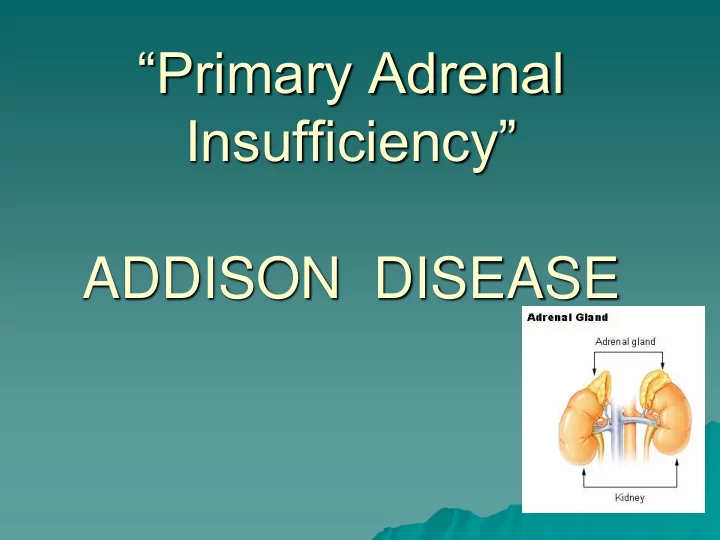
Primary Adrenal Insufficiency ADDISON DISEASE Adrenocortical - - PowerPoint PPT Presentation
Primary Adrenal Insufficiency ADDISON DISEASE Adrenocortical insufficiency comprises of primary and secondary adrenal insufficiency. Primary adrenal insufficiency can be congenital or acquired. Acquired primary adrenal
Adrenocortical insufficiency comprises
Primary adrenal insufficiency can be
Acquired primary adrenal insufficiency
Addison Disease is the result of an
liver function low sugar
Cortisol Very Low digestive enzyme vomiting, diarrhea Non functioning Adrenal gland Brain, Coma kidney, Na Low fluid Aldosterone & water loss volume very Low Shock . Heart, irregular Low BP Decrease out put
Autoimmune adrenalitis
– Isolated autoimmune adrenalitis – Autoimmune adrenalitis as a part of APS
APS type 1 APS type 2 APS type 4
Infectious Adrenalitis
– Tuberculous adrenalitis – Fungal adrenalitis – HIV associated
Bilateral Adrenal Haemorrhage Bilateral Adrenalectomy
Genetic Disorders
– Adrenoleukodystrophy – Congenital adrenal hyperplasia – Congenital lipoid adrenal hypoplasia – ACTH insensitivity syndrome – Smith-Lemli-Opitz syndrome – Triple A syndrome
Adrenal infiltration Drug induced adrenal insufficiency
Autoimmune destruction of the adrenal
glands is the most common cause of Addison Disease.
Component of autoimmune
polyendocrinopathy syndromes:
Chronic mucocutaneous candidiasis Hypoparathyroidism Addison Disease
Addison disease with Autoimmune thyroid disease (Schmidt syndrome) or Type 1 Diabetes Mellitus (Carpenter Syndrome)
Most frequent infectious etiology is
Tuberculosis is Second common
HIV infection.
Ketoconazole Rifampicin Phenobarbitone Phenytoin Mitotane
Breech presentation Anticoagulant therapy Child Abuse
Hypoglycemia
Hypotension Hypovolemia Hyponatremia Hyperkalemia
Hyperpigmentation
Marked at exposed areas, buccal and gingival mucosa, at scars and genitalia.
Non specific signs:
Serum electrolytes:
– Hypoglycemia – Hyponatremia – Hyperkalemia
ABG Renal function Plasma renin activity Urinary Sodium, and potassium
CT scan and MRI
Specific:
Serum cortisol levels (low)
Before stimulation After stimulation i.e. 30 – 60 min after administration of
0.25mg cosyntropin
dextrose.
children, and 100 mg in adolescent.
adequacy of replacement therapy