Preview of the GTF survey of SMEs responses to risk management in - - PowerPoint PPT Presentation

preview of the gtf survey of smes responses to risk
SMART_READER_LITE
LIVE PREVIEW

Preview of the GTF survey of SMEs responses to risk management in - - PowerPoint PPT Presentation

The International Timber Industry Discussion & Networking Platform Preview of the GTF survey of SMEs responses to risk management in market & producer countries. How do SMEs manage the risk of purchasing illegal timber products? Using


slide-1
SLIDE 1

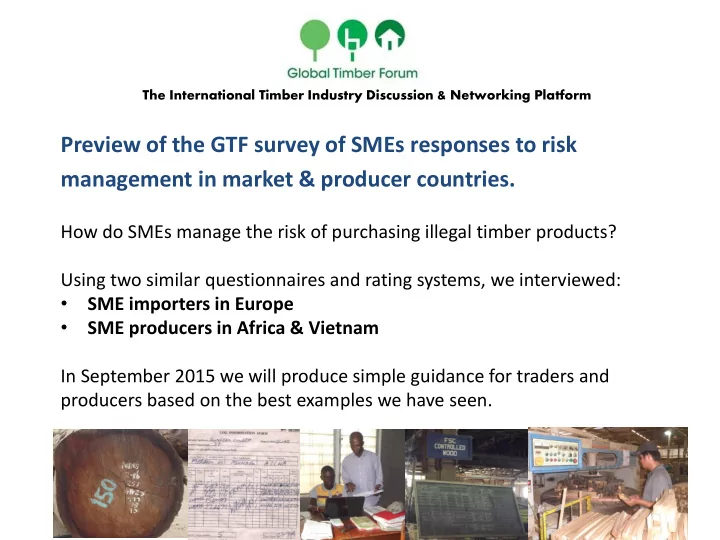
Preview of the GTF survey of SMEs responses to risk management in market & producer countries.

How do SMEs manage the risk of purchasing illegal timber products? Using two similar questionnaires and rating systems, we interviewed:

  • SME importers in Europe
  • SME producers in Africa & Vietnam

In September 2015 we will produce simple guidance for traders and producers based on the best examples we have seen.

The International Timber Industry Discussion & Networking Platform

slide-2
SLIDE 2

Based on our own knowledge and experience we broke down Due Diligence in to its simplest components:

  • Staff and systems – having the right people in place following some simple

policies

  • Knowledge of the regulator – talking is better than ignorance!
  • Keeping good records – know what you have bought
  • Assessing the risk – what should I know?
  • Mitigating the risk – what can I do about it?
  • Monitoring – does the system work consistently?

We set up a simple scoring system to see how they were doing We also wanted to find out how they set up their systems and where did they get the information and support to help them

slide-3
SLIDE 3

European SMEs

The survey so far has covered 27 companies in Germany, Netherlands, Italy, UK and France. The survey was focused on their ability to comply with the EU Timber Regulation as “Operators” We wanted to see how they were performing and see what advice they had for others.

  • Product types include: hardwood, softwood, joinery &

sheet materials

  • Source countries includes: Congo Basin, Latin America,

China, SE Asia, Russia and 10+ others

  • Turnover ranged from 1 to 80 m Euro – average was 23.7 m

Euro

  • Employees ranged from 1 to 240 – average of 22 people
slide-4
SLIDE 4

EU SME – overall performance These ones probably have a fairly robust DD system

10 20 30 40 50 60 70 80 90 100

Monitoring Risk mitigation Risk assessment Record keeping Relationship with Competent Authority Staff & systems

slide-5
SLIDE 5

EU SME – variances between countries?

69.4 76.8 71.3 71.3 71.3 74.3

10 20 30 40 50 60 70 80 90 100

France UK Netherlands Germany Italy 6 companies contracted to MO

Note: 6 companies contracted to an MO are also included each national score

slide-6
SLIDE 6

EU SME – does size affect performance of the DD system? Some relationship between T/O and performance but:

  • Large companies do not always perform better
  • Small companies can practice high levels of DD

20 40 60 80 100 FR1 FR2 FR3 FR4 FR5 FR6 FR7 UK1 UK2 UK3 UK4 UK5 UK6 UK7 UK8 NL1 NL2 NL3 NL4 DE1 DE2 DE3 DE4 DE5 IT1 IT2 IT3

Turnover (Million Euro) Score

slide-7
SLIDE 7

The cost of a due diligence system - EU

Please note only half of respondents could answer these questions.

  • The average cost of managing the Due Diligence system was 23.7k Euro per year
  • This represented 0.12% of turnover

4.5 3.6 23.7

5 10 15 20 25 30

Management time spent on legal compliance (hours / week) Management time spent on enviornmental compliance (hours / week) Estimated cost of Due Diligence system (Euro x 1000 / yr)

slide-8
SLIDE 8

Producer SMEs

The survey so far has covered 15 companies in Cameroon, DR Congo, Gabon, Ghana, Liberia and Vietnam. The survey was focused on the companies’ ability to comply with their own legislation and that of export markets and in some cases producer countries. We wanted to see how they were performing and see what advice they had for others. African companies -primarily forest managers with their own

  • sawmills. Most did not have what they considered a DD system.

Vietnamese companies - primarily manufacturers using imported and domestic timber.

  • Product types include logs, sawn wood, plywood, moulding,

joinery & furniture

  • Turnover ranged from 0.4 to 20 m Euro – average was 5.9 m

Euro.

  • Employees ranged from 9 to 2350 – average of 320 people
slide-9
SLIDE 9

25 50 75 100 Max. Cam1 Cam2 DRC1 Gab1 Gab2 Gh1 Gh2 Gh3 Gh4 Lib1 VN1 VN2 VN3 VN4 VN5

Awareness of legislation Risk mitigation Risk assessment Record keeping Staff & systems

Producer SME – overall performance These are all forest managers - a due diligence system for them = legal title and legal harvesting

slide-10
SLIDE 10

10 20 30 40 50 60 70 80 90 100 Cam1 Cam2 DRC1 Gab1 Gab2 Gh1 Gh2 Gh3 Gh4 Lib1 VN1 VN2 VN3 VN4 VN5

Turnover (annual sales) - Euros Millions Score

Producer SME – does size affect performance of the DD system? Some relationship between T/O and performance but:

  • Large companies do not always perform better
  • Small companies can practice DD
slide-11
SLIDE 11

The cost of a due diligence system – Producer countries

  • The average cost of managing the Due Diligence system (or complying with

forest laws) was 33k Euro per year

  • This represented 0.57% of turnover

17 5 33.1

5 10 15 20 25 30 35

Management time spent on legal compliance (hours / week) Management time spent on environmental compliance (hours / week) Estimated cost of Due Diligence system (Euro x 1000 / yr)

slide-12
SLIDE 12

Findings - 1

  • 1. Companies with 1 or 50 million Euro turnover can effectively practice Due Diligence
  • 2. Companies with 1 or 50 million Euro turnover can ineffectively practice Due Diligence!
  • 3. Many organisations are trying to help – some better than others
  • 4. Any timber company operating anywhere can implement a basic system that will

reduce their risk and demonstrate due diligence to customers and regulators

  • 5. In the producer countries – it’s very clear that those who have sought outside help are

better equipped – certification, capacity building, support programmes etc.

  • 6. The producer country companies spend far more time on legal (17 hours) &

environmental compliance (4 hours) per week. The European SMEs spend 3-4 hours

  • n each.
  • 7. DD system running costs are proportionately much higher for producers than EU

companies – the proportion of turnover is 0.6% to 0.12

slide-13
SLIDE 13
  • 8. Demand for legal (and sustainable) timber is strong from EU, less strong from US

and absent from China.

  • 9. Most producers have not switched export markets – they tend to stay with where

they know and learn how to keep the customer happy.

  • 9. European SMEs want more information – “where are the problems, what are the

problems, how are laws broken, who has been convicted, what are others doing…”

  • 10. 26 out of 27 European companies welcomed the EUTR in principle – their main

concern is that it is not implemented evenly. “Level playing field” Some of the respondents’ advice: “Document everything” “Talk to your customers – they know the laws in their countries” “Talk to your suppliers – they know the laws in their countries” “Exporters will face more regulations – you have to have a good system in place to cope with this” “Use experts and outside help” Findings - 2

slide-14
SLIDE 14

16 Britannia House Telephone +44 1394 420 518 Bentwaters Business Park Email georgecwhite@btinternet.com Suffolk Skype egroegetihw IP12 2TW United Kingdom

Report prepared for GTF by

George White George White Associates