Prevalence and characteristics of Hepatitis B and C in HIV infected - - PowerPoint PPT Presentation

prevalence and characteristics of hepatitis b and c in
SMART_READER_LITE
LIVE PREVIEW

Prevalence and characteristics of Hepatitis B and C in HIV infected - - PowerPoint PPT Presentation

Prevalence and characteristics of Hepatitis B and C in HIV infected patients from the RESINA cohort RESINA Study : treatment naive patients from 35 HIV centers in NRW before starting the first ART Characterization of coinfection


slide-1
SLIDE 1

Prevalence and characteristics of Hepatitis B and C in HIV‐infected patients from the RESINA cohort

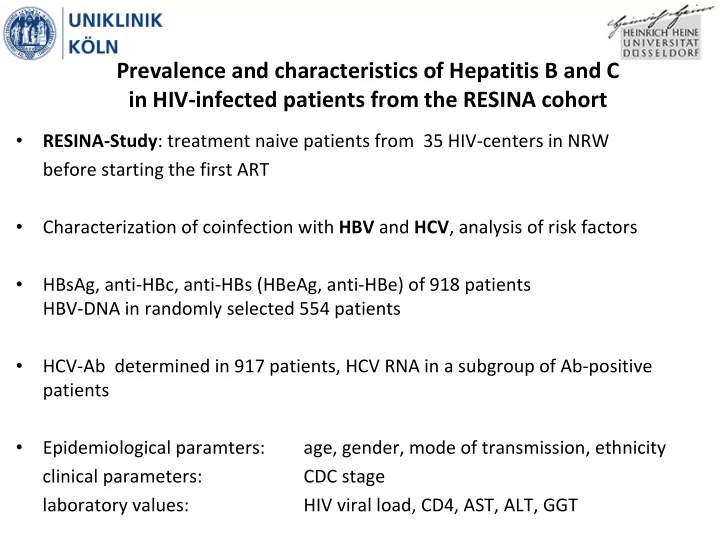
  • RESINA‐Study: treatment naive patients from 35 HIV‐centers in NRW

before starting the first ART

  • Characterization of coinfection with HBV

and HCV, analysis of risk factors

  • HBsAg, anti‐HBc, anti‐HBs (HBeAg, anti‐HBe) of 918 patients

HBV‐DNA in randomly selected 554 patients

  • HCV‐Ab determined in 917 patients, HCV RNA in a subgroup of Ab‐positive

patients

  • Epidemiological paramters:

age, gender, mode of transmission, ethnicity clinical parameters: CDC stage laboratory values: HIV viral load, CD4, AST, ALT, GGT

slide-2
SLIDE 2

HBV‐Screening

AREVIR‐meeting Bonn 2010

slide-3
SLIDE 3

Düsseldorf and Cologne

n=517 and n=401

slide-4
SLIDE 4

Analysis of HBV‐DNA

n=554

HBV-DNA pos HBV-DNA neg Total HBsAg pos 3,2 % (18) 1,1 % (6) 4,3 % (24) HBsAg neg 2,9 % (16)

  • Total

6,1 % (34)

  • 7,2 % (40)

Anti-HBc + Anti-HBs + Anti-HBc + Anti-HBs - Anti-HBc - Anti-HBs + Anti-HBc - Anti-HBs - Total Anti-HBc + Total Anti-HBc - OHBV 7 3 2 4 10 6 % 4,3 (7 / 164) 6,4 (3 / 47) 3,8 (2/ 52) 1,9 (4 / 213) 4,6 (10 / 217) 1,9 (6 / 313)

Occult HBV infection (OHBV): HBsAg negative and HBV-DNA positive

slide-5
SLIDE 5

HBV‐ und HCV coinfections: risk factors and observations

  • HBV‐DNA:

significant: higher ALT and AST trend: more MSM, caucasian and CDC‐C

  • OHBV:

no parameter showed significant correlation

slide-6
SLIDE 6

HBV‐ und HCV coinfections: risk factors and observations

Isolated antiHBc

slide-7
SLIDE 7

HBV resistance analysis

  • 30 / 34 samples sequenced (genotypes):

18 x A 7 x D 3 x G 1 x C 1 x Es

  • Sequences differing from wild‐type in 19 / 30
  • 5 patients with mutations conferring to drug resistance

I169T, L180M, V191IV, M204V

4 / 13 in patients with OHBV, 1 / 17 in HBsAg positive patients

slide-8
SLIDE 8

German HBV‐incidence (RKI) NRW HBV‐prevalence (RESINA)

slide-9
SLIDE 9

HCV‐Screening

slide-10
SLIDE 10

HBV‐ und HCV coinfections: risk factors and observations

Positive HCV serostatus

slide-11
SLIDE 11

HIV primary drug resistance (PDR)

  • 8,3% (76 / 912)

46% NRTI (35), 47% NNRTI (36), 18% PI (14)

  • HIV‐PDR was significantly correlated with

any parameter of active HBV infection (HBV‐DNA, HBsAg, OHBV) anti‐HCV

  • patients with HIV‐PDR were significantly
  • lder

more MSM more IVDU caucasian origin showed higher ALT and GGT

slide-12
SLIDE 12

CONCLUSIONS

  • HBV and HCV are frequent co‐infections in

treatment‐naive HIV patients

  • HCV co‐infection influences HIV replication
  • OHBV constitutes a major proportion of all

chronic HBV infections

  • HIV‐PDR associated with active HBV infection
slide-13
SLIDE 13

THANK YOU !!!

  • Frank Clemens Wilhelm
  • Mark Oette
  • Rolf Kaiser
  • Bastian Beggel
  • Melanie Balduin
  • Finja Schweitzer
  • Jens Verheyen
  • Ortwin Adams
  • Dieter Häussinger
slide-14
SLIDE 14

HBV resistance analysis

No. Genotype HBV-polymerase mutations HBsAg mutations 1 A N131DN, I187L, V191IV, L217R, L229M Q101H, K122KR, A159V, S167L, V168AV, W182*W, P217LP, F220L 2 D S119PST, F122L, Q130P, L132M, I169T, M171V, A211G L109LQ, T125M, F161L, P203A 3 E V191IV S167LS, W182*W, L226*L 4 G V142T, L180M, M204V, L229F M133I, Y134H, I195M, C221F 5 D H126R, Y135H, V173L, L180M, M204V, Q215S L97P, T118A, G130E, E164G, I195M, S204N, S207R 6 A L140I N131K 7 A R138K, S219A G130N, S210R 8 A R138KR, S219A G130DGNS, S210R 9 C R153QR, S223A, I224V G145GR, S210N

slide-15
SLIDE 15

HBV‐Screening and HCV seroprevalence