Presenters Dr. Gloria Bonilla-Santiago Board of Governors - - PowerPoint PPT Presentation

presenters
SMART_READER_LITE
LIVE PREVIEW

Presenters Dr. Gloria Bonilla-Santiago Board of Governors - - PowerPoint PPT Presentation

Creating a comprehensive model for serving children and families from Birth through College and Beyond in a public school setting The LEAP Academy University Charter School Model in partnership with the Community Leadership Center at Rutgers


slide-1
SLIDE 1

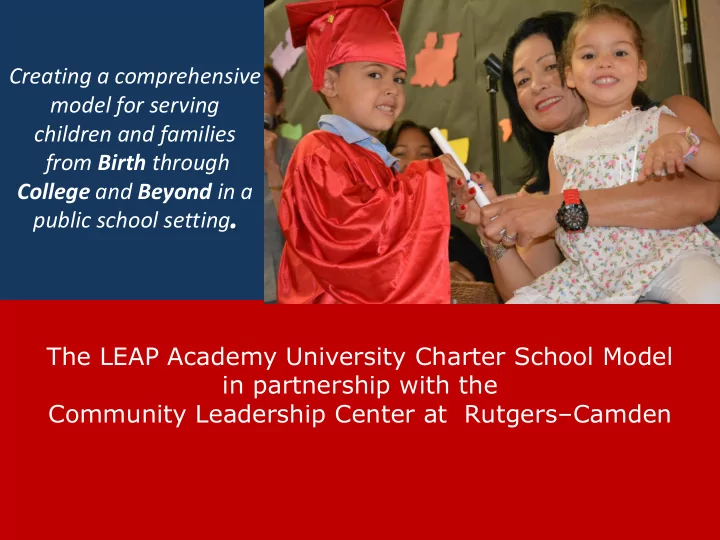
Creating a comprehensive model for serving children and families from Birth through College and Beyond in a public school setting The LEAP Academy University Charter School Model in partnership with the Community Leadership Center at Rutgers–Camden

slide-2
SLIDE 2

Presenters

  • Dr. Gloria Bonilla-Santiago

Board of Governors Distinguished Service Professor in Public Policy and Administration, Rutgers-Camden; Director of the Rutgers-Camden Community Leadership Center (CLC); Founder and Chair of LEAP Academy Charter School Khary Golden Director of the Center for College Access , LEAP Academy University Charter High School

slide-3
SLIDE 3

Case study of community transformation through a combination of elements:

  • Quality Education
  • Visionary Leadership
  • Community Engagement
  • University Partnership
slide-4
SLIDE 4

VIDEO PRESENTATION

slide-5
SLIDE 5

LEAP in Context

  • Public charter schools drive neighborhood

revitalization, merging the urban education and community development fields

  • Public charter schools foster stronger relationships

with communities by de-centralizing operations

slide-6
SLIDE 6
  • Schools have the ability to foster relationships

between various power structures of communities and elites, creating a path to economic security.

  • Schools that partner with anchor institutions

have a major impact in neighborhood development efforts.

slide-7
SLIDE 7
  • Schools connect youth to adult conventional

norms and adapting them to mainstream societal and economic structures.

slide-8
SLIDE 8

The Collective Mission Statement

The mission of the LEAP Academy is to enhance

  • pportunities for the children and families of

Camden through the collaborative design, implementation, and integration of education, health and human services, professional development, and community development.

slide-9
SLIDE 9

LEAP Historical Milestones

slide-10
SLIDE 10

Stakeholder Analysis/Engagement

  • Parents
  • Neighborhood

leaders

  • Foudantions/Funders
  • Business
  • Community based and

service organizations

  • Faculty and Staff
  • University President
  • Board of Governors
  • Students
  • Legislators (State and Local)
  • Governor
  • State and Local Officials
  • Camden Board of Educuation
  • Delaware River Port

Authority

slide-11
SLIDE 11
  • 1. Student Achievement – Comes

first

  • 2. We do what ever It takes to get

the job Done.

  • 3. We take the High Road
  • 4. We are a Family
  • 5. Positive and Caring Culture
  • 6. We are all Accountable
  • 7. Transparency with each other
  • 8. Improvement is ongoing
  • 9. Diversity is our Strength

10.We are one Team

LEAP Values

slide-12
SLIDE 12

Five Core Elements of the LEAP Model

slide-13
SLIDE 13

1.Accountability for People, Time, Money and Programs

slide-14
SLIDE 14
  • 2. Pipeline of College Access for all

students PreK- 16

slide-15
SLIDE 15
  • 3. Teacher Development

and Support

slide-16
SLIDE 16
  • 4. Parental Engagement
slide-17
SLIDE 17
  • 5. Early Learning means

Later Earning

slide-18
SLIDE 18
slide-19
SLIDE 19

A Focus on Pipeline Development The Rutgers/LEAP Pipeline to College

19

slide-20
SLIDE 20

BIRTH – 16 EDUCATIONAL INVESTMENTS AND INNOVATIONS

slide-21
SLIDE 21
  • School based centers to channel university support for

the school. – Health and Wellness, offering primary health and social work services to families and children – Early Learning Research Academy offering a infants and pre-school curriculum

POINT S OF PRIDE

slide-22
SLIDE 22

– Fabrication Lab, offering innovative products and project base learning opportunities; – Parents Academy providing programs to strengthen the skills of families;

slide-23
SLIDE 23

– Center for College Access working with students, teachers and families in ensuring college preparedness – Legal Enrichment Center offering free legal services and educational programming to families; applied research, academic training, and experiential learning for law school and LEAP students

slide-24
SLIDE 24

Enrollment Profile of the Birth-12th Pipeline

  • 1,705 students Birth through 12th
  • LEAP Academy

– Lower Elementary Campus (K-3) – Upper Elementary (4-6) – Intermediate High School (7-9) – High School (10-12)

  • Early Learning Research Academy

– Infants (6 months - 1 year) – Toddlers (age 1-3 ) – Preschoolers (ages 3-4)

slide-25
SLIDE 25

Children Impacted: Educational Pipeline Five-Year Enrollment Trends ELRA, LEAP, Combined

90 126 126 206 325 751 860 1,194 1,313 1,380 841 986 1,320 1,519 1,705 1000 2000 3000 4000 2011 2012 2013 2014 2015 Five-Years ELRA LEAP Combined

slide-26
SLIDE 26

Factors of LEAP Model

slide-27
SLIDE 27

Family Engagement

slide-28
SLIDE 28

Core Elements of LEAP’s Family Engagement Framework

slide-29
SLIDE 29

LEAP Principles for Family Engagement

slide-30
SLIDE 30

IMPACT

slide-31
SLIDE 31
  • 100% in 2005
  • 100% in 2006
  • 100% in 2007
  • 100% in 2008
  • 100% in 2009
  • 100% in 2010
  • 100% in 2011
  • 100% in 2012
  • 100% in 2013
  • 100% in 2014
  • 100% in 2015
slide-32
SLIDE 32

Transforming Cooper Street and the Educational Corridor

slide-33
SLIDE 33

(PK-6): 639 Cooper Street

slide-34
SLIDE 34

(7-12): 549 Cooper Street

slide-35
SLIDE 35

528 Cooper Street

slide-36
SLIDE 36

501 Cooper Street

slide-37
SLIDE 37

130 North Broadway, Camden

slide-38
SLIDE 38

SCHOOLS AS NEXUS FOR COMMUNITY DEVELOPMENT

slide-39
SLIDE 39

Theory of Action

slide-40
SLIDE 40

Strong Early Childhood Programs High Performing Schools Effective K-12 programs Higher high school graduation rates Successful transitions from high school to college/career Academic enrichment programs Social, recreation and character building for children and youth Quality health services Social service programs Adult learning opportunities and Job readiness training Neighborhood based employment opportunities Legal services Safe schools and neighborhoods Business development Crime prevention Local/community based leadership development Better housing options and support for residents Community Building and Ownership Interagency Collaboration

Better outcomes for children and youth

Children & Youth

Better outcomes for the community

Community

Better outcomes for families

Families

Logic Model of Outcomes

slide-41
SLIDE 41

Lessons Learned from our Applied Work

slide-42
SLIDE 42
  • A collaborative,

comprehensive approach, with intentional alignment across institutions and contexts (e.g. family, school, the broader community), instead of piecemeal, uncoordinated efforts;

  • Participation by diverse partners instead of

single-sector initiatives;

slide-43
SLIDE 43
  • A focus on geographically

defined areas instead of being too broad in scope;

  • A governance structure that includes a lead
  • rganization to drive the effort instead of a

leaderless coalition;

  • Active engagement by residents instead of

purely top-down decisions;

slide-44
SLIDE 44
  • Cross fertilization between

students and faculty to engage in research, service learning and community development;

  • An asset-based approach that builds on existing

resources and strengths rather than considering communities as deficits to be remediated; and

slide-45
SLIDE 45
  • Flexible, non-categorical funding from diverse

sources instead of restricted funds that constrain nimble actions