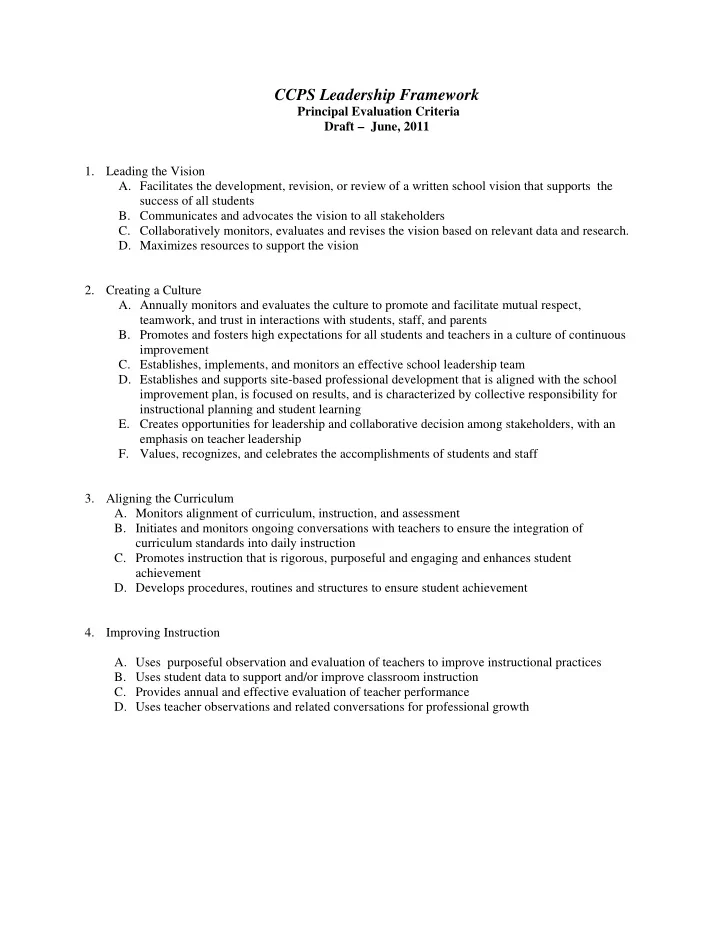
CCPS Leadership Framework Principal Evaluation Criteria Draft - - PDF document

ccps leadership framework
SMART_READER_LITE
LIVE PREVIEW

CCPS Leadership Framework Principal Evaluation Criteria Draft - - PDF document

CCPS Leadership Framework Principal Evaluation Criteria Draft June, 2011 1. Leading the Vision A. Facilitates the development, revision, or review of a written school vision that supports the success of all students B. Communicates and


slide-1
SLIDE 1

CCPS Leadership Framework

Principal Evaluation Criteria Draft – June, 2011

  • 1. Leading the Vision
  • A. Facilitates the development, revision, or review of a written school vision that supports the

success of all students

  • B. Communicates and advocates the vision to all stakeholders
  • C. Collaboratively monitors, evaluates and revises the vision based on relevant data and research.
  • D. Maximizes resources to support the vision
  • 2. Creating a Culture
  • A. Annually monitors and evaluates the culture to promote and facilitate mutual respect,

teamwork, and trust in interactions with students, staff, and parents

  • B. Promotes and fosters high expectations for all students and teachers in a culture of continuous

improvement

  • C. Establishes, implements, and monitors an effective school leadership team
  • D. Establishes and supports site-based professional development that is aligned with the school

improvement plan, is focused on results, and is characterized by collective responsibility for instructional planning and student learning

  • E. Creates opportunities for leadership and collaborative decision among stakeholders, with an

emphasis on teacher leadership

  • F. Values, recognizes, and celebrates the accomplishments of students and staff
  • 3. Aligning the Curriculum
  • A. Monitors alignment of curriculum, instruction, and assessment
  • B. Initiates and monitors ongoing conversations with teachers to ensure the integration of

curriculum standards into daily instruction

  • C. Promotes instruction that is rigorous, purposeful and engaging and enhances student

achievement

  • D. Develops procedures, routines and structures to ensure student achievement
  • 4. Improving Instruction
  • A. Uses purposeful observation and evaluation of teachers to improve instructional practices
  • B. Uses student data to support and/or improve classroom instruction
  • C. Provides annual and effective evaluation of teacher performance
  • D. Uses teacher observations and related conversations for professional growth
slide-2
SLIDE 2
  • 5. Planning with Data
  • A. Provides leadership in developing, implementing and evaluating the school improvement plan
  • B. Reviews and shares disaggregated data periodically to monitor progress and drive instructional

decision making

  • C. Makes instructional decisions based on careful and thorough analysis of student performance

and the underlying root causes

  • D. Supports regular collaboration among teachers for analyzing student work, progress monitoring,

and strategic planning.

  • 6. Building Capacity
  • A. Provides differentiated professional development based on the needs of the staff and linked to

school improvement

  • B. Provides standards-based and results oriented professional development that is aligned with

identified curricular, instructional, and assessment needs.

  • C. Provides opportunities for teachers to engage in collaborative planning and job-embedded

professional development

  • D. Identifies and provides professional development for potential and current school leaders
  • 7. Involving the Community
  • A. Demonstrates that parents and caregivers are welcomed in the school, encouraged to participate,

and given resources to help their children learn

  • B. Demonstrates that parents and caregivers are active members of the school improvement

process

  • C. Demonstrates that community stakeholders and school partners readily participate in school life
  • D. Models a respect for diversity and is sensitive to the needs within the school community
  • 8. Managing Personal and Professional Resources
  • A. Makes staffing decisions that maximize and promote student success
  • B. Maintains a safe, healthy, and orderly learning environment
  • C. Works within policies, laws, and regulations
  • D. Models mutual respect, teamwork, and trust in dealings with students, staff, and parents
  • E. Seeks ways to improve professional skills and knowledge
slide-3
SLIDE 3

CCPS Leadership Framework Indicator Rubrics

Domain 1: Leading the Vision

Leaders are future focused and can communicate a shared vision that provides members with a compelling purpose or mission for their work. The vision becomes the driving force for productive and meaningful change.

INDICATOR UNSATIFACTORY BASIC PROFICIENT DISTINGUISHED

1.A. Facilitates the development, revision, or review of a written school vision that supports the success

  • f all students

A written vision does not exist. A vision exists however it is not current and has not been reviewed

  • r is not used to guide school-based

decisions The written vision communicates a commitment to high expectations for student success in a diverse and global community …and The written vision is a compelling image of a learning community that reflects the highest standards for excellence and achievement 1.B. Communicates and advocates the vision to all stakeholders to ensure articulation within the entire school community The vision is communicated by the principal but not articulated by staff members The vision is communicated by the principal and articulated by staff but there is limited connection to instructional decisions and practices Staff connect instruction and decision making to the vision

  • n a regular basis

…and The school community is actively involved in supporting the school’s vision 1.C. Collaboratively monitors, evaluates and revises the vision based on relevant data and research. There is minimal evidence of data used to support the vision. Data is shared and used with limited connections made to the school vision. Data is used to gain shared commitment for the success of the vision. Collaborative processes are designed and implemented to collect and monitor progress. …and Data is used to promote

  • wnership of a compelling

instructional vision. Long and short term goals are measurable and set to achieve the vision. 1.D. Maximizes resources to support the vision There is minimal evidence that decisions regarding resources are aligned to the vision. At times, resource allocations support the vision, but the alignment to the vision is not consistent. All decisions ensure the strategic allocation of resources including budget, staffing, professional development and instruction to meet goals that align to the vision …and Feedback and data are used to assess the success of funding and resource decisions.

slide-4
SLIDE 4

Domain 2: Creating a Culture

Great leaders create a culture that is grounded in the beliefs and values of their organization. They build and sustain an environment that embodies a sense of belonging in a positive and productive learning community.

INDICATOR BELOW BASIC BASIC PROFICIENT DISTINGUISHED

  • 2. A. Annually monitors and

evaluates the culture to promote and facilitate mutual respect, teamwork, and trust in interactions with students, staff, and parents There is minimal awareness

  • f the cultural dynamics within

the school community Stakeholder satisfaction is monitored but there is limited attempt to address identified cultural needs. Multiple and various sources

  • f data are used to monitor and

assess the culture. Areas of concern are strategically addressed. …and Authentic assessment data, including self appraisal is used to assess the culture; results are frequently communicated to teachers, community, and school system members. 2.B. Promotes and fosters high expectations for all students and teachers in a culture of continuous improvement There is minimal evidence of high expectations for all students and teachers. There are high expectations for students and staff evident in some but not all disciplines

  • r classrooms.

High expectations for all staff and students in all disciplines are a visible characteristic of a culture committed to continuous improvement. ….and Staff and students identify the knowledge, skills, and concepts essential for their success and apply appropriately

  • 2. C. Establishes, implements,

monitors an effective school leadership team There is minimal evidence of a team with leadership responsibilities. A school leadership team has limited influence on the culture of the school. The school leadership team provides effective leadership that supports a healthy professional culture. …and The school leadership team encourages shared leadership among teachers and promotes student leadership behaviors as well.

  • 2. D. Establishes and supports site-

based professional development that is aligned with the school improvement plan, is focused on results, and is characterized by collective responsibility for instructional planning and student learning There is minimal evidence of planning and/or implementation of site-based professional development. Plans for professional development exist within the school improvement plan but there is limited evidence of implementation or follow- through. High-quality, site-based professional development

  • ccurs regularly based on

school improvement goals. …and Professional learning is a natural element of the school culture and includes all staff

  • members. Feedback is

provided that sustains individual and group learning goals.

  • 2. E. Creates opportunities for

leadership and collaborative decision making among stakeholders, with an emphasis on teacher leadership There is little evidence of efforts to build leadership capacity among staff members. Provides some leadership

  • pportunities with limited

participation. Opportunities for quality leadership development and collaborative decision making are provided for most staff members ..and Opportunities are differentiated to meet the unique goals of staff members and system needs.

  • 2. F. Values, recognizes, and

celebrates the accomplishments of students and staff There is minimal evidence of recognition for students and staff Students and staff are sometimes recognized for various accomplishments which may or may not be based on established criteria Individuals are routinely recognized for accomplishments based on established criteria …and A positive culture of celebration and high expectation is evident in daily behaviors

slide-5
SLIDE 5

Domain 3: Aligning the Curriculum

Leaders are committed to ensuring equal access for all students to the guaranteed and viable curriculum. They are relentless in their efforts to maximize learning

  • pportunities for every student.

INDICATOR BELOW BASIC BASIC PROFICIENT DISTINGUISHED

3.A Monitors alignment of curriculum, instruction, and assessment There is minimal evidence of alignment among curriculum, instruction, and assessment and little evidence of collaboration with content supervisor Curriculum, instruction, and assessment are aligned in some areas but not all. There is some collaboration with content supervisors Curriculum, instruction, and assessments are aligned with CCPS curriculum with ongoing collaboration with curriculum supervisors. …and The principal has a broad understanding of all content areas and their relationship to each other

  • 3. B. Initiates and monitors
  • ngoing conversations with

teachers to ensure the implementation of curriculum standards into daily instruction There is minimal evidence of curriculum based conversations. Conversations about curriculum

  • ccur occasionally or if

directed. Regular and on-going conversations are held with and among teachers that promote the implementation of curriculum standards into daily instruction. …and Collaborative conversations promote inter-discipline learning opportunities for students. 3.C. Promotes instruction that is rigorous, purposeful and engaging and enhances student achievement Instruction shows minimal evidence of rigorous, engaging, and purposeful methodologies. Instruction shows evidence of rigorous, engaging, and purposeful methodologies in some classrooms. Instruction shows evidence of rigorous, engaging, and purposeful methodologies in all classrooms …and Instruction at high levels of rigor produces consistently high levels of student achievement.

  • 3. D. Develops procedures,

routines and structures to ensure student achievement Procedures, routines, or structures are not linked to student achievement Some, but not all, procedures, routines, or structures are established to support student achievement Structures and programs are periodically reviewed and adjusted to support high levels

  • f student achievement

…and New and innovative structures

  • r programs that result in

improved student achievement are continuously developed, piloted, and implemented.

slide-6
SLIDE 6

Domain 4: Improving Instruction

Leaders set high expectations for teaching and learning. They use the observation and evaluation process to communicate and reinforce their expectations for teacher performance.

INDICATOR UNSATISFACTORY BASIC PROFICIENT DISTINGUISHED

  • 4. A. Uses purposeful
  • bservation of teachers to

improve instructional practices Observations are not conducted as required. Observations are completed as required but often lack meaningful feedback Quality feedback provided during the observation process provides teachers with the

  • pportunity to improve

instructional practice …and Observations are used to make informed decisions to guide site-based professional development

  • 4. B. Uses student data to

support and/or improve classroom instruction There is minimal use of formative and summative data that improves instruction. Formative and summative data is collected and analyzed but there is limited application to classroom instruction. Formative and summative data is collected, analyzed, and used to guide informed instructional decisions. …and Teachers are empowered to regularly collaborate to monitor student progress and set goals for increasing individual student achievement.

  • 4. C. Provides annual and

effective evaluation of teacher performance Evaluations are not completed in a timely manner or in compliance with CCPS policies and practices. Evaluations are based on limited data from formal and informal observations. Evaluations are based on frequent formal and informal

  • bservations in collaboration

with supervisors. Evaluations are supported with student achievement data and comply with CCPS policies and practices. …and Evaluations include a strong element of self-reflection and are a shared responsibility between the principal and teacher.

  • 4. D. Uses teacher observations

and related conversations for professional growth Conversations for professional growth do not occur Conversations for professional growth occur, but clear and specific plans are not established or implemented. Conversations for professional growth occur; clear and specific plans are collaboratively established, implemented, and monitored …and Staff are empowered and supported to use feedback to take ownership and initiative to participate in activities such as peer observations and professional collaboration to support their growth plan

slide-7
SLIDE 7

Domain 5: Planning With Data

Leaders embrace the process of data-driven decision making as the primary option for designing or selecting structures and systems that support increased student achievement and promote continuous improvement. They are committed to a culture that relies on the school improvement process to drive purposeful change.

INDICATOR UNSATISFACTORY BASIC PROFICIENT DISTINGUISHED

5.A. Provides leadership in developing, implementing and evaluating the school improvement plan There is minimal evidence of leadership provided for the development of the school improvement plan The school improvement plan is developed collaboratively but implementation and/or monitoring efforts are not evident The school improvement plan is collaboratively developed, implemented, and monitored as planned …and There is a shared responsibility and ownership among internal and external stakeholders for the planning, implementation, and monitoring of on-going school improvement

  • 5. B. Reviews and shares

disaggregated data periodically to monitor progress and drive instructional decision making There is minimal evidence of the use of data to drive instructional decisions Data are shared among stakeholders with little or no focus on instructional improvement Disaggregated data are used periodically to monitor progress and drive instructional decision making …and Professional development is provided to increase staff capacity to effectively use data to guide instructional decision making

  • 5. C. Makes instructional

decisions based on careful and thorough analysis of student performance and the underlying root causes Minimal evidence of the use of data to make instructional decisions related to student performance Data are used to make instructional decisions related to student performance without identifying underlying root causes Instructional decisions are made based on an analysis of student performance and the underlying root causes …and Longitudinal data are used to identify patterns and other underlying root causes to inform instructional decisions that contribute to successful vertical alignment

  • 5. D. Supports regular

collaboration among teachers for analyzing student work, progress monitoring, and strategic planning Minimal evidence of collaboration among teachers for data analysis and strategic planning Provides opportunities for collaboration among teachers for data analysis and strategic planning Provides access, structure, and resources and monitors the collaboration among teachers for data analysis, strategic planning, and progress monitoring …and Staff takes the initiative to collaborate routinely to analyze data, strategically plan, and monitor progress for individual

  • r groups of students
slide-8
SLIDE 8

Domain 6: Building Capacity

Leaders understand that the organization is only as strong as each of its members and are persistent in their efforts to build the individual and collective skills and knowledge that transfer into highly skilled teachers and staff. They are committed to building a culture of continuous professional learning with structures and goals based

  • n standards for effective practice.

INDICATORS UNSATISFACTORY BASIC PROFICIENT DISTINGUISHED

  • 6. A. Provides differentiated

professional development based

  • n the needs of the staff and

linked to school improvement There is minimal evidence that professional development activities are linked to school improvement Professional development

  • pportunities are linked to

school improvement goals and

  • initiatives. However, the use of

new learning by staff is limited

  • r not evident.

Professional development needs are determined from various data sources and provide multiple and ongoing

  • pportunities to increase

teachers’ skills and knowledge related to those needs. Data shows a positive impact on student achievement. …and Professional development is embedded in daily activities and characterized by high levels of staff ownership, shared leadership.

  • 6. B. Provides standards-based

and results oriented professional development that is aligned with identified curricular, instructional, and assessment needs Professional development lacks measurable standards-based and curricular aligned goals and

  • utcomes.

Professional development may contain identifiable outcomes based on current teaching practices, curricular and student achievement needs; however, expectations for the achievement of the outcomes lack clarity, definition, and/or follow-through. Professional development activities are outcomes based and reflect current instructional practices and curricular needs related to student achievement. ...and There is clear alignment between teachers’ individual professional development goals, school improvement goals, and student needs. All goals are linked to the CCPS Framework for Teaching.

  • 6. C. Provides opportunities for

teachers to engage in collaborative planning and job- embedded professional development There is minimal evidence of site-based, job-embedded professional development There is some evidence of collaborative planning and job- embedded professional development. Teachers regularly engage in collaborative planning and job- embedded professional development that is aligned to school improvement initiatives …and Feedback and follow-up is used to ensure implementation and monitor progress of the transfer

  • f professional development

learning to classroom practice

  • 6. D. Identifies and provides

professional development for potential and current school leaders There is minimal evidence of professional development for potential and current school leaders Selected staff is invited to take leadership roles within the school; some professional development to build leadership capacity may be provided. Potential and current school leaders are identified and provided with leadership

  • pportunities and the

professional development needed to develop the related skills and dispositions …and Staff leaders have a positive influence on school culture and contribute to school and system initiatives.

slide-9
SLIDE 9

Domain 7: Involving the Community

Leaders value the unique contributions that members of the community make to the school environment. They create an environment that welcomes the community not simply as guests but as partners in the decision making process. Efforts to reach into the community convey a sense of unity and belonging.

INDICATOR BELOW BASIC BASIC PROFICIENT DISTINGUISHED

7.A Demonstrates that parents and caregivers are welcomed in the school, encouraged to participate, and given resources to help their children learn The school is not a welcoming environment for parents and caregivers. Activities occur that include community involvement but do not engage parents or caregivers in the learning process Parents and caregivers feel welcomed, are encouraged to participate; opportunities to participate and resources are made accessible to all families. …and Opportunities are provided to build parent and caregiver understandings of the

  • perational and instructional

elements of the school 7.B Demonstrates that parents and caregivers are active members of the school improvement process Parents and caregivers are not active members in the school improvement process. Parents and caregivers are members of the school improvement process. Parents and caregivers are active members of the school improvement process and represent the diversity of the school community …And Members of the community at large are included in the school improvement process

  • 7. C. Demonstrates that

community stakeholders and school partners actively participate in school life There is minimal participation by community stakeholders and school partners in school life Community stakeholders and school partners participate in some elements of school life A strategic plan is implemented to seek input, support, and participation of community stakeholders and school partners in school life …and There is mutual support, advocacy, and ongoing involvement between the school and the community

  • stakeholders. The school is a

visible partner in community activities.

  • 7. D Promotes an awareness
  • f and respect for the diversity

within the school community There is minimal evidence of awareness for diverse needs of the school community There is an awareness of the diverse needs of the school community but there are minimal adjustments made to meet those needs. There is recognition of the diverse needs of the school community and adjustments are made to maximize awareness and respect for all students …and The school capitalizes on the diversity of their students to improve school and community programs and meet the diverse needs of all students

slide-10
SLIDE 10

Domain 8: Managing Professional Responsibilities

Leaders manage professional resources so that members of their organization are empowered to meet expected levels of performance. They set the moral and philosophical foundation upon which the organization operates and they manage and restructure resources to promote productive change.

INDICATORS BELOW BASIC BASIC PROFICIENT DISTINGUISHED

8.A Makes staffing decisions that maximize and promote student success in all areas There is minimal consideration given to student success when making staffing decisions. Student success is generally considered when making staffing decisions. Thorough knowledge of staff strengths and qualifications guide staffing decisions that will maximize student success. …and Staffing decisions are made in collaboration with school leaders to maximize staff strengths to promote student success.

  • 8. B. Maintains a safe,

healthy, and orderly learning environment There is minimal evidence that a safe, healthy, and orderly environment exists. The learning environment is generally safe, healthy and

  • rderly.

Actively seeks to improve a healthy, safe, and orderly environment in collaboration with school leaders ..and Constantly seeks to improve building conditions through diligent monitoring and effective utilization of resources.

  • 8. C. Works within policies,

laws, and regulations There is minimal knowledge of policies, laws, and regulations. Works within policies, laws, and regulations without regard for individual student needs Works within policies, laws, and regulations in order to meet individual student needs …and Sought out by colleagues for advice, guidance, and support; provides input and guidance for policy revisions and/or development

  • 8. D. Models mutual respect,

teamwork, and trust in dealings with students, staff, and parents There is minimal effort made to model mutual respect, teamwork, and trust in dealings with students, staff, and parents There is an effort to model mutual respect, teamwork, and trust in dealings with students, staff, and parents with some evidence of positive results Consistent modeling of mutual respect, teamwork, and trust in dealings with students, staff, and parents contributes to a positive school culture …and Staff , parents, and students model mutual respect, teamwork, and trust which continues to sustain a positive school culture

  • 8. E. Seeks ways to improve

professional skills and knowledge There is minimal effort made to grow professionally Participates in required pd

  • activities. New learning is not

always evident in daily practice. Meets professional certification

  • requirements. Recognizes

needs for professional growth and seeks activities that support those needs. New learning is demonstrated in daily practice …and Uses expertise to contribute to the learning of others throughout the system, state, or national level.