Presenter Disclosures Warren Ortland (1) The following personal - - PDF document

presenter disclosures
SMART_READER_LITE
LIVE PREVIEW

Presenter Disclosures Warren Ortland (1) The following personal - - PDF document

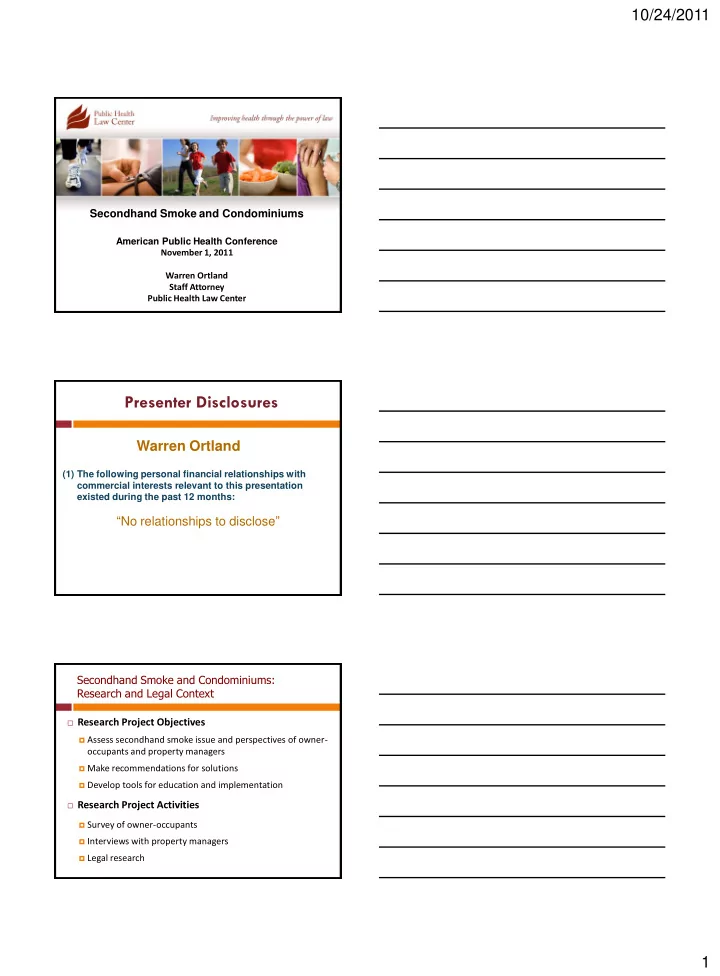
10/24/2011 Secondhand Smoke and Condominiums Julie American Public Health Conference November 1, 2011 Warren Ortland Staff Attorney Public Health Law Center Presenter Disclosures Warren Ortland (1) The following personal financial


slide-1
SLIDE 1

10/24/2011 1

Julie

Secondhand Smoke and Condominiums

American Public Health Conference November 1, 2011 Warren Ortland Staff Attorney Public Health Law Center

Presenter Disclosures

(1) The following personal financial relationships with commercial interests relevant to this presentation existed during the past 12 months:

Warren Ortland

“No relationships to disclose”

Secondhand Smoke and Condominiums: Research and Legal Context

 Research Project Objectives  Assess secondhand smoke issue and perspectives of owner-

  • ccupants and property managers

 Make recommendations for solutions  Develop tools for education and implementation  Research Project Activities  Survey of owner-occupants  Interviews with property managers  Legal research

slide-2
SLIDE 2

10/24/2011 2

ASHRAE Statement

American Society of Heating, Refrigeration and Air- Conditioning Engineers

2008 Position Statement:

  • At present, the only means of effectively eliminating health risk

associated with indoor exposure is to ban smoking activity.

ASHRAE Position Document on Environmental Tobacco Smoke Approved by ASHRAE Board of Directors June 25, 2008

Surgeon General

The Surgeon General’s Call to Action to Promote Healthy

Homes – June 2009

Owner-occupant survey Secondhand Smoke in Condominiums

slide-3
SLIDE 3

10/24/2011 3

Survey Methodology

 Population  76,106 SF-detached (townhouses, twin homes…)  43,152 2-50+ (apartment-style)  Data collection Jan 6 – Mar 6, 2009  Respondent n = 495

Secondhand Smoke in Units

0% 10% 20% 30% 40% 50% 60% 70% 80% 90% 100% Townhouse (n = 225) Apartment (n = 263) All (n = 488) Often or most of time Sometimes Rarely Never

In past six months, how often has tobacco smoke come into your unit?

Resident Reaction to Secondhand Smoke

0% 10% 20% 30% 40% 50% 60% 70% 80% 90% 100% Townhouse (n = 132) Apartment (n = 147) All (n = 279) A lot Some A little Not at all

How much does it bother you when tobacco smoke from somewhere else in or around the building comes into your unit?

slide-4
SLIDE 4

10/24/2011 4 Existing Smoke-Free Policies

What rules does your association currently have about smoking in… residents' units?

0% 25% 50% 75% 100% Townhouse (n = 214) Apartment (n = 258) All (n = 472) Smoking is permitted Smoking is not permitted Don't know

Effect of Secondhand Smoke on Resale Value

Effect on resale value of your unit if potential buyers knew that tobacco smoke came into it 1 day per week?

0% 10% 20% 30% 40% 50% 60% 70% 80% 90% 100% Townhouse (n = 220) Apartment (n = 251) All (n = 471) Decrease it a lot Decrease it some Decrease it a little No effect Don't know

Purchasing preference

Suppose you were buying a new unit and had a choice between two buildings that were identical except for their smoking policies. …which building would you choose?

0% 10% 20% 30% 40% 50% 60% 70% 80% 90% 100% Townhouse (n = 226) Apartment (n = 268) All (n = 494) Definitely would choose the smoking permitted bldg Probably would choose the smoking permitted bldg No preference Probably would choose the no smoking bldg Definitely would choose the no smoking bldg

slide-5
SLIDE 5

10/24/2011 5 Effect of Secondhand Smoke on Purchasing

If you were considering buying a particular unit, would you still buy it if you found out that tobacco smoke came in 1 day per week?

0% 25% 50% 75% 100% Townhouse (n = 220) Apartment (n = 261) All (n = 481) No Yes Don't Know

Decision-maker interviews Secondhand Smoke in Condominiums

Interview Methodology

 Sampling frame of CIC management firms (N = 38)

compiled from:

 Community Associations Institute  CIC Midwest  Minnesota Multi Housing Association  Manta.com  17 Respondents (49%)  Respondents personally manage or supervise the

management of 21% of the CIC units in Minnesota (27,009 out of 128,291).

slide-6
SLIDE 6

10/24/2011 6

SHS incursion

 Total 126 smoke

incursion problems since in current position

 Apt-style buildings

20% of units, 69% of problems

Apt-Style 69.0% SF- Attached 30.2% SF- Detached 0.8%

Perceived Benefits of Smoke-Free Policies

Healthier envt for residents; cleaner envt, cleaner air Reduce complaints, disagreements, problems w SHS Reduce maintenance, maint. costs, clogging of filters Attract "better" buyers Happier residents; happier non-smoking residents Increase sale prices; easier to sell unit

Concerns of Adopting a Smoke-Free Policy

Legal ramifications; infringement on smokers' rights; legal concerns over grandfathering, discriminatory Loss of buyers, harder to sell, reduced mkt value Enforcement - legal costs, mgmt time

slide-7
SLIDE 7

10/24/2011 7

Views on associations’ rights

Associations should have a right to adopt policies prohibiting smoking…

0% 20% 40% 60% 80% in residents' units.

  • n residents' patios, decks and balconies.

in outdoor common areas. Strongly agree Somewhat agree Neutral (not read) Somewhat disagree Strongly disagree Don't know (not read)

Legal Considerations

Secondhand Smoke in Multi-Unit Buildings State & Local Laws

  • State Clean Indoor Air Acts:
  • Condominium complexes common areas
  • Prohibits smoking in indoor public places and places of

employment: sales offices and maintenance areas

  • Utah
  • Secondhand smoke is a nuisance
  • City / Counties (California)
  • Prohibits smoking in individual units
slide-8
SLIDE 8

10/24/2011 8

Adoption of Smoke Free Policies

Can we do it? Yes

  • Declaration / Bylaws – permit any material

restrictions on use or occupancy of a unit

  • Rules and regulations – regulate the use of the

units, and conduct of unit occupants, which may jeopardize the health, safety or welfare of other

  • ccupants, which involves noise or other disturbing

activity, or which may damage the common areas

  • r other units.

Discrimination

  • Is it discriminatory to adopt and implement a

smoke-free policy? No

– Not a protected activity or right. – Not a protected category – Not a disability Recommendation: implement policy based on activity (smoking) and not individual’s status.

Adoption of Smoke Free Policies

What factors should be considered?

  • Extent of the policy – will it cover common areas, individual units,

specific outdoor areas (pools, recreation areas) or entire property?

  • Likelihood that the association will modify the policy in the future
  • Approach towards existing smoking owners
  • Expectation that the policy will be challenged by some owners

Recommendation: Provide education to all parties and conduct survey to assess attitudes towards policy

slide-9
SLIDE 9

10/24/2011 9

Adoption of Smoke-Free Policies

What if we have support for a strong policy?

Adopt the policy by way of a change to the declaration

Positives

  • More likely to withstand a legal challenge
  • Courts are deferential to association decisions to amend declaration

Negatives

  • More costly
  • Harder to get passed; requires super-majority of association members

Adoption of Smoke Free Policies

What if we want an gradual, incremental adoption?

Adopt the policy by way of a change to the rules and regulations

Positives

  • Only requires majority vote of the association board; less costly
  • Easier to adapt over time as needed

Negatives

  • Weaker if legally challenged
  • Can be easily changed if board membership changes

Adoption of Smoke Free Policies

Is enforcement an issue?

  • Should be enforced as are other use

restrictions – pets, excessive noise

  • Follow documented procedures
  • Relatively new issue
  • “Grandfathering” could pose

enforcement issues

slide-10
SLIDE 10

10/24/2011 10

Alternatives to Smoke Free Policies

  • Costs for alternative measures
  • Individual actions for nuisance; owner vs.
  • wner
  • Action to require the board to enforce the

“nuisance” clause in the declaration

  • Disability accommodation request from non-

smoker

What are the risks of permitting smoking?

Accommodations for Nonsmokers

  • Federal or state disability statutes
  • Disability determined on a case-by-case

basis

  • Accommodations also determined on a

case-by-case basis

  • Modifications permitted to unit
  • Providing outdoor shelter; check on

definition of “common areas”

  • Adoption of a smoke-free policy

Accommodations for Smokers

Would an accommodation be granted to a mobility limited individual or other disabled individual allowing him or her to smoke inside? Probably not

  • “Nexus” between disability and accommodation
  • “Nothing…requires that a dwelling be made

available to an individual whose tenancy would constitute a direct threat to the health or safety of

  • ther individuals.”

Fair Housing Act, 42 U.S.C. 3604(f)(9).

slide-11
SLIDE 11

10/24/2011 11

Public Policy Options

  • Common areas of condominiums
  • Language in condominium statutes that

references smoking as an example of an activity that can be controlled by the association

  • Language in nuisance statutes
  • Disclosure of smoking policies for condominium

complexes as part of sales process

Resources Available to Associations

  • Owner-occupant survey results fact

sheet

  • Property manager interviews fact

sheet

  • Legal issues fact sheet
  • Handbook for homeowners’

associations

  • Model language for smoke-free

policy

Contact

 Public Health Law Center

http://publichealthlawcenter.org

 Live Smoke Free

http://www.mnsmokefreeshousing.org

Public dissemination of information relating to this grant was made possible by Grant Number RC-2007-0044 from ClearWay MinnesotaSM. The contents are solely the responsibility of the authors and do not necessarily represent the

  • fficial views of ClearWay Minnesota.