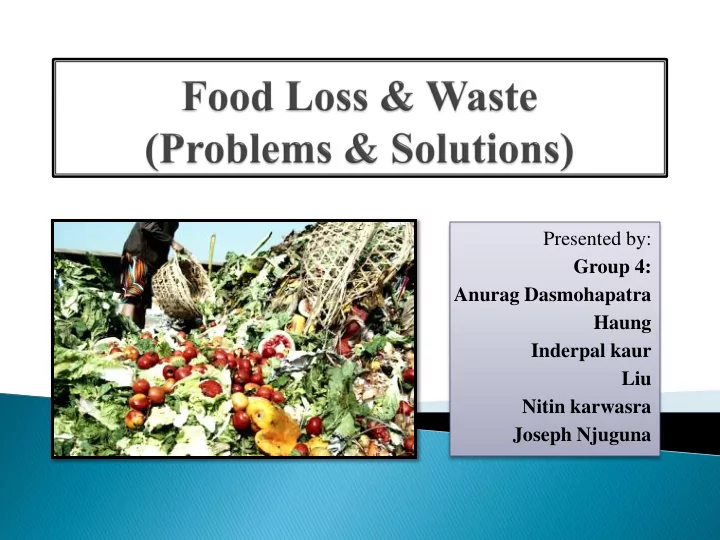
SLIDE 1
Presented by: Group 4: Anurag Dasmohapatra Haung Inderpal kaur Liu Nitin karwasra Joseph Njuguna
SLIDE 2 INTRODUCTION
- 1. According to FAO, almost one-third of food produced for
human consumption – approximately 1.3 billion tonnes per year, is either lost or wasted globally.
- 2. The issue of food losses is an high alert situation for the efforts
to counter hunger, elevate income and ameliorate food security especially in the world’s poorest countries.
- 3. Food losses have an humongous impact on food security for
poor people, on food quality and safety, on economic development and on the environment.
SLIDE 3
DEFINITION Food loss is defined as “the decrease in quantity or quality of food” and are the agricultural or fisheries products intended for human consumption that are ultimately not eaten by people or that have incurred a reduction in quality reflected in their nutritional value, economic value or food safety. Food waste, refers to the discarding or alternative use of food that was fit for human consumption, by choice or after the food has been left to spoil or expire as a result of negligence.
SLIDE 4 TYPES OF FOOD LOSSES / WASTE
- Animal commodities and products
- Vegetable commodities and products
Further classified into -
- 1. Agricultural production
- 2. Post– harvest handling and storage
- 3. Processing
- 4. Distribution
- 5. Consumption
SLIDE 5
PROBLEMS
1. Risk of decreasing food security and nutritional quality 2. Due to food loss increased methane production and increased global warming 3. Increased water pollution due to mixing up off the debris due to waste material rotting 4. Increased microorganism growth and fear of new disease incidence 5. Last but not the least , even if we focus on increasing production and quality if we don’t minimize loss/waste nothing is going to change in future.
SLIDE 6
The destiny of wasted food
SLIDE 7
Per capita food losses and waste, at consumption and pre-consumptions stages
SLIDE 8
SLIDE 9
SLIDE 10 A gift of nature - principle depends on cooling by
evaporation.
Efficiency of evaporative cooler depends on humidity
Very dry, low humidity air can absorb a lot of moisture
so considerable cooling occurs.
In theory lowest temperature that can be reached is wet
bulb temperature.
It is a double brick-wall structure, structure, the cavity
is filled with sand and walls of the chamber are soaked in water.
SLIDE 11
1.
It does not require any electricity or power to operate
2.
Materials required like bricks, sand, bamboo etc. available easily and cheaply.
3.
Even unskilled labour can build the chamber, as it does not require any specialized skill.
4.
Small and marginal farmers can store a few days' harvest to avoid middlemen.
5.
Cool chambers can reduce temperature by 10-15 °C and maintain high humidity of about 95% that can increase shelf life and retain quality of horticultural produce.
SLIDE 12
Source: http://ucce.ucdavis.edu
SLIDE 13 Generally, tomato and eggplant had a shelf life of 7 and 4 days at
room temperature, respectively, as compared to 16 and 9 days when stored in the ZECC.
Tomato and eggplant treated with hot water reduced the
percentage of rotting.
Tomato treated with hot water at 60°C for three minutes and
eggplant treated with hot water at 45°C for an hour when stored inside silver-ion-coated containers in the ZECC showed extended shelf life of up to 28 and 15 days, respectively. Source:https://www.researchgate.net/publication/279974670_Zero_ Energy_Cool_Chamber_for_Extending_the_Shelf- Life_of_Tomato_and_Eggplant
SLIDE 14
Kale et al. (2016) Low Cost Storage Structures for Fruits and Vegetables Handling in Indian Conditions
SLIDE 15
Whirlpool’s Zera Food R Recycl ycler
Composting Zera food recycler
SLIDE 16
SLIDE 17
SLIDE 18
GADGETS AND GIZMOS THAT HELP REDUCE FOOD WASTE
Phresh Food Protector
Herb Keeper
SLIDE 19
SLIDE 20
Eliminating food waste requires behavioral changes, but GMOs can help too
SLIDE 21
knock-down LsXTH16 gene would improve lettuce shelf life
Short shelf life lettuce Long shelf life lettuce
SLIDE 22
knock out vacuolar invertase gene (Vinv) could have significantly lower levels of reducing sugars and acrylamide
SLIDE 23
SLIDE 24
Reducing Food Loss Close to the Farm
Improved storage methods Redistribute food
Reducing Food Waste Close to the Fork
Better food date labels Reduce portion sizes Launch consumer awareness campaigns
SLIDE 25
Develop a food loss and waste measurement protocol: Set food loss and waste reduction targets: Increase investment in reducing post-harvest losses in
developing countries:
Create entities devoted to reducing food waste in
developed countries:
Accelerate and support collaborative initiatives to
reduce food loss and waste:
SLIDE 26
Prevent and Reduce Food Waste in Your Own Life Spread the Word Volunteer with Local Food Rescue Organizations Start a Food Waste Campaign in Your Community Support Businesses with Good Food Waste Practices Engage with Local Government Tell Your Legislators That Food Waste Is an Important
Issue
Organize a Food Waste Event in Your Area
SLIDE 27
Bluapple BluWrap
SLIDE 28
- Copia
- Edipeel
- IRRI Super Bag
- Smart
Packaging
SLIDE 29
SLIDE 30
With thanks to faculty of Manna Centre