PRESENTATION SKILLS A. Structure of presentation Introduction - - PDF document

presentation skills
SMART_READER_LITE
LIVE PREVIEW

PRESENTATION SKILLS A. Structure of presentation Introduction - - PDF document

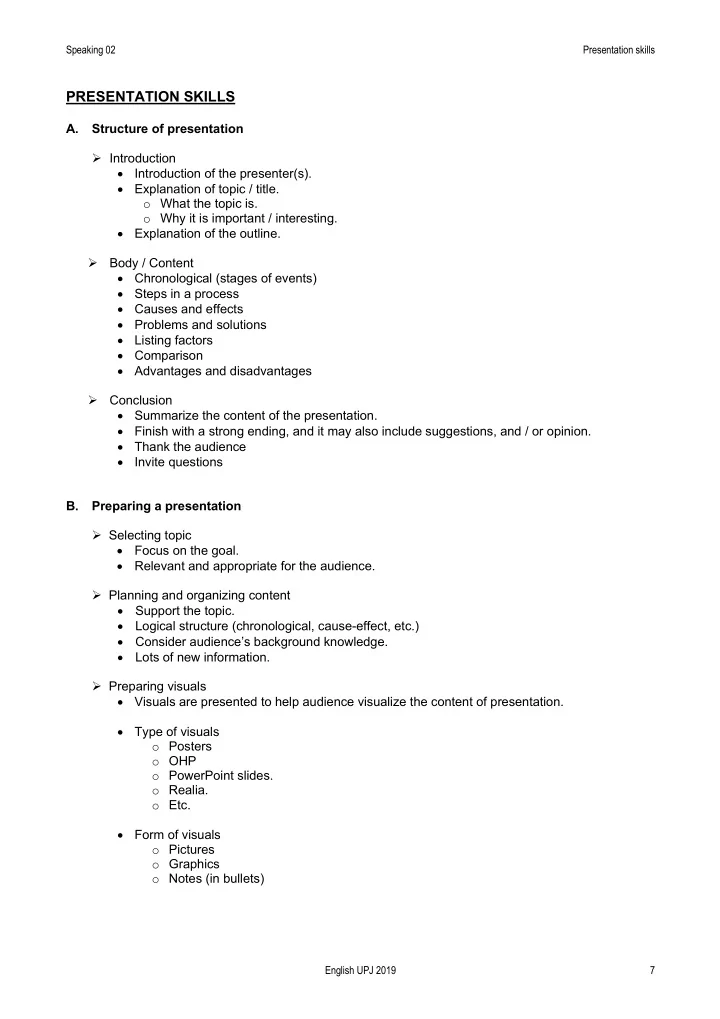
Speaking 02 Presentation skills PRESENTATION SKILLS A. Structure of presentation Introduction Introduction of the presenter(s). Explanation of topic / title. o What the topic is. o Why it is important / interesting. Explanation of


slide-1
SLIDE 1

Speaking 02 Presentation skills English UPJ 2019 7

PRESENTATION SKILLS

  • A. Structure of presentation

Ø Introduction

  • Introduction of the presenter(s).
  • Explanation of topic / title.
  • What the topic is.
  • Why it is important / interesting.
  • Explanation of the outline.

Ø Body / Content

  • Chronological (stages of events)
  • Steps in a process
  • Causes and effects
  • Problems and solutions
  • Listing factors
  • Comparison
  • Advantages and disadvantages

Ø Conclusion

  • Summarize the content of the presentation.
  • Finish with a strong ending, and it may also include suggestions, and / or opinion.
  • Thank the audience
  • Invite questions
  • B. Preparing a presentation

Ø Selecting topic

  • Focus on the goal.
  • Relevant and appropriate for the audience.

Ø Planning and organizing content

  • Support the topic.
  • Logical structure (chronological, cause-effect, etc.)
  • Consider audience’s background knowledge.
  • Lots of new information.

Ø Preparing visuals

  • Visuals are presented to help audience visualize the content of presentation.
  • Type of visuals
  • Posters
  • OHP
  • PowerPoint slides.
  • Realia.
  • Etc.
  • Form of visuals
  • Pictures
  • Graphics
  • Notes (in bullets)
slide-2
SLIDE 2

Speaking 02 Presentation skills English UPJ 2019 8

  • Rules of good visuals
  • Information can be clearly seen by the audience.
  • Use the same format and fonts throughout the presentation.
  • Not too much information on one visual.
  • Good slides often have the least information.

Ø Others

  • Time limit
  • Venue
  • Seating arrangements
  • Technical aspects
  • Etc.
  • C. Delivering a presentation

Ø Describing Facts and Figures

  • Use visuals where possible
  • Pronounce numbers clearly.
  • Repeat important information if necessary
  • Select only the important and relevant information

Ø Presenting graphics / tables

  • Do not read out all information in the graphic.
  • Pick out high and low figures.
  • Pick out surprising / interesting figures.
  • Summarize the data.

Ø Supporting a point of view

  • Giving examples, evidence, conclusion of earlier studies / reports
  • Recognize opposing view but (politely) saying why it is wrong
  • Avoid emotive language and unsupported personal experience.

Ø Rules of Delivery

  • Speak clearly and confidently.
  • Speak loudly enough for everyone to hear.
  • Do not read out the information written on visuals.
  • Give ‘open gesture’
  • Face and make eye contact with people in the audience
  • Do not cross arms / legs
  • Do not read from notes
  • D. Language of Presentation

Ø Introduction

  • Good morning, thank you for joining me today.
  • My topic today is …
  • The topic I intend to discuss is …
  • Our team/group will be discussing …
  • I’m going to divide this talk into three parts.
  • There a four main points I’d like to discuss: A, B, C and D.
slide-3
SLIDE 3

Speaking 02 Presentation skills English UPJ 2019 9

Ø Body (Starting)

  • I want to start by …,
  • Let’s begin by … ,

(Bridging between parts)

  • Now let's consider ...
  • Let’s move on to …
  • My next point is ...
  • Now what about …

(Referring to visual aid)

  • Now, I'll show you …
  • As you can see here …
  • The diagram indicates …
  • This slide shows…

Ø Conclusion

  • To sum up ...
  • As a result ...
  • To conclude ...
  • Finally, I want to say ...

Ø Inviting Questions

  • Any questions?
  • Are there any questions you’d like to ask?
  • Does anyone have any questions?
  • If you have any questions, please ask.

Ø Building rapport (Additional Skills) (Common experience)

  • “As all of us probably know, ...”
  • “When we think of …, most of us probably have … in mind.”

(Anecdote)

  • “I remember when …”
  • “An interesting thing happened to me,

(Asking Questions)

  • “How many people ...”
  • “Is anyone here from ...?”

Reference

  • Harrison, R. (2011). Headway. Academic Skills. Listening, Speaking, and Study Skills. Level 3.

Oxford, Oxford University Press.