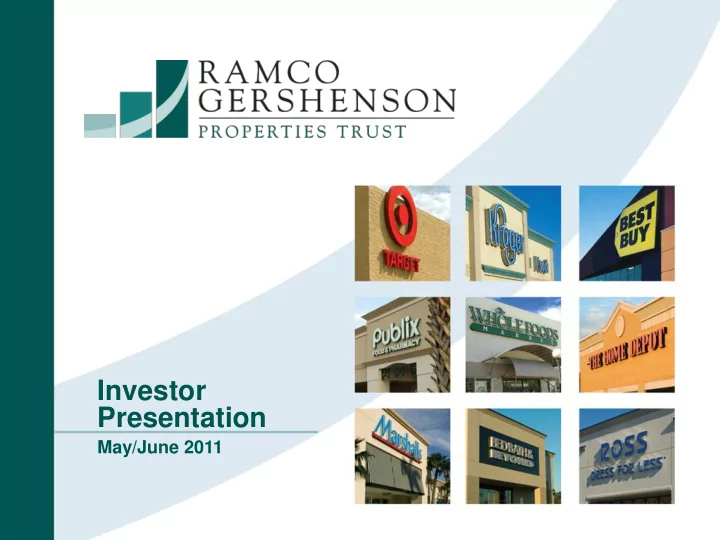
Presentation May/June 2011 Investment Highlights Superior shopping - - PowerPoint PPT Presentation

presentation
SMART_READER_LITE
LIVE PREVIEW

Presentation May/June 2011 Investment Highlights Superior shopping - - PowerPoint PPT Presentation

Investor Presentation May/June 2011 Investment Highlights Superior shopping center portfolio in major metropolitan markets. Diverse, credit-quality tenant mix with strong grocery and destination anchors. Consistently improving


slide-1
SLIDE 1

Investor Presentation

May/June 2011

slide-2
SLIDE 2

Investment Highlights

2

Superior shopping center portfolio in major metropolitan markets.

Diverse, credit-quality tenant mix with strong grocery and destination anchors.

Consistently improving operating metrics and accelerating leasing velocity.

Significant balance sheet de-levering with manageable debt maturity schedule.

Committed to building long-term shareholder value.

slide-3
SLIDE 3

Company Overview

  • Listed on the NYSE in 1996.
  • Properties located primarily in the Eastern and

Midwestern United States.

  • 89 retail shopping centers predominantly anchored

by supermarket and/or national chain stores.

  • Over $2.0 billion in assets under management in

twelve states.

  • $1.1 billion total capitalization.

3

Source: Company filings as of March 31, 2011.

slide-4
SLIDE 4

Operating Strategy- Core Portfolio and Markets

slide-5
SLIDE 5

Operating Strategy - Core Portfolio

  • Centers predominantly located in metropolitan

markets with strong demographics.

  • Resilient shopping center type, primarily grocery and

value retail.

  • Multi-anchor format with strong regional and

national destination retailers promoting stability and draw.

  • Commitment to value-added portfolio improvement.

5

slide-6
SLIDE 6

Leading Metropolitan Markets

  • Approximately 90% of the total portfolio is located in 16 of the top 100 MSAs1 in the Country.
  • Focus on strong trade area demographics that far exceed state wide averages.
  • High barrier to entry markets.

Total Number of Properties2 89 Total GLA 20.6M Company owned GLA 15.7M 3 Mile Population3 66,018 5 Mile Population3 169,124 3 Mile Avg. HH Income3 $79,070 5 Mile Avg. HH Income3 $80,069

6

1MSA per US Census Bureau. 2Includes the acquisition of Heritage Place and the sale of Lantana in 2Q2011. 3Per CoStar Group: 2010 data.

slide-7
SLIDE 7

High quality portfolio in SE Michigan

Competitive Advantage in Michigan and Florida

7

1Source: CoStar Group: 2010 data. As defined by number of shopping centers owned. 2Includes both company-owned and anchor owned space. 3Includes company-owned space in wholly-owned and joint venture properties. 4Source: CoStar Group: 2010 data.

  • Largest owner and manager of shopping centers in Southeast Michigan1.
  • Majority of centers predominantly located in or near Oakland County, one of the

wealthiest counties in the nation (per capita).

  • Current leased occupancy of 93.7%, versus total portfolio leased occupancy of 90.1%.
  • High-quality, multi-anchored centers with average total GLA of 250,000 square feet2.

Total # of Properties 24 Gross Leasable Area3 4.5M 5 Mile Population4 228,224 5 Mile Avg. HH Income4 $86,759

SE Michigan SE Florida

  • Infill market locations with superior demographics.
  • Six Publix anchored centers generating sales of over $520 psf.
  • Large concentration of properties creates economies of scale.

Total # of Properties 13 Gross Leasable Area3 2.5M 5 Mile Population4 198,195 5 Mile Avg. HH Income4 $76,757

Significant ownership in SE Florida

slide-8
SLIDE 8

Strong Anchor Tenant Mix

8

2.3% 2.6% 3.9% 4.3% 4.5% 10.3% WRI FRT RPT DDR REG EQY

  • Diverse line-up of high-quality national and regional tenants account for 81% of total base rent.
  • Limited exposure to any single tenant.
  • Approximately 56% of centers are grocery anchored.
  • Average grocer sales of approximately $450 PSF.

1Source: Peer company filings as of March 31, 2011, based on annualized minimum rents. 2Source: Latest tenant filings per CreditRiskMonitor for the quarter ended March 31, 2011. Includes the

combined wholly owned and joint venture portfolio.

Tenant Credit Rating S&P/Moody’s

  • No. of

Stores % of Annualized Base Rent

T.J. Maxx/Marshalls A/A3 20 3.9% Publix NR/NR 12 3.0% Home Depot BBB+/Baa1 3 2.0% Kmart/Sears BB-/Ba2 6 1.8% Dollar Tree NR/NR 29 1.8% OfficeMax B/B1 11 1.8% Jo-Ann Fabrics NR/NR 6 1.7% Burlington Coat NR/NR 5 1.6% Staples BBB/Baa2 10 1.5% Best Buy BBB-/Baa2 5 1.5%

RPT’s top tenants2 Top tenant exposure (peers)1

slide-9
SLIDE 9

Ramco’s Long-Term Business Strategy

slide-10
SLIDE 10

Executing on Three-year Strategic Plan- Commitment to Long-term Shareholder Value

Further strengthen the balance sheet and improving liquidity.

10

  • Aggressively lease vacant space and replace underperforming retailers to drive
  • ccupancy and increase average base rents.
  • Sell non-core shopping centers and/or land, recycling capital into higher quality properties

with dominant anchors in targeted metropolitan markets.

  • Expand geographic footprint and reduce concentration in Michigan portfolio.
  • Undertake value-add redevelopments and pursue developments on a selective basis with

attractive risk-adjusted returns.

  • Pursue a strategy of low leverage and unencumbered assets.
  • Pay down debt with proceeds from sales of shopping centers, land and outparcels.
  • Achieve consistently improving debt metrics.

Continually improve the quality of the shopping center portfolio to generate predictable and sustainable earnings and NAV growth.

Goals Strategy

Streamline corporate structure and position RPT as a top tier shopping center REIT.

  • Focus on core business fundamentals to achieve long-range financial and operational

goals.

  • Ensure operational efficiencies.
  • Continue to reduce G & A as a percentage of revenue.

10

slide-11
SLIDE 11

Goal-Continually Improve the Quality of the Portfolio

Strategy: Aggressively lease our shopping centers to achieve positive same-center NOI each year and increase occupancy to 94%.

The Plan:

  • Fortify regional leasing teams with additional agents and

canvassers to increase leasing velocity.

  • Institute new short-form lease agreement reducing cost and time

spent on lease negotiations.

  • Retain high percentage of existing expiring tenancies.

11

slide-12
SLIDE 12

Focus on Operating Metrics

12

  • The company achieved its highest level of new lease signings and renewals during 2010.

1Q '10 2Q '10 3Q '10 4Q '10 1Q'11

  • 1.8%
  • 1.5% -1.5%

2010 Activity

Leases Signed 141 leases/849,000 SF Anchor Leases Signed 13 leases/354,000 SF Shop Tenancy Signed 128 leases/495,000 SF Renewals: 203 of 268 Expirations 75.7% Retention

  • 1.0%

Improving Cash NOI Accelerating Leasing Velocity

  • 0.1%

2011 Operating Statistics - Projections

  • Leased occupancy of 91%-92%.
  • Tenant retention rate of > 77%.
  • New lease signings increase of 10% - 15%

above 2010 level.

  • Same Center NOI of between 1.0% to -1.0%.
slide-13
SLIDE 13

Goal-Continually Improve the Quality of the Portfolio

Strategy: Sell non-strategic shopping centers and recycle capital into high- quality properties in geographically diverse markets.

The Plan:

  • Completed thorough review of existing portfolio and identified specific

shopping centers and outparcels for potential sale.

  • Non-core disposition candidates not predominantly distressed.
  • Goal is to acquire $50 million to $75 million above asset dispositions with

the following characteristics:

  • Metro markets promoting geographic diversification.
  • Superior demographic/profile.
  • Market dominant community centers with grocery or discount anchor component.
  • Competitive pricing with upside potential.

13

slide-14
SLIDE 14

Goal-Continually Improve the Quality of the Portfolio

14

Acquisition Highlights:

  • 107,000 SF grocery-anchored community shopping center.
  • 55,000 SF Jewel-Osco Supermarket currently generating sales of over

$650 PSF.

  • 3 mile trade area population/average household income:

28,325/$111,000.

  • Opportunity for lease-up of small shop space and sell net leased

national credit outlots with flat rents.

Strategic Acquisition: Liberty Square in Wauconda (Chicago), Illinois

Investment Highlights:

  • Located in targeted Chicago

MSA market.

  • Number one grocer in Illinois

with very strong sales (Jewel- Osco).

  • Extremely high average

household incomes.

slide-15
SLIDE 15

Goal-Continually Improve the Quality of the Portfolio

15

Strategic Acquisition: The Shoppes at Fox River in Waukesha (Milwaukee), Wisconsin

Acquisition Highlights:

  • 136,000 SF grocery-anchored community center in Milwaukee MSA

market, shadow anchored by 132,000 SF Target.

  • 61,045 SF Pick ‘n Save Supermarket currently generating sales of over

$480 PSF.

  • 3 mile trade area population/average household income:

59,242/$77,941.

  • Opportunity for redevelopment/expansion.

Investment Highlights:

  • Growing trade area.
  • Close proximity to existing assets.
  • Geographic diversification at an

attractive price.

slide-16
SLIDE 16

Goal-Continually Improve the Quality of the Portfolio

16

Strategic Acquisition: Heritage Place, Creve Coeur (St. Louis), Missouri

Acquisition Highlights:

  • 269,000 SF grocery-anchored community center in St. Louis MSA

market.

  • Anchors include Dierbergs (high-end specialty grocery), Marshalls,

T.J. Maxx, OfficeMax, and Petco.

  • 3 mile trade area average population/household income:

57,913/$96,115.

  • 90.4% occupied, with immediate lease-up potential.

Investment Highlights:

  • High-end specialty grocery-

anchored center.

  • Multiple creditworthy mid-

box anchors.

  • Attractive portfolio

expansion market.

slide-17
SLIDE 17

Goal-Continually Improve the Quality of the Portfolio

17

Strategy: Redevelop/Develop properties with attractive risk adjusted returns.

The Plan:

  • Proactively respond to increasing tenant sales, changing consumer

tastes and opportunities to expand, retenant or redevelop the core portfolio.

  • Pursue a conservative approach to existing pipeline of potential

development projects including land sales and partner participation.

  • Developments will only be considered upon achieving certain, specific

criteria:

  • Critical mass of signed anchor leases.
  • Demonstrated demand for small shop space.
  • Firm construction costs.
  • Construction financing in place.
slide-18
SLIDE 18

Case Study-Portfolio Improvement

18

  • Former Farmer Jack (A&P) anchored center acquired in 2008.
  • Replaced Farmer Jack with upscale specialty grocer Plum Market.
  • Added a number of destination retailers including Running Fit, Five Guys Burgers & Fries, Churchill’s Cigars

and 7 Bar and Grill.

  • Completed façade renovation, parking lot improvements and pylon signage upgrades.
  • Stabilizing end of 3Q2011.

BEFORE AFTER

2010 Redevelopment: The Shops at Old Orchard, West Bloomfield, Michigan

slide-19
SLIDE 19

Conservative Approach to Development

  • Currently the company has four development projects in the pre-

development phase.

  • Proceeding with the development process will be considered after meeting

specific criteria.

  • Approximately 50% of land held for development is slated to be sold over a

number of years to anchors, out parcel retailers, or non-retail developers in conjunction with RPT’s development of the projects, reducing land holdings to approximately 4.0% of total assets.

  • Will re-evaluate alternatives of proceeding with each project or selling the

fully entitled land with tenants commitments.

19

slide-20
SLIDE 20

Goal-Commitment to Further Strengthen the Balance Sheet

20

Strategy: Reduce cost of capital, limit risk and maintain a balanced capital structure to position the company to take advantage of future

  • pportunities.

The Plan:

  • Reduce overall leverage utilizing proceeds from asset sales.
  • New line of credit at favorable terms with expanded borrowing

power.

  • Finance a limited number of larger assets and utilize proceeds to

produce a greater pool of unencumbered assets.

  • Improve debt metrics:
  • Net Debt to EBITDA goal of 6.5x to 7.0x
  • Fixed charge coverage of 2.0x to 2.5x
  • Overall leverage of less than 50%
slide-21
SLIDE 21

Improved Capital Structure and Liquidity

21

1 Includes capital lease obligations and funding for acquisition of Heritage Place. Excludes pro rata share

  • f unconsolidated joint venture debt.

2 Excludes pro rata share of unconsolidated joint venture debt.

Debt Measures Pro Forma May 13, 2011

Total Consolidated Debt1 $541.9 Average Term2 5.6 yrs Debt to Market Capitalization 46% Pro Rata Share of JV Debt $108 million

Recent Activities

Total Consolidated Debt, $541.9 Convertible Perpetual Preferred Equity, $102.6 Shareholder's Equity, $527.6

  • Completed $100 million convertible perpetual preferred offering.
  • Closed new 5-year $75 million term loan and 3-year $175 million line of credit.
  • Financed Jackson Crossing shopping center with 7-year CMBS loan at $24.7 million.
  • Raised $8.9 million through controlled equity offering.

Total Market Capitalization Pro-Forma as of May 13, 2011

slide-22
SLIDE 22

Debt Maturities and Liquidity

22

  • Manageable debt schedule with staggered maturities.
  • Paid off $30 million bridge loan, $30 million term loan and reduced line borrowings with proceeds

from equity offerings, asset sales and property financings.

  • Current weighted average term to maturity 5.6 years1.

1 Includes funding for acquisition of Heritage Place. Excludes pro rata share of unconsolidated joint venture debt.

$19.8 $34.1 $23.5 $31.8 $78.6 $175.8 $28.1 $3.4 $9.2 $60.6 $14.7 $20.2

$0.0 $50.0 $100.0 $150.0 $200.0 $250.0 2011 2012 2013 2014 2015 2016+

($ in millions)

Mortgage Corporate JV (at pro rata share)

$23.2 $43.3 $72.8 $41.0 $75.0 $224.1

Pro Forma Debt Maturity Schedule as of May 13, 2011

$168.3 $84.1

slide-23
SLIDE 23

Goal-Position RPT as a Top Tier REIT

23

Strategy: Improve processes and consolidate functions to reduce costs and increase efficiency.

The Plan:

  • Implement cost-effective technology solutions to facilitate

productivity.

  • Realign responsibilities to increase efficiency.
  • Take advantage of current staffing levels to achieve economies of

scale as the company grows.

slide-24
SLIDE 24

Safe Harbor Statement

24

Information included herein contains forward-looking statements within the meaning of Section 27A of the Securities Act of 1933, as amended, or the “Securities Act”, and Section 21E of the Securities Exchange Act of 1934, as amended, or the “Exchange Act.” You can identify these forward-looking statements by our use of the words “believe,” “anticipate,” “plan,” “expect,” “may,” “might,” “should,” “will,” “intend,” “estimate,” “predict” and similar expressions, whether in the negative or

  • affirmative. These forward-looking statements represent our expectations or beliefs concerning future events, including:

statements regarding future developments and joint ventures, rents, returns, and earnings; statements regarding the continuation of trends; and any statements regarding the sufficiency of our cash balances and cash generated from

  • perating, investing, and financing activities for our future liquidity and capital resource needs. We caution that although

forward-looking statements reflect our good faith beliefs and reasonable judgment based upon current information, these statements are not guarantees of future performance and are qualified by important factors that could cause actual results to differ materially from those in the forward-looking statements, because of risks, uncertainties, and factors including, but not limited to: the final size of the offering; our success or failure in implementing our business strategy; economic conditions generally and in the commercial real estate and finance markets specifically; our cost of capital, which depends in part on our asset quality, our relationships with lenders and other capital providers; our business prospects and outlook; changes in governmental regulations, tax rates and similar matters; and our continuing to qualify as a REIT. Further, we have included important factors under the heading “Risk Factors” and elsewhere in our Annual Report on Form 10-K for the year ended December 31, 2010, and other periodic reports, that we believe could cause our actual results to differ materially from the forward-looking statements that we make. All forward-looking statements are made as of the date hereof or the date specified herein, based on information available to us as of such date. Except as required by law, we do not undertake any obligation to update our forward-looking statements or the risk factors contained herein to reflect new information or future events or otherwise. You are cautioned not to place undue reliance on forward-looking statements.

slide-25
SLIDE 25

Investor Presentation

May/June 2011