Presentation plan: 1-2 hour training Teams enhances the way - - PDF document

presentation plan 1 2 hour training
SMART_READER_LITE
LIVE PREVIEW

Presentation plan: 1-2 hour training Teams enhances the way - - PDF document

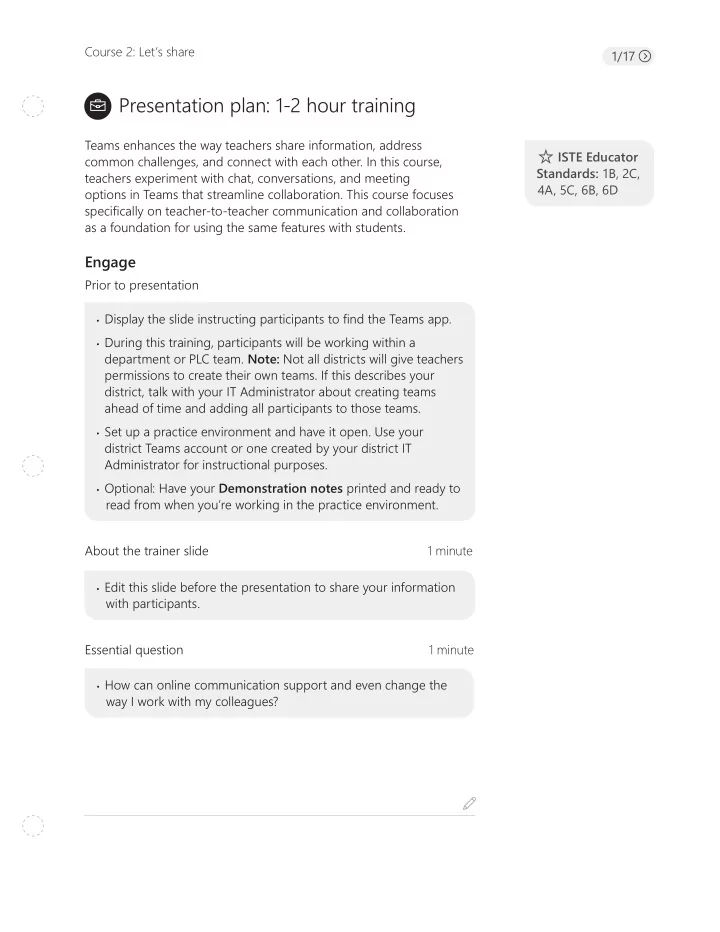
Course 2: Lets share 1/17 Presentation plan: 1-2 hour training Teams enhances the way teachers share information, address ISTE Educator common challenges, and connect with each other. In this course, Standards: 1B, 2C, teachers


slide-1
SLIDE 1

 Course 2: Let’s share

  • Display the slide instructing participants to fjnd the Teams app.
  • During this training, participants will be working within a

department or PLC team. Note: Not all districts will give teachers permissions to create their own teams. If this describes your district, talk with your IT Administrator about creating teams ahead of time and adding all participants to those teams.

  • Set up a practice environment and have it open. Use your

district Teams account or one created by your district IT Administrator for instructional purposes.

  • Optional: Have your Demonstration notes printed and ready to

read from when you’re working in the practice environment.

Presentation plan: 1-2 hour training

1/17 1 minute 1 minute

  • Edit this slide before the presentation to share your information

with participants.

  • How can online communication support and even change the

way I work with my colleagues? Essential question About the trainer slide

 Engage

Prior to presentation Teams enhances the way teachers share information, address common challenges, and connect with each other. In this course, teachers experiment with chat, conversations, and meeting

  • ptions in Teams that streamline collaboration. This course focuses

specifjcally on teacher-to-teacher communication and collaboration as a foundation for using the same features with students. ISTE Educator Standards: 1B, 2C, 4A, 5C, 6B, 6D

slide-2
SLIDE 2

 Course 2: Let’s share

  • Note: This section is optional. Use or omit based on your

audience’s need for review.

  • Refresh knowledge of Teams features by going through the

screenshots on the slides.

  • Refer participants to the Test your knowledge of Teams

features handout and the Teams spaces takeaway.

  • Facilitates collaboration between teachers
  • Allows educators to collaborate, converse, and share

with each other Value Review 1 minute 5 minutes 2-3 minutes

  • “What are some ways you currently communicate online

with your colleagues?”

  • “What could be done to improve these methods and make

them easier, more effjcient, or more efgective?” Discuss 1 minute

  • Distribute Learner skills checklist and ask participants to use

this document to track their learning and take notes. Skills Checklist 2/17 Take mental note of responses. They will likely connect to scenarios in this training.

slide-3
SLIDE 3

 Course 2: Let’s share

  • Invite teachers to explore the features of conversations that

you’ve just covered on their own, including:

  • Adding team members
  • Posting a reminder
  • @mentioning
  • And for more practice:
  • Customizing messages (add a gif or emoji;

edit text size and color)

  • Mark a message as important
  • Save a message
  • Refer to the Conversations in Teams activity handout

and the Managing conversations in Teams takeaway. Explore 10 minutes

  • Set up the sample situation about planning a fjeld trip.
  • Toggle into your demonstration team.
  • Explain:
  • What a conversation is.
  • Who can see conversations.
  • Where to fjnd them in Teams.
  • Demonstrate how to:
  • Start a new conversation about hypothetical

fjeld trip scenario.

  • @mention a specifjc person to demonstrate how to

draw attention to a conversation.

  • Add someone who isn’t already on the team so they

can become aware of the conversation.

Explain, Explore, Experience

In this section, participants will practice steps for working in Teams, including starting conversations, private chats, fjles, and meetings. 5-7 minutes Conversations: Situation & Demonstration 3/17

slide-4
SLIDE 4

 Course 2: Let’s share

  • Have teachers discuss what they discovered and any ideas

they have for using conversations in the classroom using the questions on the screen to guide them:

  • A ha! moments
  • Uses within a PLC or department
  • Uses with students (extra challenge)

2-3 minutes Private Chats: Situation & Demonstration 3-4 minutes

  • Continue the sample situation about planning a department

fjeld trip, shifting the discussion to why teachers might need both group and private discussions to plan for the trip.

  • Toggle into your practice team.
  • Explain:
  • What a chat is.
  • Who can see chats.
  • Where to fjnd them in Teams.
  • Demonstrate how to:
  • Start a private chat.
  • Send a message.
  • Customize the message with fonts, text size,

emojis, stickers, and gifs.

  • Add another person to the chat.
  • Save a message for future reference.
  • Invite teachers to explore the features of private chats that

you’ve just covered including:

  • Starting a private chat
  • Formatting a message
  • Saving a message

Explore 5 minutes Discuss 4/17

slide-5
SLIDE 5

 Course 2: Let’s share

  • Refer participants to the Private chats in Teams activity

handout and the Managing private chats in Teams takeaway. Explore (Continued)

  • Have participants discuss what they discovered and any ideas

they have for using private chats in their collaboration with colleagues, using the questions on the screen to guide them:

  • A ha! moments
  • Uses within a PLC or department
  • Uses with students (extra challenge)

Discuss 1-2 minutes

  • Play the Managing classroom conversations in Microsoft Teams

video as a review to summarize what participants have just experienced. Review: Play Video 4 minutes Brain Break 2 minutes

  • Give participants a 2-minute brain break.
  • Have them partner up and mimic what the other one does, or

select a brain break that best meets participants’ needs.

  • Continue the sample situation about planning a department

fjeld trip, shifting the discussion to the need to distribute a permission slip.

  • Toggle into the practice team.

Files: Situation & Demonstration 7-8 minutes Yay! Time for a brain break!

5/17

slide-6
SLIDE 6

Course 2: Let’s share

  • Explain:
  • Why you might want to work with fjles in Teams.

(Allows documents to be saved in one place)

  • Where in the interface participants will work with their fjles.
  • Demonstrate how to:
  • Create a new fjle.
  • Edit it.
  • Open it in multiple platforms.
  • Share a link to the fjle in a conversation or chat.
  • Upload a fjle.
  • Find the fjle in the Files tab.

Files: Situation & Demonstration (Continued)

  • Invite teachers to explore the features of fjles that you’ve just

covered on their own, including:

  • Uploading a fjle to a conversation
  • Edit the fjle from a conversation and talk to teammates

in the conversation pane while editing it.

  • Find the fjle in the Files tab.
  • Share a link to a fjle in a private chat.
  • Save the message with the fjle.
  • Search for the fjle in the search bar.
  • Refer participants to the Files in Teams activity handout and

the Sharing and saving fjles in Teams takeaway. Explore 5 minutes

  • Have participants discuss what they discovered and any ideas

they have for using fjles in Teams with colleagues, using the questions on the screen to guide them:

  • A ha! moments
  • Uses within a PLC or department
  • Uses with students (extra challenge)

Discuss 1-2 minutes  6/17

slide-7
SLIDE 7

 Course 2: Let’s share

  • Play the Saving and sharing fjles in Microsoft Teams video as a

review to summarize what participants have just experienced. Review: Play video

  • Continue the sample situation about planning a department

fjeld trip, shifting the discussion to the need to meet about the upcoming fjeld trip.

  • Toggle into the practice environment (your personal team).
  • Explain:
  • Why you might want to host a Teams video meeting with

your department or privately with colleagues.

  • That there are two ways to meet in Teams: meet now,
  • r schedule a meeting for later.
  • Demonstrate how to:
  • Find the Meetings icon.
  • See what you’ve got on the calendar.
  • Schedule a meeting.
  • Add colleagues to the meeting.
  • Meet now in a channel.
  • Meet now privately.

Meetings: Situation & Demonstration 7-8 minutes

  • Invite teachers to explore the features of Meetings that you’ve

just covered on their own, including:

  • Launching a meeting from a private chat
  • Inviting additional people
  • Answering a Meet now call
  • Sharing your screen
  • Sharing a fjle to the call
  • Launching a meeting from a conversation
  • Refer participants to the Meetings activity handout and the

Meeting in Teams takeaway. Explore 5 minutes 7-8 minutes 7/17

slide-8
SLIDE 8

 Course 2: Let’s share

  • Have teachers discuss what they discovered and any ideas

they have for using conversations in the classroom, using the questions on the screen to guide them:

  • A ha! moments
  • Uses within a PLC or department
  • Uses with students (extra challenge)

Discuss 1-2 minutes

  • Play the Meet now or meet later in Microsoft Teams video as a

review to summarize what participants have just experienced. Review: Play video 3 minutes

Evaluate

2 minutes 5 minutes 10 minutes

  • Prompt: “How can you use features in Teams to enhance your

communication and collaboration with colleagues?”

  • Prompt participants to provide feedback using the QR code
  • r link to the survey.
  • Prompt: “Identify new ways you could collaborate with

colleagues using Teams.”

  • Plan: Create a plan to bring regular communication
  • r meetings online using Teams.

Plan

Elaborate

Review essential question Time to witness the teacher magic!

8/17

slide-9
SLIDE 9

 Course 2: Let’s share

  • Laptop
  • Offjce 365 login credentials
  • Teams downloaded prior to training, with a pre-created team

Presenter

Supplies

Participant Suggested classroom device access Software requirements:

  • Computer: Windows 10; Offjce 2013 or later; .Net Framework

4.5.0 or later

  • Mobile: iOS 10.0 or later; Android 4.3 or later
  • Account: O365 for EDU account or a general Microsoft account

  • WiFi access
  • Laptop or mobile device with access to Microsoft Offjce 365

and login credentials

  • Power cord for laptop or mobile device
  • Projection capability
  • Speaker for external audio
  • Dongle to connect to projector
  • Printed copies of Learner’s skills checklist
  • Request that teachers download the Teams app ahead of time.

To implement the above activities, we suggest access to a Windows 10 computer with:

  • Processor: 1 gigahertz (GHz) or faster
  • RAM: 1 gigabyte (GB) (32-bit) or 2 GB (64-bit)
  • 16 GB of free hard disk space
  • Graphics card: Microsoft DirectX 9 graphics device

with WDDM driver

  • A Microsoft account and internet access

9/17 Don’t forget to bring a dongle along with your amazing skill.

slide-10
SLIDE 10

Course 2: Let’s share

  • “Now I’ll demonstrate how to have a conversation in Teams.”
  • “Any conversation you start within a team can be seen by

any member of that team.”

  • “In other words, these are group conversations. We’ll cover

how to have private conversations later in our section on chats.”

  • “We’re going to work inside departmental and PLC teams

we have already created.”

  • “To begin, click into your department team.”
  • “Select the channel you want to start the discussion in. If

you don’t have a specifjc one, just use the General channel.”

  • “Navigate down to the conversation pane.”
  • “You’ll know you’re there because you’ll see the words,

‘Start a new conversation.”

  • “Click into the box.”
  • “Type your message to your department.”
  • “Click the paper airplane to send it, or just hit return.”

Demonstration notes

Conversations:

This is a series of scripts you can read while you’re covering the Demonstration sections of the Presentation plan. If you’re already expert in Teams—and you wouldn’t use our tongue in cheek voice— feel free to teach these demonstrations however you like while you’re covering the noted topics. You’ll also fjnd these notes in the “Say this/Do this” section of the notes in the Presenter’s slide deck. (Continued on the following page) 10/17 Use this

  • ptional script

to support your demonstrations.

slide-11
SLIDE 11

Course 2: Let’s share

Conversation (continued)

  • “Right now, I’m going to imagine I’m having a

conversation in Teams about an upcoming fjeld trip. Let’s say in this scenario I have this one teacher who was absent on the day most of the conversation happened, and I want to make sure when they login, their attention is drawn to the discussion.”

  • “I click back into the box.”
  • “Then I type the @ symbol along with their name.

Next time that colleague logs in to Teams, they will see a notifjcation in their activity bell and know to check that conversation thread.”

  • “You can use @mentions for all sorts of things, drawing

a colleague’s attention to uploaded fjles, asking for their

  • pinion or contribution, or simply keeping the whole

team included.”

  • “Okay, so let’s say I realize partway through the

conversation about this fjeld trip that I’d like my instructional assistant to be included, but they are not a member of our team yet. As it stands currently, they will not see this conversation.”

  • “Let’s add them.”
  • “Refer to your Create a team takeaway for more

information either as I talk, or later to refresh your memory.”

  • “I’m selecting the More button next to the team,

then “Add members.”

  • “For this scenario, I’m making sure I’ve selected Teachers.”
  • “I type in the name of my teaching assistant.”
  • “Then I click add.”
  • “We’re done! Now the instructional assistant can see the

entire conversation taking place in the channel.”

11/17

slide-12
SLIDE 12

Course 2: Let’s share

  • “To start or add to a chat, I’ll click on the Chat icon in the

app bar.”

  • “This brings up all of the private chats I’m currently in.”
  • “If I’ve previously chatted with the person I’m reaching out

to the chat will be listed here for me to click into.”

  • “Since I haven’t, I’ll select the New chat icon.”
  • “Now I’ll type in the name of the instructional assistant.”
  • “The name I want should pop up on its own before I get too

far.”

  • “I’ll type my message in the New message box.”
  • “As in Conversations, I can augment the message by

attaching a fjle, customizing the font type, size, or color, or sending an emoji, sticker, or gif.”

  • “Now I’ll just push the paper airplane to send, or hit enter.”
  • “Now, let’s say I want to add someone new to the chat, like

another team member.”

  • “I’ll select the Add people icon.”
  • “Type in the name of the desired teacher.”

Private chats

(Continued on the following page) 12/17

slide-13
SLIDE 13

Course 2: Let’s share

  • “I’m asked to decide if I (1) do NOT want to include the chat
  • history. If I select this option, the new person won’t see

anything I’ve written to the person I was already chatting with.”

  • “(2) To include the chat history, but only from the previous

number of days I select.”

  • “(3) To include all chat history.”
  • “I make my choice, and select Add.”
  • “You can save a message for future reference by clicking on

the bookmark.”

  • “If you tried this out in the extra challenge portion of the

Conversations activity, you’ll notice this works in exactly the same way.”

  • “As you can see, there are also great applications here for

working with students, which we’ll talk about more in the next course.”

  • “You might, for example, chat 1:1 with a student to provide

individualized support.”

  • “Or, you might have a group chat with a few students about

a group project.” Private chats (continued)

13/17

slide-14
SLIDE 14

Course 2: Let’s share

  • “When I click into my team, I see a tab called Files.”
  • “Selecting it will show me all of the fjles that have been

shared in my team.”

  • “I’ll click New to create a new fjle for my permission slip and

share it to the channel.”

  • “I’ll select the kind of fjle I want it to be.”
  • “In this case, I’m going to choose a Microsoft Word document.”
  • “I’ll name it and select Create.”
  • “I’m going to quickly create a permission slip for the

hypothetical fjeld trip from the previous scenario.”

  • “I can now see the permission slip in the fjle activity stream.”
  • “I can edit it from here. This means I can make my permission

slip within the Teams environment without ever clicking out

  • f it.”
  • “However, if I want to open this fjle in its native environment,

I just have to select the More icon and then Open in Word or Open in Word Online.”

  • “If my document is already ready-made, I can add it easily to

the channel.”

  • “I’ll click Upload to upload a fjle into the channel.”
  • “When I want to share a fjle, I click the ellipses (…) next to the

fjle and select Get link.”

  • “Once I’ve copied this link, I can paste it into a conversation
  • r chat.”
  • “I choose Add storage to pull a fjle in from my preferred

cloud storage provider.” Files

(Continued on the following page) 14/17

slide-15
SLIDE 15

Course 2: Let’s share

  • “Clicking Open in Sharepoint will bring me to a shared space

in a Web browser where I can also see and access all of the team’s fjles.”

  • “This manner of adding and sharing fjles is intended to give

us a sense of where fjles live in Teams.”

  • “However, I can also easily add fjles directly to conversations

and private chats.”

  • “To add our permission slip right into the fjeld trip conversation,

all I have to do is click back into the conversation.”

  • “Beneath the conversation pane there is a paperclip icon.”
  • “I click it.”
  • “I’ll choose a fjle either from within Teams itself or from my

computer to upload.”

  • “Then I attach it and select send.”
  • “When I choose to upload a fjle this way, the fjle will still

appear in the fjles tab for that channel.”

  • “For some of you, you will be able to repeat this process

when adding fjles to private chats.”

  • “I’m going to click back into that chat I’m having with the

instructional assistant to show you what this looks like.”

  • “Then I’ll click the paperclip again and upload the permission

slip in exactly the same way.”

  • “If you don’t see a paperclip in a private chat when you

navigate there, don’t worry.”

  • “That means your permissions setting won’t allow you to upload

this way.”

  • “In that case, if you want to share a fjle in a private chat, you will

paste in the Teams link as we explored just a little while ago.” Files (continued)

15/17

slide-16
SLIDE 16

Course 2: Let’s share

  • “To schedule our team meeting, I’ll go to the Meetings app,

which can be found on the App bar.”

  • “If I’m using Outlook at school, any meetings I’ve already got

scheduled there will pop up now in Teams.”

  • “This way, when I’m scheduling my meeting, I’ll have a good

sense of when I’m free.”

  • “I can browse my calendar by date.”
  • “Or I can switch to agenda view.”
  • “To get this meeting scheduled, I select – you guessed it –

schedule a meeting.”

  • “Now I’ll fjll in details for our meeting.”
  • “I’ll include a title, like, ‘Meeting to Discuss Field Trip

Logistics.’”

  • “I’ll select a date and time right here.”
  • “In Details, I’ll fjll in a quick description of the meeting and an

agenda.”

  • “Under location, I’m going to decide to make this a Microsoft

Teams video meeting, but I could also select an in-person location here as well.”

  • “If I wanted to keep the meeting to just a few or one other

person, I’d type in and select their names here.”

  • “But since I want to meet with the whole department, I’m

going up to Select a channel to meet in.”

  • “Now I’ll select the name of our department team.”
  • “This way, every team member will receive an invitation and

automatically be able to join the meeting.” Meet later (schedule a meeting):

(Continued on the following page) 16/17

slide-17
SLIDE 17

Course 2: Let’s share

  • “And the meeting itself will actually be hosted in the team

channel I selected.”

  • “Now, I click Schedule a meeting.”
  • “Now that it’s scheduled, channel members can join the

meeting from the conversation stream, or from the meeting invite they received from me.” Meet later (continued)

  • “There are two ways I can host a meeting right now.”
  • “First, I can start a meeting through a conversation

in a channel.”

  • “Again, when I do this, anybody who is in the channel can join.”
  • “To do this, I simply click the camera icon beneath the

New message box.”

  • “To meet privately with my point person for school buses,

I open up a chat with the person I’d like to speak to.”

  • “I’ll select either the video or phone icons at the top of the

chat, and our meeting will begin.”

  • “I can also add more people to the private meeting by

clicking on the people icon and typing in any relevant names.”

  • “When I’m in the meeting, I’ll be able to chat with

collaborators in the chat pane and add fjles right next to the screen where we’re meeting.”

  • “You’ll play around with these features when we take time to

explore them on our own.” Meet now:

17/17