Presentation plan: 1-2 hour training Teams enhances the way - - PDF document

presentation plan 1 2 hour training
SMART_READER_LITE
LIVE PREVIEW

Presentation plan: 1-2 hour training Teams enhances the way - - PDF document

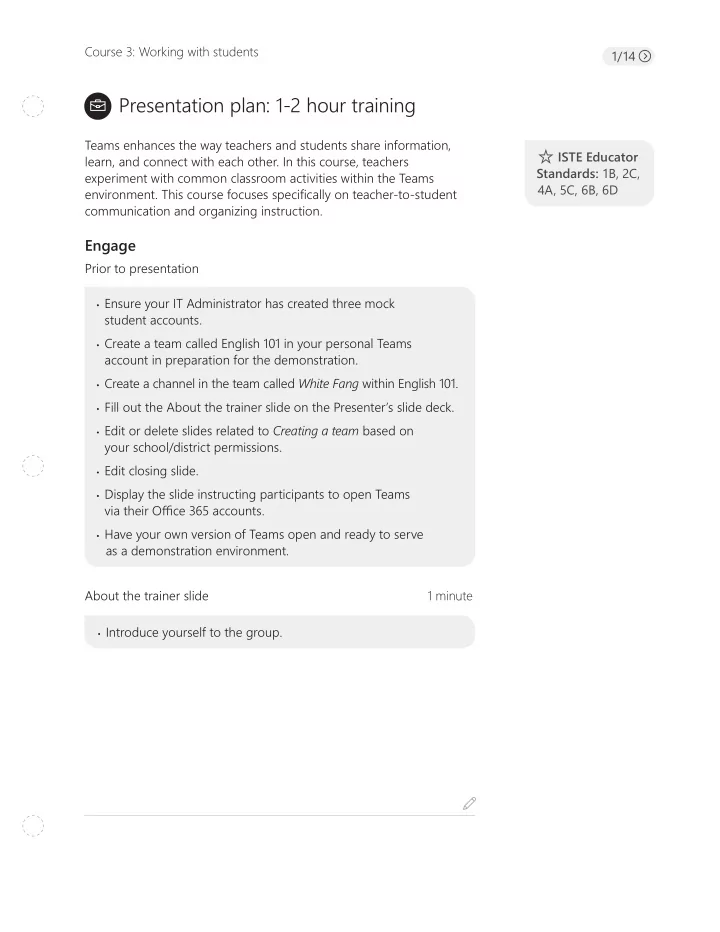
Course 3: Working with students 1/14 Presentation plan: 1-2 hour training Teams enhances the way teachers and students share information, ISTE Educator learn, and connect with each other. In this course, teachers Standards: 1B, 2C,


slide-1
SLIDE 1

 Course 3: Working with students

  • Ensure your IT Administrator has created three mock

student accounts.

  • Create a team called English 101 in your personal Teams

account in preparation for the demonstration.

  • Create a channel in the team called White Fang within English 101.
  • Fill out the About the trainer slide on the Presenter’s slide deck.
  • Edit or delete slides related to Creating a team based on

your school/district permissions.

  • Edit closing slide.
  • Display the slide instructing participants to open Teams

via their Offjce 365 accounts.

  • Have your own version of Teams open and ready to serve

as a demonstration environment.

Presentation plan: 1-2 hour training

1/14 1 minute

  • Introduce yourself to the group.

About the trainer slide

 Engage

Prior to presentation Teams enhances the way teachers and students share information, learn, and connect with each other. In this course, teachers experiment with common classroom activities within the Teams

  • environment. This course focuses specifjcally on teacher-to-student

communication and organizing instruction. ISTE Educator Standards: 1B, 2C, 4A, 5C, 6B, 6D

slide-2
SLIDE 2

 Course 3: Working with students

  • How can you use Teams to encourage students to work

together online?

  • How can Teams help enhance teacher-student communication?

Essential question

  • Play video.

Teams: Giving every student a voice 2 minutes 4 minutes 2 minutes

  • Prompt participants to answer:

“What are some ways you can envision Teams changing the way your students communicate and learn?” Discuss 2/14 Take mental note of responses. They will likely connect to scenarios in this training.

  • Allows educators to collaborate, converse, and share

with students Value: Re-introduce Teams 1 minute 3 minutes

  • Note: This section is optional. Use or omit based on your

audience’s need for review.

  • Refresh knowledge of Teams UI by going through the screenshots
  • n the slides and watching the Microsoft Teams essentials video.
  • Refer participants to the Test your knowledge of Teams features

handout and Teams spaces takeaway. Prompt participants to complete the handout as a review excercise. Review

slide-3
SLIDE 3

 Course 3: Working with students

  • Prompt participants to create class teams and practice

adding students.

  • Review steps participants will take in activity.
  • Refer participants to How to create a class team takeaway

for support and the Create your fjrst team handout for further instructions. Explore 3-4 minutes

  • Describe how to create and personalize a class team.

Explain, Explore, Experience

In this section, participants will practice steps for working in Teams, including creating a class team, working with channels and students, using fjles and reminders, managing students, and using apps in Teams. 3-4 minutes Create a class team: Explain 3/14

  • Set a scene for participants about wanting to establish guided

reading groups for students in Teams.

  • Demonstrate how to do this by creating channels in your

personal Teams account (i.e. the demonstration environment). Channels and students: Situation and demonstration 5 minutes

  • Prompt participants to create channels, such as guided

reading channels, in one of their teams. They should @mention specifjc students and communicate to students what the channels are for.

  • Refer participants to the Add a channel section of

Create your fjrst team handout and the How to create a team takeaway for support. Explore 5 minutes

slide-4
SLIDE 4

 Course 3: Working with students

  • Give participants a 2-minute brain break.
  • Encourage participants get out of their chairs and practice sports

poses, or select a brain break appropriate for your audience. 2 minutes Files and reminders: Situation & demonstration 5 minutes

  • Describe a situation in which a forgetful student loses a rubric

and you, the teacher, want to send it to her with a reminder.

  • Demonstrate how to upload the rubric into her reading channel

and @mention her.

  • Prompt participants to practice uploading their own document,

such as a rubric, to the channels they’ve created.

  • Refer participants to the Files and reminders section of the

Create your fjrst team handout. Explore 3 minutes Brain break 4/14

  • Describe a situation in which the forgetful student went into

the wrong channel and posted ofg-task, unhelpful comments.

  • Reference muting, deleting, and running interference over

private chat as the solution. Managing students in Teams: Situation & demonstration 4 minutes

  • Explain how to delete a comment and mute a student,

referring to the screenshots on screen.

  • Mention following up with the student over private chat,

and then explain how to reinstate her privileges after the chat is complete.

  • Refer students to the Managing conversations in Teams takeaway.

Explain 3-4 minutes Yay! Time for a brain break!

slide-5
SLIDE 5

 Course 3: Working with students

  • Prompt participants to practice installing the YouTube, Quizlet,

and/or Flipgrid apps to their class team.

  • Note: Both Quizlet and Flipgrid require users to set up an
  • account. This is a brief process. Consider allowing time for

participants to explore these apps if time permits.

  • Refer to the Teams apps takeaways.

Explore 3-4 minutes 5/14

  • Describe a situation where you, the teacher, want to augment

lessons by adding an app (YouTube).

  • Demonstrate how to do this in your personal Teams account.

5 minutes Apps: Situation and demonstration

slide-6
SLIDE 6

 Course 3: Working with students

Evaluate

2 minutes 5 minutes 10 minutes

  • Prompts: “How can we use Teams to encourage students to

work together online?”

  • “How can Teams help enhance teacher-student communication?”
  • Prompt participants to provide feedback using the QR code
  • r link to the survey.

Plan

Elaborate

Review essential question Time to witness the teacher magic!

6/14

  • Review: “How can an online communication platform change

classroom instruction and facilitate teacher-student and peer-to-peer communication?”

  • Prompt: “Identify features of Teams that you can use with your

class in the upcoming week.”

  • Plan: Prompt teachers to plan discussion prompts for future use

with classes, encouraging multimedia and visuals: “Jot down two ideas for discussion prompts you can pose to your classes or small groups in the conversation tab within Teams.”

  • Share: Discuss ideas at table groups or prompt teachers to post

their ideas in a new conversation thread in Teams.

slide-7
SLIDE 7

 Course 3: Working with students

  • Laptop
  • Offjce 365 login credentials
  • Teams downloaded prior to training, with a pre-created team
  • Digital copy of a rubric

Presenter

Supplies

Participant

  • WiFi access
  • Laptop or mobile device with access to Microsoft Offjce 365

and login credentials

  • Power cord for laptop or mobile device
  • Projection capability
  • Speaker for external audio
  • Dongle to connect to projector
  • Printed copies of handouts and takeaways
  • Ensure teachers have access to the Teams app via their

Offjce 365 account ahead of time

  • Ask IT to set up three mock student accounts

7/14 Suggested classroom device access To implement the above activities, we suggest teacher and student access to a Windows 10 computer with:

  • Processor: 1 gigahertz (GHz) or faster
  • RAM: 1 gigabyte (GB) (32-bit) or 2 GB (64-bit)
  • 16 GB of free hard disk space
  • Graphics card: Microsoft DirectX 9 graphics device

with WDDM driver

  • A Microsoft account and internet access

(Continued on the following page)

slide-8
SLIDE 8

 Course 3: Working with students Software requirements:

  • Computer: Windows 10; Offjce 2013 or later; .Net Framework

4.5.0 or later

  • Mobile: iOS 10.0 or later; Android 4.3 or later
  • Account: O365 for EDU account or a general Microsoft account

8/14

slide-9
SLIDE 9

Course 3: Working with students

Demonstration notes

This document is a series of scripts you can read while you are covering the Situation and demonstration sections of the Presentation plan. If you’re already an expert in Teams—and you wouldn’t use our tongue-in-cheek voice—feel free to teach these demonstrations however you like, just making sure you’re covering the noted topics. You will also fjnd these notes in the “Say this” section of the notes in the Presenter’s slide deck. (Continued on the following page) Use this

  • ptional script

to support your demonstrations.

9/14

Teams spaces

  • “There are three main spaces to know when working in Teams.
  • “We will start with the Me Space.”
  • “The Me Space is where you will keep track of your own apps

and fjles.”

  • “This space includes two areas.”
  • “The fjrst is the app bar.”
  • “Think of this like the control center for all of your work

in Teams.”

  • “This includes your notifjcations. Chats. Teams. Meetings.

Personal fjles. All the assignments you create for class. Plus any apps you add.”

  • “When you select an app, that changes what you see in the

Left Rail, which we’ll talk about more in a moment. For instance, clicking on the activity bell shows you your notifjcations.”

  • “Notifjcations let you know when someone has communicated

with you, either through an @mention, chat, conversation, or comment like.”

slide-10
SLIDE 10

Course 3: Working with students

  • “Chats are where you can communicate privately with colleagues
  • r students.”
  • “Selecting Teams lets you navigate between your teams

and channels.”

  • “Meetings is where you can schedule and see what you have on

your calendar.”

  • “Files is where you can see all of the fjles you have access to

across all teams.”

  • “Assignments is where you can see the assignments you’ve

created, check in on who has turned in what, and return feedback and grades.”

  • “This is the left rail. This refmects what you’ve selected on

the app bar.”

  • ”The next space in Teams to get to know is the We Space.”
  • ”The We Space has two areas: the Class Nav and Tabs.“
  • “This is your class nav.”
  • “You can think of it like a signpost that shows you where

you are.”

  • “All students share this class nav with you.”
  • “Underneath the class nav you’ll fjnd all your tabs for the

channel.”

  • “This is where you’ll fjnd everything related to the class,

including conversations for group discussions, any fjles added, a Class Notebook (should you choose to set one up), and your assignments.” Teams spaces (continued)

(Continued on the following page) 10/14

slide-11
SLIDE 11

Course 3: Working with students

  • “You can add any extra apps or documents you’d like,

such as a syllabus.”

  • “Click the plus sign to add a new tab.”
  • “This is the canvas. This is where you work alone in the

Me Space, and where you work together in the We Space.”

  • “This is the Command box. You can use it to search Teams

for anything, such as a fjle, conversation, or assignment.”

  • “That was a ton of information. Again, you’ll get a better

sense of what these things are as you actually use the tool. Rest easy, there are no pop quizzes.” Teams spaces (continued) Channels and students

  • “Now I’ll demonstrate how to have a conversation in Teams.”
  • “I’ll start by clicking into my class team, English 101.”
  • “Now I’m going to our magic more icon.”
  • “I’ll click on Add channel.”
  • “For the channel name, I’m typing in the title of the book for

that reading group, in this case, Little Women.”

  • “I’ll just write a brief description of the channel now.”
  • “This is optional, but I like to put a few grounding details

here to guide student work in the channel.”

  • “Then I click Add, and we’re brought back to the canvas, where

you can see I already have another channel created, White Fang, for another guided reading group.”

(Continued on the following page) 11/14

slide-12
SLIDE 12

Course 3: Working with students 12/14

  • “Now I can see my new Little Women channel underneath

English 111, my class team.”

  • “Sometimes you won’t see this immediately.”
  • “That’s just because I need to click the expand arrow next to the

team name.”

  • “When I do that, I can see my new channel, and any new channels I

create after that.”

  • “Now that I’ve created my Little Women channel, I’m going to make

sure that all of the students from the Little Women reading group know where they’ll be working.”

  • “To do this, I’m clicking into the channel I just created and then

into the Conversations tab.”

  • “Now I’m going to the compose pane.”
  • “I’ll @mention the three students who are in this group.”

Note: Type in the names of the three students you’ve had IT create.

  • “I want to give them some framing so they get started on the right

foot, so along with the @mentions I’m also going to write out some context.

  • Type something like the following: “@student1, @student2,

@student3 Welcome to the Little Women channel! This is a space where you can discuss ideas about the book. I’ll be posting assignments and reference materials here. You can also @mention me when you need help. This is your space, so have fun with it and make it your own.” Channels and students (continued)

slide-13
SLIDE 13

Course 3: Working with students 13/14

Files and reminders

  • “Back in my class team, I’ll make sure I’m in our forgetful

student’s reading group channel, Little Women.”

  • “Now I’m headed back to the conversation tab and am

clicking into the compose box.”

  • “When I click on the paperclip, I’m given several difgerent
  • ptions for uploading a fjle.”
  • “I can choose a recent fjle.”
  • “This would be a helpful option if I’d worked on the rubric in

Teams or uploaded it recently.”

  • “I haven’t, so I’m going to look at these other options.”
  • “Browse teams and channels would be a good option if I

already had the rubric uploaded and simply want to pull it in from where I have it stored.”

  • “If I have the rubric stored in my OneDrive account, I can also

select it from there.”

  • “I’m going to choose Upload from my computer.”
  • “Once I do that, it’s just like choosing an attachment

for an email.”

  • “This window comes up, I browse my fjles, fjnd the rubric I’m

looking for, and attach it.”

  • “Now that it’s attached, I’ll @mention my forgetful student

and let him know that he can fjnd all the information he needs in the rubric below.”

  • “I’ll send my message.”
  • “Now our forgetful student will see a notifjcation in his

activity bell the next time he logs in letting him know that I’ve posted the rubric for him.”

slide-14
SLIDE 14

Course 3: Working with students 14/14

Apps

  • “If you remember from our overview, Teams has this helpful

app bar right here.”

  • “When I click the More button on the App bar, the apps I

currently have installed pop up.”

  • “I want YouTube and that’s not here, so I choose More apps

at the bottom here.”

  • “I’m searching for YouTube in the search bar.”
  • “Once it pops up, I click on it.”
  • “I’ll choose the channel where I want to install it.”
  • “Then I click install.”
  • “Now both my students and I can fjnd the YouTube app in

the More apps section.”