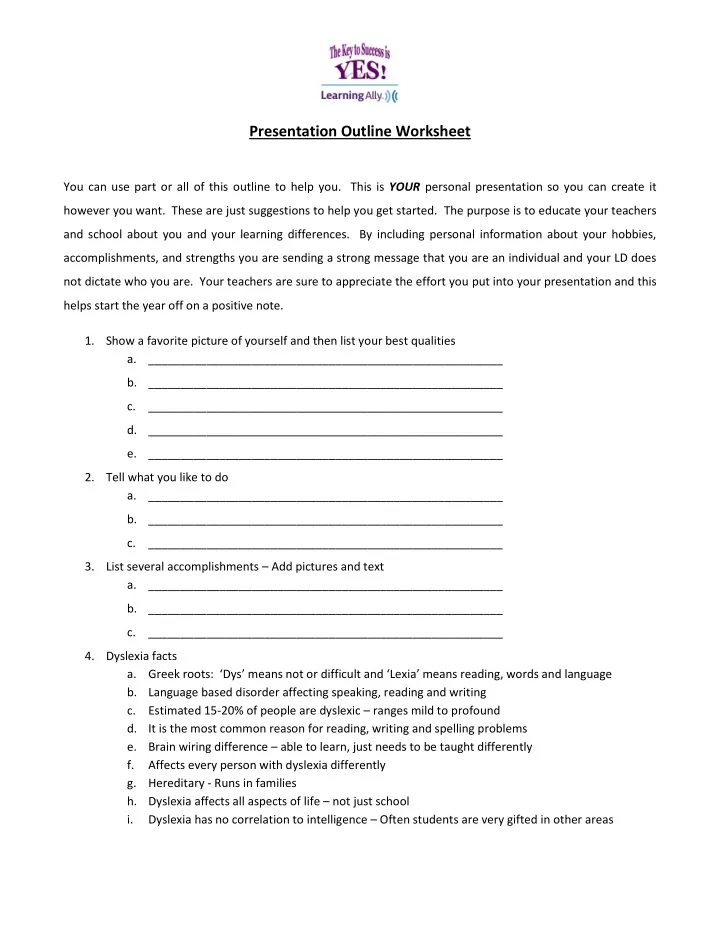
Presentation Outline Worksheet You can use part or all of this - - PDF document

presentation outline worksheet
SMART_READER_LITE
LIVE PREVIEW

Presentation Outline Worksheet You can use part or all of this - - PDF document

Presentation Outline Worksheet You can use part or all of this outline to help you. This is YOUR personal presentation so you can create it however you want. These are just suggestions to help you get started. The purpose is to educate your


slide-1
SLIDE 1

Presentation Outline Worksheet

You can use part or all of this outline to help you. This is YOUR personal presentation so you can create it however you want. These are just suggestions to help you get started. The purpose is to educate your teachers and school about you and your learning differences. By including personal information about your hobbies, accomplishments, and strengths you are sending a strong message that you are an individual and your LD does not dictate who you are. Your teachers are sure to appreciate the effort you put into your presentation and this helps start the year off on a positive note.

  • 1. Show a favorite picture of yourself and then list your best qualities
  • a. _______________________________________________________
  • b. _______________________________________________________
  • c. _______________________________________________________
  • d. _______________________________________________________
  • e. _______________________________________________________
  • 2. Tell what you like to do
  • a. _______________________________________________________
  • b. _______________________________________________________
  • c. _______________________________________________________
  • 3. List several accomplishments – Add pictures and text
  • a. _______________________________________________________
  • b. _______________________________________________________
  • c. _______________________________________________________
  • 4. Dyslexia facts
  • a. Greek roots: ‘Dys’ means not or difficult and ‘Lexia’ means reading, words and language
  • b. Language based disorder affecting speaking, reading and writing
  • c. Estimated 15-20% of people are dyslexic – ranges mild to profound
  • d. It is the most common reason for reading, writing and spelling problems
  • e. Brain wiring difference – able to learn, just needs to be taught differently
  • f. Affects every person with dyslexia differently
  • g. Hereditary - Runs in families
  • h. Dyslexia affects all aspects of life – not just school

i. Dyslexia has no correlation to intelligence – Often students are very gifted in other areas

slide-2
SLIDE 2
  • 5. Myths about dyslexia
  • a. You do NOT see letters backward or upside-down
  • b. You will NOT outgrow dyslexia
  • c. You can NOT cure dyslexia by completing a program or taking medication
  • d. You are NOT Lazy, Dumb or less intelligent than your peers
  • e. Dyslexia does NOT affect primarily boys
  • f. Dyslexia is NOT a vision problem
  • 6. Characteristics associated with dyslexia
  • a. Difficulty learning letters and their sounds
  • b. Reads slowly and lacks comprehension
  • c. Difficulty organizing thoughts when writing
  • d. Difficulty remembering spelling
  • e. Difficulty with rote memorization (ie math facts)
  • f. Difficulty managing assignments, deadlines and belongings
  • g. Difficulty with verbal communication
  • h. Feeling ‘dumb’ and stressed at school
  • 7. Review the history of your dyslexia
  • a. I knew I was different in the _________ grade.
  • b. I just couldn’t seem to _________________ like the other kids.
  • c. I found out I was dyslexic when I was ______________ years old.
  • d. When I found out I felt _______________________________.
  • 8. Share any tutoring, test scores, and improvements with your teacher.
  • a. _____________________________________________________________
  • b. _____________________________________________________________
  • c. _____________________________________________________________
  • 9. Share your strengths in school and how you learn best
  • a. What is your favorite subject? _____________________________________
  • b. In what subject to you excel? ______________________________________
  • c. Why? _________________________________________________________
  • d. How do you learn best? (hands-on, by listening, by seeing, etc.)

______________________________________________________________

  • e. What learning tools work best for you (pictures, maps, building, computer activities, etc.)

__________________________________________________

  • 10. Explain how your dyslexia affects you
  • a. ______________________________________________________________
  • b. ______________________________________________________________
  • c. ______________________________________________________________
slide-3
SLIDE 3
  • 11. Identify and give more detail about your biggest challenge
  • a. ______________________________________________________________
  • b. ______________________________________________________________
  • 12. Identify and give more detail about your second biggest challenge
  • a. ______________________________________________________________
  • b. ______________________________________________________________
  • 13. Review your top 3-5 agreed upon or proposed classroom accommodations
  • a. ______________________________________________________________
  • b. _____________________________________________________________
  • c. _____________________________________________________________
  • d. _____________________________________________________________
  • e. _____________________________________________________________
  • 14. Discuss how the accommodations should look in the classroom
  • a. _____________________________________________________________
  • b. _____________________________________________________________
  • c. _____________________________________________________________
  • d. _____________________________________________________________
  • e. _____________________________________________________________
  • 15. Make a commitment to your teachers – list what you are going to do to succeed
  • a. _____________________________________________________________
  • b. _____________________________________________________________
  • c. _____________________________________________________________
  • 16. Tell your teachers what you need from them – be specific
  • a. _____________________________________________________________
  • b. _____________________________________________________________
  • c. _____________________________________________________________
  • 17. Show them your support team and invite them to join
  • a. Mom / Dad / Parents
  • b. Outside Tutor
  • c. Advocate
  • d. Extended family and friends
  • e. _____________________________________________________________
  • f. _____________________________________________________________
  • 18. Thank them for their time