SLIDE 1
Presentation notes for Inter Process Communication
Pipes
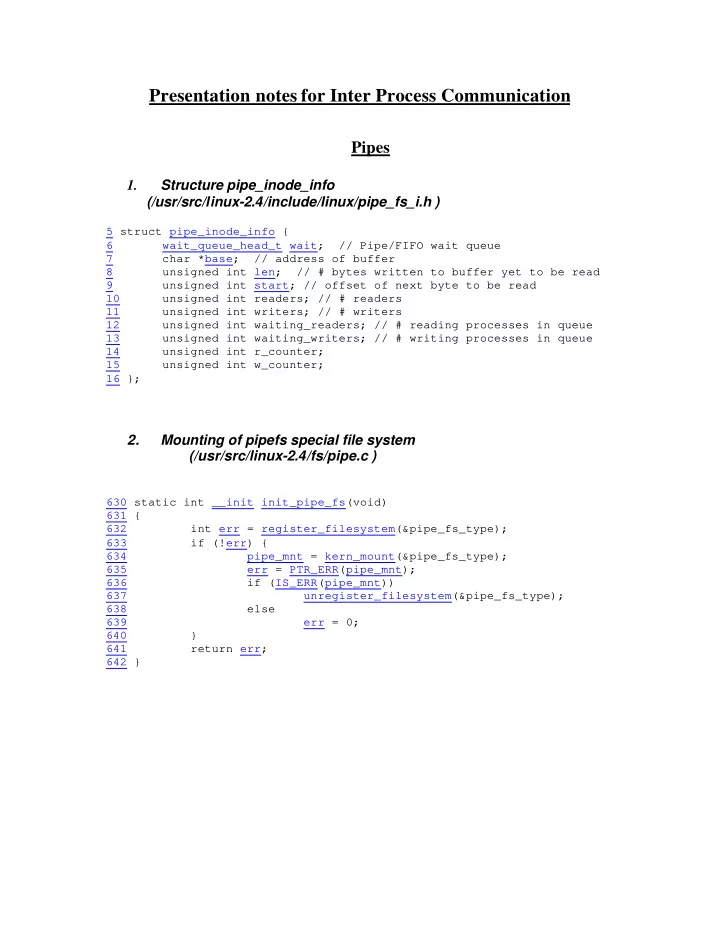
1. Structure pipe_inode_info (/usr/src/linux-2.4/include/linux/pipe_fs_i.h )
5 struct pipe_inode_info { 6 wait_queue_head_t wait; // Pipe/FIFO wait queue 7 char *base; // address of buffer 8 unsigned int len; // # bytes written to buffer yet to be read 9 unsigned int start; // offset of next byte to be read 10 unsigned int readers; // # readers 11 unsigned int writers; // # writers 12 unsigned int waiting_readers; // # reading processes in queue 13 unsigned int waiting_writers; // # writing processes in queue 14 unsigned int r_counter; 15 unsigned int w_counter; 16 };
2. Mounting of pipefs special file system (/usr/src/linux-2.4/fs/pipe.c )
630 static int __init init_pipe_fs(void) 631 { 632 int err = register_filesystem(&pipe_fs_type); 633 if (!err) { 634 pipe_mnt = kern_mount(&pipe_fs_type); 635 err = PTR_ERR(pipe_mnt); 636 if (IS_ERR(pipe_mnt)) 637 unregister_filesystem(&pipe_fs_type); 638 else 639 err = 0; 640 } 641 return err; 642 }
SLIDE 2
3. Creation of a pipe sys_pipe () function (/usr/src/linux-2.4/arch/i386/kernel/sys_i386.c)
29 asmlinkage int sys_pipe(unsigned long * fildes) 30 { 31 int fd[2]; 32 int error; 33 34 error = do_pipe(fd); 35 if (!error) { 36 if (copy_to_user(fildes, fd, 2*sizeof(int))) 37 error = -EFAULT; 38 } 39 return error; 40 }
do_pipe () function (/usr/src/linux-2.4/fs/pipe.c )
505 int do_pipe(int *fd) 506 { 507 struct qstr this; 508 char name[32]; 509 struct dentry *dentry; 510 struct inode * inode; 511 struct file *f1, *f2; 512 int error; 513 int i,j; 514 515 error = -ENFILE; 516 f1 = get_empty_filp(); 517 if (!f1) 518 goto no_files; 519 520 f2 = get_empty_filp(); 521 if (!f2) 522 goto close_f1; 523 524 inode = get_pipe_inode(); . . . . 585 }
SLIDE 3
get_pipe_inode () function (/usr/src/linux-2.4/fs/pipe.c )
473 static struct inode * get_pipe_inode(void) 474 { 475 struct inode *inode = new_inode(pipe_mnt->mnt_sb); 476 477 if (!inode) 478 goto fail_inode; 479 480 if(!pipe_new(inode)) 481 goto fail_iput; 482 PIPE_READERS(*inode) = PIPE_WRITERS(*inode) = 1; . . . . 503 }
pipe_new() function (/usr/src/linux-2.4/fs/pipe.c )
439 struct inode* pipe_new(struct inode* inode) 440 { 441 unsigned long page; 442 443 page = __get_free_page(GFP_USER); 444 if (!page) 445 return NULL; 446 447 inode->i_pipe = kmalloc(sizeof(struct pipe_inode_info), GFP_KERNEL); 448 if (!inode->i_pipe) 449 goto fail_page; 450 451 init_waitqueue_head(PIPE_WAIT(*inode)); 452 PIPE_BASE(*inode) = (char*) page; 453 PIPE_START(*inode) = PIPE_LEN(*inode) = 0; 454 PIPE_READERS(*inode) = PIPE_WRITERS(*inode) = 0; 455 PIPE_WAITING_READERS(*inode) = PIPE_WAITING_WRITERS(*inode)=0; 456 PIPE_RCOUNTER(*inode) = PIPE_WCOUNTER(*inode) = 1; . . . . 462 }
SLIDE 4
4. Reading from a pipe pipe_read () function (/usr/src/linux-2.4/fs/pipe.c )
39 static ssize_t 40 pipe_read(struct file *filp, char *buf, size_t count, loff_t *ppos) 41 { 42 struct inode *inode = filp->f_dentry->d_inode; 43 ssize_t size, read, ret; 44 45 /* Seeks are not allowed on pipes. */ 46 ret = -ESPIPE; 47 read = 0; 48 if (ppos != &filp->f_pos) 49 goto out_nolock; 50 51 /* Always return 0 on null read. */ 52 ret = 0; 53 if (count == 0) 54 goto out_nolock; 55 56 /* Get the pipe semaphore */ 57 ret = -ERESTARTSYS; 58 if (down_interruptible(PIPE_SEM(*inode))) 59 goto out_nolock; 60 61 if (PIPE_EMPTY(*inode)) { 62 do_more_read: 63 ret = 0; 64 if (!PIPE_WRITERS(*inode)) 65 goto out; 66 67 ret = -EAGAIN; 68 if (filp->f_flags & O_NONBLOCK) 69 goto out; 70 71 for (;;) { 72 PIPE_WAITING_READERS(*inode)++; 73 pipe_wait(inode); 74 PIPE_WAITING_READERS(*inode)--; . . . . 84 } 85 86 out: /* Read what data is available. */ 87 ret = -EFAULT; 88 while (count > 0 && (size = PIPE_LEN(*inode))) { 89 char *pipebuf = PIPE_BASE(*inode) + PIPE_START(*inode); 90 ssize_t chars = PIPE_MAX_RCHUNK(*inode); 91 92 if (chars > count) 93 chars = count; 94 if (chars > size)
SLIDE 5
95 chars = size; 96 97 if (copy_to_user(buf, pipebuf, chars)) 98 goto out; 99 100 read += chars; 101 PIPE_START(*inode) += chars; 102 PIPE_START(*inode) &= (PIPE_SIZE - 1); 103 PIPE_LEN(*inode) -= chars; 104 count -= chars; 105 buf += chars; 106 } . . . . 112 if (count && PIPE_WAITING_WRITERS(*inode) && !(filp- >f_flags & O_NONBLOCK)) { 113 /* 114 * We know that we are going to sleep: signal 115 * writers synchronously that there is more 116 * room. 117 */ 118 wake_up_interruptible_sync(PIPE_WAIT(*inode)); 119 if (!PIPE_EMPTY(*inode)) 120 BUG(); 121 goto do_more_read; 122 } 123 /* Signal writers asynchronously that there is more room. */ 124 wake_up_interruptible(PIPE_WAIT(*inode)); 125 126 ret = read; 127 out: 128 up(PIPE_SEM(*inode)); 129 out_nolock: 130 if (read) 131 ret = read; 132 133 UPDATE_ATIME(inode); 134 return ret; 135 }
SLIDE 6
5. pipe_wait() function (/usr/src/linux-2.4/fs/pipe.c)
27 void pipe_wait(struct inode * inode) 28 { 29 DECLARE_WAITQUEUE(wait, current); 30 current->state = TASK_INTERRUPTIBLE; 31 add_wait_queue(PIPE_WAIT(*inode), &wait); 32 up(PIPE_SEM(*inode)); 33 schedule(); 34 remove_wait_queue(PIPE_WAIT(*inode), &wait); 35 current->state = TASK_RUNNING; 36 down(PIPE_SEM(*inode)); 37 }
6. Writing to a pipe pipe_write () function (/usr/src/linux-2.4/fs/pipe.c )
137 static ssize_t 138 pipe_write(struct file *filp, const char *buf, size_t count, loff_t *ppos) 139 { 140 struct inode *inode = filp->f_dentry->d_inode; . . . . 153 /* Acquire the semaphore. */ 154 ret = -ERESTARTSYS; 155 if (down_interruptible(PIPE_SEM(*inode))) 156 goto out_nolock; 157 158 /* No readers yields SIGPIPE. */ 159 if (!PIPE_READERS(*inode)) 160 goto sigpipe; 161 162 /* If count <= PIPE_BUF, we have to make it atomic. */ 163 free = (count <= PIPE_BUF ? count : 1); 164 165 /* Wait, or check for, available space. */ 166 if (filp->f_flags & O_NONBLOCK) { 167 ret = -EAGAIN; 168 if (PIPE_FREE(*inode) < free) 169 goto out; 170 } else { 171 while (PIPE_FREE(*inode) < free) { 172 PIPE_WAITING_WRITERS(*inode)++; 173 pipe_wait(inode); 174 PIPE_WAITING_WRITERS(*inode)--; 175 ret = -ERESTARTSYS; 176 if (signal_pending(current)) 177 goto out; 178 179 if (!PIPE_READERS(*inode))
SLIDE 7
180 goto sigpipe; 181 } 182 } 183 184 /* Copy into available space. */ 185 ret = -EFAULT; 186 while (count > 0) { 187 int space; 188 char *pipebuf = PIPE_BASE(*inode) + PIPE_END(*inode); 189 ssize_t chars = PIPE_MAX_WCHUNK(*inode); 190 191 if ((space = PIPE_FREE(*inode)) != 0) { 192 if (chars > count) 193 chars = count; 194 if (chars > space) 195 chars = space; 196 197 if (copy_from_user(pipebuf, buf, chars)) 198 goto out; 199 200 written += chars; 201 PIPE_LEN(*inode) += chars; 202 count -= chars; 203 buf += chars; 204 space = PIPE_FREE(*inode); 205 continue; 206 } 207 208 ret = written; 209 if (filp->f_flags & O_NONBLOCK) 210 break; . . . . 230 /* Signal readers asynchronously that there is more data. */ 231 wake_up_interruptible(PIPE_WAIT(*inode)); 232 233 inode->i_ctime = inode->i_mtime = CURRENT_TIME; 234 mark_inode_dirty(inode); 235 236 out: 237 up(PIPE_SEM(*inode)); 238 out_nolock: 239 if (written) 240 ret = written; 241 return ret; 242 243 sigpipe: 244 if (written) 245 goto out; 246 up(PIPE_SEM(*inode)); 247 send_sig(SIGPIPE, current, 0); 248 return -EPIPE; 249 }
SLIDE 8 FIFOs
fifo_open() function (/usr/src/linux-2.4/fs/fifo.c)
31 static int fifo_open(struct inode *inode, struct file *filp) 32 { . . . . 37 if (down_interruptible(PIPE_SEM(*inode)))ret = -ENOMEM; 42 if(!pipe_new(inode)) . . . . 47 switch (filp->f_mode) { 48 case 1: 49 /* 50 * O_RDONLY 51 * POSIX.1 says that O_NONBLOCK means return with the FIFO 52 * opened, even when there is no process writing the FIFO. 53 */ . . . . 55 PIPE_RCOUNTER(*inode)++; 56 if (PIPE_READERS(*inode)++ == 0) 57 wake_up_partner(inode); 58 59 if (!PIPE_WRITERS(*inode)) { 60 if ((filp->f_flags & O_NONBLOCK)) { 61 /* suppress POLLHUP until we have 62 * seen a writer */ 63 filp->f_version = PIPE_WCOUNTER(*inode); 64 } else 65 { 66 wait_for_partner(inode, &PIPE_WCOUNTER(*inode)); 67 if(signal_pending(current)) 68 goto err_rd; 69 } 70 } 71 break; 72 73 case 2: 74 /* 75 * O_WRONLY 76 * POSIX.1 says that O_NONBLOCK means return -1 with 77 * errno=ENXIO when there is no process reading the FIFO. 78 */ 79 ret = -ENXIO;
SLIDE 9
80 if ((filp->f_flags & O_NONBLOCK) && !PIPE_READERS(*inode)) 81 goto err; 82 83 filp->f_op = &write_fifo_fops; 84 PIPE_WCOUNTER(*inode)++; 85 if (!PIPE_WRITERS(*inode)++) 86 wake_up_partner(inode); 87 88 if (!PIPE_READERS(*inode)) { 89 wait_for_partner(inode, &PIPE_RCOUNTER(*inode)); 90 if (signal_pending(current)) 91 goto err_wr; 92 } 93 break; 94 95 case 3: 96 /* 97 * O_RDWR 98 * POSIX.1 leaves this case "undefined" when O_NONBLOCK is set. 99 * This implementation will NEVER block on a O_RDWR open, since 100 * the process can at least talk to itself. 101 */ 102 filp->f_op = &rdwr_fifo_fops; 103 104 PIPE_READERS(*inode)++; 105 PIPE_WRITERS(*inode)++; 106 PIPE_RCOUNTER(*inode)++; 107 PIPE_WCOUNTER(*inode)++; 108 if (PIPE_READERS(*inode)==1||(*inode) == 1) 109 wake_up_partner(inode); 110 break; 111 . . . . 139 kfree(info); 140 . . . .
SLIDE 10 System V IPC
1. Structure ipc_ids (/usr/src/linux-2.4/ipc/util.h )
15 struct ipc_ids { 16 int size; //current max # or resources 17 int in_use; // # of allocated resources 18 int max_id; // max slot index in use 19 unsigned short seq; // slot usage sequence # for next alloc. 20 unsigned short seq_max; // max seq 21 struct semaphore sem; // semaphore structure protecting race 22 spinlock_t ary; // spinlock protecting resources 23 struct ipc_id* entries; // array of IPC descriptors 24 };
- 2. Structure kern_ipc_perm ( include/linux/ipcl.h)
57 struct kern_ipc_perm 58 { 59 key_t key; 60 uid_t uid; 61 gid_t gid; 62 uid_t cuid; 63 gid_t cgid; 64 mode_t mode; 65 unsigned long seq; // used to compute IPC id 66 };
Semaphores
- 1. Structure sem_array ( include/linux/sem.h )
88 struct sem_array { 89 struct kern_ipc_perm sem_perm; 90 time_t sem_otime; // timestamp of last semop() 91 time_t sem_ctime; // time of last change 92 struct sem *sem_base; // ptr to first sem struct 93 struct sem_queue *sem_pending; // pending operations 94 struct sem_queue **sem_pending_last; 95 struct sem_undo *undo; // undo struct 96 unsigned long sem_nsems; // # of semaphores 97 };
SLIDE 11
- 2. Structure sem ( include/linux/sem.h )
82 struct sem { 83 int semval; 84 int sempid; 85 };
- 3. Structure sem_queue (include/linux/sem.h)
100 struct sem_queue { 101 struct sem_queue * next; 102 struct sem_queue ** prev; 103 struct task_struct* sleeper; 104 struct sem_undo * undo; 105 int pid; 106 int status; 107 struct sem_array * sma; // ptr of semaphore descriptor 108 int id; // slot index 109 struct sembuf * sops; // array of pending operations 110 int nsops; // # pending operations 111 int alter; // flag for setting sem value 112 };
- 4. Structure sem_undo (include/linux/sem.h)
117 struct sem_undo { 118 struct sem_undo * proc_next; 119 struct sem_undo * id_next; 120 int semid; 121 short * semadj; 122 };
- 5. Structure semun (include/linux/sem.h)
45 union semun { 46 int val; 47 struct sem_arrary *buf; 48 unsigned short *array; 49 50 };
SLIDE 12
- 5. Structure sembuf (include/linux/sem.h)
38 struct sembuf { 39 unsigned short sem_num; 40 short sem_op; 41 short sem_flg; // flag SEM_UNDO, NO_WAIT etc 42 };
7. semget() (/usr/src/linux-2.4/ipc/sem.c)
152 asmlinkage long sys_semget (key_t key, int nsems, int semflg) 153 { 154 int id, err = -EINVAL; 155 struct sem_array *sma; 156 157 if (nsems < 0 || nsems > sc_semmsl) 158 return -EINVAL; 159 down(&sem_ids.sem); 160 161 if (key == IPC_PRIVATE) { 162 err = newary(key, nsems, semflg); 163 } else if ((id = ipc_findkey(&sem_ids, key)) == -1) { /* key not used */ 164 if (!(semflg & IPC_CREAT)) 165 err = -ENOENT; 166 else 167 err = newary(key, nsems, semflg); 168 } else if (semflg & IPC_CREAT && semflg & IPC_EXCL) { 169 err = -EEXIST; 170 } else { 171 sma = sem_lock(id); 172 if(sma==NULL) 173 BUG(); 174 if (nsems > sma->sem_nsems) 175 err = -EINVAL; 176 else if (ipcperms(&sma->sem_perm, semflg)) 177 err = -EACCES; 178 else 179 err = sem_buildid(id, sma->sem_perm.seq); 180 sem_unlock(id); 181 } 182 183 up(&sem_ids.sem); 184 return err; 185 }
SLIDE 13
- 8. semctl()(/usr/src/linux-2.4/ipc/sem.c)
755 asmlinkage long sys_semctl (int semid, int semnum, int cmd, union semun arg) 756 { 757 int err = -EINVAL; 758 int version; 759 760 if (semid < 0) 761 return -EINVAL; 762 763 version = ipc_parse_version(&cmd); 764 765 switch(cmd) { 766 case IPC_INFO: 767 case SEM_INFO: 768 case SEM_STAT: 769 err = semctl_nolock(semid,semnum,cmd,version,arg); 770 return err; 771 case GETALL: 772 case GETVAL: 773 case GETPID: 774 case GETNCNT: 775 case GETZCNT: 776 case IPC_STAT: 777 case SETVAL: 778 case SETALL: 779 err = semctl_main(semid,semnum,cmd,version,arg); 780 return err; 781 case IPC_RMID: 782 case IPC_SET: 783 down(&sem_ids.sem); 784 err = semctl_down(semid,semnum,cmd,version,arg); 785 up(&sem_ids.sem); 786 return err; 787 default: 788 return -EINVAL; 789 } 790 } 791
SLIDE 14
- 9. semop()(/usr/src/linux-2.4/ipc/sem.c)
840 asmlinkage long sys_semop (int semid, struct sembuf *tsops, unsigned nsops) 841 { 842 int error = -EINVAL; 843 struct sem_array *sma; 844 struct sembuf fast_sops[SEMOPM_FAST]; 845 struct sembuf* sops = fast_sops, *sop; 846 struct sem_undo *un; 847 int undos = 0, decrease = 0, alter = 0; 848 struct sem_queue queue; 849 850 if (nsops < 1 || semid < 0) 851 return -EINVAL; 852 if (nsops > sc_semopm) 853 return -E2BIG; 854 if(nsops > SEMOPM_FAST) { 855 sops = kmalloc(sizeof(*sops)*nsops,GFP_KERNEL); 856 if(sops==NULL) 857 return -ENOMEM; 858 } 859 if (copy_from_user (sops, tsops, nsops * sizeof(*tsops))) { 860 error=-EFAULT; 861 goto out_free; 862 } 863 sma = sem_lock(semid); 864 error=-EINVAL; 865 if(sma==NULL) 866 goto out_free; 867 error = -EIDRM; 868 if (sem_checkid(sma,semid)) 869 goto out_unlock_free; 870 error = -EFBIG; 871 for (sop = sops; sop < sops + nsops; sop++) { 872 if (sop->sem_num >= sma->sem_nsems) 873 . . . . goto out_unlock_free; 887 /* Make sure we have an undo structure 888 * for this process and this semaphore set. 889 */ 890 un=current->semundo; . . . . 906 907 error = try_atomic_semop (sma, sops, nsops, un, current- >pid, 0); 908 if (error <= 0) 909 goto update;
SLIDE 15
924 if (alter) 923 append_to_queue(sma ,&queue); 924 else 925 prepend_to_queue(sma ,&queue); 926 current->semsleeping = &queue; 927 928 for (;;) { 929 struct sem_array* tmp; 930 queue.status = -EINTR; 931 queue.sleeper = current; 932 current->state = TASK_INTERRUPTIBLE; 933 935 schedule(); . . . . 967 current->semsleeping = NULL; 968 remove_from_queue(sma,&queue); 969 update: 970 if (alter) 971 update_queue (sma); 972 out_unlock_free: 973 sem_unlock(semid); 974 out_free: 975 if(sops != fast_sops) 976 kfree(sops); 977 return error; 978 }
SLIDE 16 Message Queues
- 1. Structure msg_queue ( include/linux/msg.h )
15 struct msg_queue { 16 struct ipc_perm msg_perm; 17 struct msg *msg_first; 18 struct msg *msg_last; 19 __kernel_time_t msg_stime; 20 __kernel_time_t msg_rtime; 21 __kernel_time_t msg_ctime; 22 unsigned long msg_lcbytes; 23 unsigned long msg_lqbytes; 24 unsigned short msg_cbytes; 25 unsigned short msg_qnum; 26 unsigned short msg_qbytes; 27 __kernel_ipc_pid_t msg_lspid; 28 __kernel_ipc_pid_t msg_lrpid; 29 };
- 2. Structure msg_msg ( include/linux/msg.h )
35 struct msgbuf { 36 long mtype; /* type of message */ 37 char mtext[1]; /* message text */ 38 };
SLIDE 17 Shared Memory
- 1. Structure shmid_kernel ( include/linux/shm.h )
21 struct shmid_kernel { 22 struct ipc_perm shm_perm; 23 struct file* shm_file 23 int shm_segsz; 24 __kernel_time_t shm_atime; 25 __kernel_time_t shm_dtime; 26 __kernel_time_t shm_ctime; 27 __kernel_ipc_pid_t shm_cpid; 28 __kernel_ipc_pid_t shm_lpid; 29 unsigned short shm_nattch; 30 unsigned short shm_unused; 31 };