Presentation and Outcome of Shabana Jamal* Zainab Mahsal Khan** - - PDF document

presentation and outcome of
SMART_READER_LITE
LIVE PREVIEW

Presentation and Outcome of Shabana Jamal* Zainab Mahsal Khan** - - PDF document

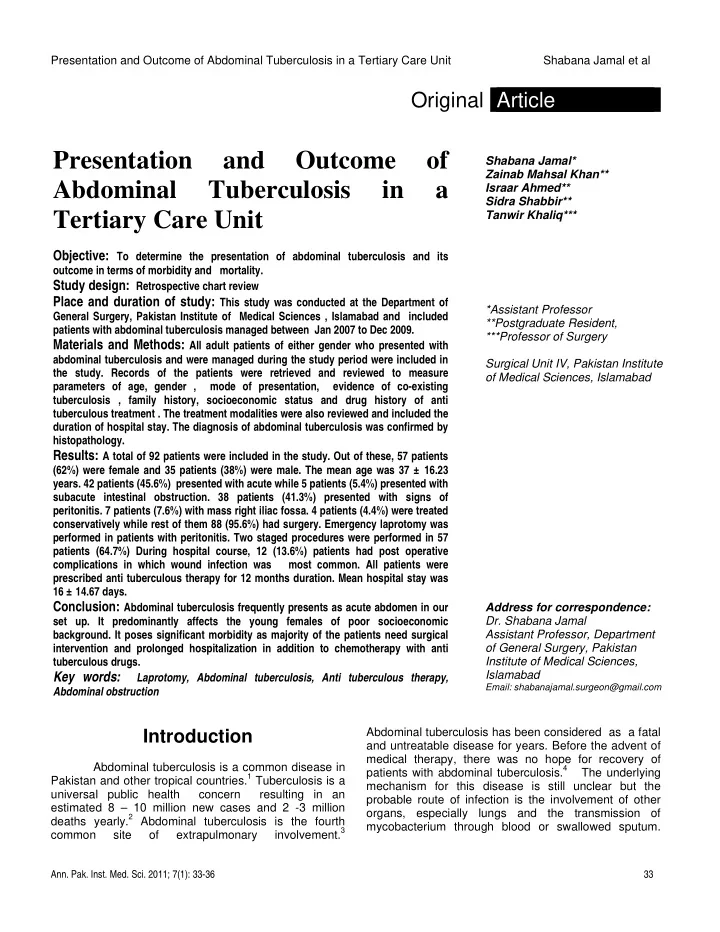
Presentation and Outcome of Abdominal Tuberculosis in a Tertiary Care Unit Shabana Jamal et al Original Article Presentation and Outcome of Shabana Jamal* Zainab Mahsal Khan** Abdominal Tuberculosis in a Israar Ahmed** Sidra Shabbir**


slide-1
SLIDE 1

Presentation and Outcome of Abdominal Tuberculosis in a Tertiary Care Unit Shabana Jamal et al

  • Ann. Pak. Inst. Med. Sci. 2011; 7(1): 33-36

33

Original Article

Presentation and Outcome

  • f

Abdominal Tuberculosis in a Tertiary Care Unit

Objective: To determine the presentation of abdominal tuberculosis and its

  • utcome in terms of morbidity and mortality.

Study design: Retrospective chart review Place and duration of study: This study was conducted at the Department of

General Surgery, Pakistan Institute of Medical Sciences , Islamabad and included patients with abdominal tuberculosis managed between Jan 2007 to Dec 2009.

Materials and Methods: All adult patients of either gender who presented with

abdominal tuberculosis and were managed during the study period were included in the study. Records of the patients were retrieved and reviewed to measure parameters of age, gender , mode of presentation, evidence of co-existing tuberculosis , family history, socioeconomic status and drug history of anti tuberculous treatment . The treatment modalities were also reviewed and included the duration of hospital stay. The diagnosis of abdominal tuberculosis was confirmed by histopathology.

Results: A total of 92 patients were included in the study. Out of these, 57 patients

(62%) were female and 35 patients (38%) were male. The mean age was 37 ± 16.23

  • years. 42 patients (45.6%) presented with acute while 5 patients (5.4%) presented with

subacute intestinal obstruction. 38 patients (41.3%) presented with signs of

  • peritonitis. 7 patients (7.6%) with mass right iliac fossa. 4 patients (4.4%) were treated

conservatively while rest of them 88 (95.6%) had surgery. Emergency laprotomy was performed in patients with peritonitis. Two staged procedures were performed in 57 patients (64.7%) During hospital course, 12 (13.6%) patients had post operative complications in which wound infection was most common. All patients were prescribed anti tuberculous therapy for 12 months duration. Mean hospital stay was 16 ± 14.67 days.

Conclusion: Abdominal tuberculosis frequently presents as acute abdomen in our

set up. It predominantly affects the young females of poor socioeconomic

  • background. It poses significant morbidity as majority of the patients need surgical

intervention and prolonged hospitalization in addition to chemotherapy with anti tuberculous drugs.

Key words: Laprotomy, Abdominal tuberculosis, Anti tuberculous therapy,

Abdominal obstruction Shabana Jamal* Zainab Mahsal Khan** Israar Ahmed** Sidra Shabbir** Tanwir Khaliq*** *Assistant Professor **Postgraduate Resident, ***Professor of Surgery Surgical Unit IV, Pakistan Institute

  • f Medical Sciences, Islamabad

Address for correspondence:

  • Dr. Shabana Jamal

Assistant Professor, Department

  • f General Surgery, Pakistan

Institute of Medical Sciences, Islamabad

Email: shabanajamal.surgeon@gmail.com

Introduction

Abdominal tuberculosis is a common disease in Pakistan and other tropical countries.1 Tuberculosis is a universal public health concern resulting in an estimated 8 – 10 million new cases and 2 -3 million deaths yearly.2 Abdominal tuberculosis is the fourth common site

  • f

extrapulmonary involvement.3 Abdominal tuberculosis has been considered as a fatal and untreatable disease for years. Before the advent of medical therapy, there was no hope for recovery of patients with abdominal tuberculosis.4 The underlying mechanism for this disease is still unclear but the probable route of infection is the involvement of other

  • rgans, especially lungs and the transmission of

mycobacterium through blood or swallowed sputum.

slide-2
SLIDE 2

Presentation and Outcome of Abdominal Tuberculosis in a Tertiary Care Unit Shabana Jamal et al

  • Ann. Pak. Inst. Med. Sci. 2011; 7(1): 33-36

34

Direct invasion from adjacent structures might be another route of infection .5 Abdominal tuberculosis is reported from a number of countries.6 It is also an important health problem in Pakistan. It has various modes of presentation and high index of suspicion is required for its diagnosis.3,7 Tuberculosis is a disease affecting the young population with an average age of 20 – 40 years with an increased incidence in females.8 Patients with abdominal tuberculosis present with constitutional symptoms of fever, malaise, abdominal pain and altered bowel habits in the early stage of the disease. If not diagnosed early, this leads to complications like intestinal mass, malabsorption , intestinal obstruction or intestinal perforation requiring emergency surgery.9 This study was undertaken to document the presentation and outcome of abdominal tuberculosis in a tertiary care surgical setup.

Material and Methods

This study was conducted in the Department of Surgery at Pakistan Institute of Medical Sciences, Islamabad and included patients with abdominal tuberculosis managed from Jan 2007 to Dec 2009. The hospital records of patients diagnosed of having abdominal tuberculosis were retrieved and studied. Data were reviewed for variables like age, gender, mode of presentation, management, type of surgery, post

  • perative course and follow up. Patients who had acute

intestinal obstruction and signs of peritonitis were

  • perated in the emergency. All these patients were

resuscitated and optimized for surgery with parenteral fluids and antibiotics. Baseline investigations were done in all patients and included Blood Complete Picture, ESR, Serum electrolytes, X - ray chest, X- ray abdomen erect and supine and ultrasound abdomen. Patients who had presented with an abdominal mass and sub- acute intestinal obstruction were initially managed conservatively and investigated accordingly. The investigations included Barium meal follow through and colonoscopy. Among those operated in emergency, diagnosis of tuberculosis was made on finding tubercles, enlarged mesenteric lymph nodes, strictures and

  • ascites. Definitive diagnosis of abdominal tuberculosis

was made by histopathology. In patients who presented with peritonitis due to intestinal peforation, ileostomy was performed as a first stage procedure. Where indicated, resection of the disease segment of gut and ileostomy was performed. Patients with strictures underwent stricturoplasty. Patients with ileostomy had reversal of stoma as a second stage

  • procedure. During this period all the patients had a full

course of anti tuberculous therapy for twelve month duration.

Results

A total of 92 patients were included in the study. Out of these, 57 patients (62%) were female and 35 patients (38%) were male. The age range of patients presenting with abdominal tuberculosis was between 18

  • 55 years and mean age of 37 ± 16.23 years.

On history, 38 patients (41 %) gave positive family history of abdominal tuberculosis and 10 patients (10.8 %) had history of having pulmonary tuberculosis and received complete course of anti-tuberculous treatment in the past. 72 patients (78%) belonged to poor socio economic class and had no permanent source of income. As shown in table I, 82 patients (89 %) presented with pain abdomen while 7 patients (7.6 %) with a mass abdomen. On the basis of clinical findings 42 patients (45.6 %) had intestinal obstruction, 38 patients (41.3 %) had signs and symptoms of peritonitis and 7 patients (7.6 %) had mass abdomen. Table II shows the various operative findings among the operated patients. Table III shows the surgical procedure undertaken among the patients. Table IV shows the various postoperative complications observed among our patients. There was in hospital mortality of 3 patients (4%) who had been operated for faecal peritonitis due to late presentation. Eighty eight patients (95.6%) underwent surgical intervention while 4 patients (4.4%) were treated conservatively. Patients were also trained regarding stoma

  • management. All the patients had regular follow up.

Second stage surgery i.e. ileostomy reversal was done 3 to 4 months in patients with wide spread disease while those with localized disease it was done after two month duration. All patients were discharged

  • n

anti tuberculous therapy for a duration of 12 months. Table I: Presenting complaints among patients (n= 92) Presenting complaints No.

  • f

patients Percentage Pain abdomen 82 89.1% Abdominal distension 75 81.5% Fever 50 54.4% Nausea 55 59.8% Vomiting 65 71% Altered bowel habits 78 84.8% Mass abdomen 7 7.6%

slide-3
SLIDE 3

Presentation and Outcome of Abdominal Tuberculosis in a Tertiary Care Unit Shabana Jamal et al

  • Ann. Pak. Inst. Med. Sci. 2011; 7(1): 33-36

35

Discussion

Despite advances in drug therapy and diagnostic facilities , tuberculosis remains a major health problem in the developing countries especially Africa and the IndoPak subcontinent.10 The high frequency of primary intestinal tuberculosis in our study is in conformity with

  • ther studies conducted in other developing countries.11

The different variety of clinical presentation and complications of abdominal tuberculosis continue to challenge the diagnostic acumen and therapeutic skills

  • f

all physicians.12 In abdominal tuberculosis, gastrointestinal tract and peritoneum are the most frequent sites of involvement.5 This is in accordance with our study as well where small intestine and peritoneum were involved. In our study we found predominant involvement

  • f younger population. Abdominal tuberculosis can
  • ccur at any age but is predominantly a disease of

young adults. In our study the mean age was 37 ± 16.23

  • years. This is similar to observation in other studies.7

Moreover, the disease was more common in females than males which is also reported by other studies .3, 7-

9, 13,14 Majority of patients in our study belonged to low

socio economic class .Poor nutrition, lack of basic health facilities and inadequate pasteurization of milk are factors leading to this problem.15 In our study 88 patients (95.6%) required urgent surgical intervention. This is also reported by Channa et al in their study.16 60 patients (68.2 %) presented with peritonitis due to intestinal perforation which is in contrast to other studies where strictures were a common per operative finding.17 There was an in hospital mortality of 3 patients (4%) in

  • ur study in patients with faecal peritonitis because of

late presentation . Kaker et al reported 45% mortality in patients with peritonitis due to perforation.18 Post

  • perative complications were encountered in 12 patients

(13.6%) and included wound infection in 6 patients (50%) and abdominal wound dehiscence in 2 patients (16%). Wound infection as a post operative complication is also reported by Ishtiaq et al in their study.9 Patients with peritonitis had a two stage

  • procedure. In the first stage, ileostomy was performed

which was reversed later after disease control. Ileostomy as a safe primary procedure is documented in

  • ther studies.7

Patients were prescribed anti tuberculous drugs for 12 months as most series recommended.19 Abdominal tuberculosis is a disease which has no clear clinical features even after a complete range of

  • investigations. Thus, a high index of clinical suspicion is

required to establish a diagnosis.20 Abdominal tuberculosis is still very common in

  • ur country. Unless there is a high index of suspicion,

the diagnosis is often overlooked resulting in significant morbidity and mortality. Laproscopy may also be employed as an affective modality for the diagnosis of patients with abdominal tuberculosis and should be considered in cases where there is clinical suspicion of the disease. Patients diagnosed and operated in time have a good outcome and response to anti tuberculous therapy is satisfactory. Stress has to be given on screening and identification of population at risk affected by this infectious but preventable disease.

Conclusion

Abdominal tuberculosis frequently presents as acute abdomen in our set up. It predominantly affects the young females of poor socioeconomic background. It poses significant morbidity as majority of the patients need surgical intervention and prolonged hospitalization in addition to chemotherapy with anti tuberculous drugs.

References

1. Hossain J, Al Aska AK, Al Mofleh. Laproscopy in tuberculous

  • peritonitis. JH Soc med 1992; 85(2): 89- 91

2. Kochi A. The global tuberculosis situation and the new control strategy

  • f the world health organization .Tubercle 1991; 72 - 6

Table II: Operative findings among operated patients (n=88) Findings No .of patients Percentage Intestinal perforation 60 68.2% Strictures 20 22.73% Mass ileocaecal region 8 9.1% Table III: Post operative complications observed (n=12) Chest infection 3 (13%) Wound infection 6 (50%) Intra abdominal collection 1 (8%) Abdominal dehiscence 2 (16%) Table IV: Surgical procedures undertaken among the patients(n=88) S no. Procedure

  • No. Of patients

1 Loop ileostomy 57(64.7%) 2 Right hemicolectomy 18(20.5%) 3 Stricturoplasty 13(14.7%)

slide-4
SLIDE 4

Presentation and Outcome of Abdominal Tuberculosis in a Tertiary Care Unit Shabana Jamal et al

  • Ann. Pak. Inst. Med. Sci. 2011; 7(1): 33-36

36 3. Arif A, Shah A, Sadiq M. The frequency and management of intestinal tuberculosis; a hospital based study. J Post Grad Med 2008; 22: 152- 156. 4. Abbasi A, Javaher M, Arab M, Keshoofy M. Surgical treatment for complication of abdominal tuberculosis. Are Iranian Men 7 (1) ; 2004 : 57-60 5. Marshell JB. Tuberculosis of the gastrointestinal tract and peritoneum. Am J Gastroenterology, 1993; 88 : 989-9 6. Bhansali SK. Abdominal tuberculosis; experience with 300 cases. Am J Gastroenterology, 1977; 67: 324-37 7. Baloch AN, Baloch AM, Baloch AF . A study of 86 cases of abdominal

  • tuberculosis. Pakistan J Surg , 2008; 13:30-32.

8. Sharma MP, Bhatia V. Abdominal Tuberculosis . India J Med Res 120 , 2004 : 305 – 15 . 9. Khan AI , Khattak I, Asif S, Nasir M , Abdominal Tuberculosis an experience at Ayub Teaching Hospital Abbottabad . J Ayub Med Coll Abbottabad , 2008 ; 24: 115 – 17

  • 10. Kapoor VK. Kocks or Crohns. Int J Clin Pract 1997; 51:246-7
  • 11. Caper VM, Sharma LK.Abdominal tuberculosis. Br J Surg 1988;75 : 2-

3

  • 12. Veragandham RS, Lunch FP, Caniy TG, Collers DL, Danker WB.

Abdominal tuberculosis in children: Review of 26 cases, J Paediatric Surg Jan 1999; 31(1) : 170 -5

  • 13. Gondal KM, Khan AFA. Changing patterns of abdominal tuberculosis.

Pak J Surg 1995 ; 11: 109-13

  • 14. Vogel Y, Boas JC, Winnekendonk G, Henning BF. Case report

tuberculosis peritonitis in a German patient with primary biliary cirrhosis: a case report. J Med Case Reports 2008 ; 2 : 32

  • 15. Ayaz M, Rathore MA, Afzal MF, Waris M, Chaudry ZU. Changing

trends in abdominal tuberculosis. Pak J Surg 1996; 12 :186- 7

  • 16. Channa GA, Khan MA. Abdominal tuberculosis: Surgeon’s
  • perspective. J Surg Pak 2002 ; 8 : 18 -22
  • 17. Hasnain SQ , Ahmed M. Intestinal obstruction in an adult at Agha

Khan University Hospital. J Pak Med Assoc 1994; 44 : 143- 5

  • 18. Kakar A, Aranya RC, Nair SK. Acute perforation of small intestine due

to tuberculosis. Aust N Z J Surg 1983 ;53(4) : 381-3

  • 19. Miller B. Preventive therapy in tuberculosis. Med Clin North Ann 1993;

77 :1263-75

  • 20. LamKSF, Seorya CR, Mah PK, Tan D. Diagnosis of tuberculosis Med

1999 ;40 : 1- 3