Present and (near) future CMB observations from space Marco - - PowerPoint PPT Presentation

present and near future cmb observations from space
SMART_READER_LITE
LIVE PREVIEW

Present and (near) future CMB observations from space Marco - - PowerPoint PPT Presentation

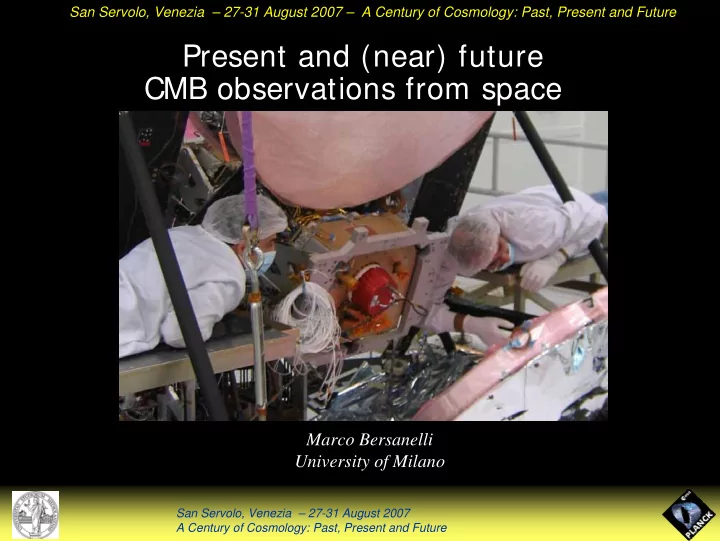
San Servolo, Venezia 27-31 August 2007 A Century of Cosmology: Past, Present and Future Present and (near) future CMB observations from space Marco Bersanelli University of Milano San Servolo, Venezia 27-31 August 2007 A Century


slide-1
SLIDE 1

San Servolo, Venezia – 27-31 August 2007 – A Century of Cosmology: Past, Present and Future

Marco Bersanelli University of Milano

Present and (near) future CMB observations from space

San Servolo, Venezia – 27-31 August 2007 A Century of Cosmology: Past, Present and Future

slide-2
SLIDE 2

John C. Mather George F. Smoot

“For their discovery of the blackbody form and anisotropy of the cosmic microwave background radiation”

Cosmic Background Explorer

COBE-FIRAS COBE-DMR

High precision New discovery

San Servolo, Venezia – 27-31 August 2007 A Century of Cosmology: Past, Present and Future

slide-3
SLIDE 3
slide-4
SLIDE 4

Expected CMB power spectrum

San Servolo, Venezia – 27-31 August 2007 A Century of Cosmology: Past, Present and Future

) , ( ) , ( φ ϑ φ ϑ

m m mY

a T

l l l

= Δ

− =

+ = =

l l l l l

l

m m m

a a C

2 2

1 2 1

Multipole l = π/Θ Within Horizon

Primordial fluctuations Acoustic peaks Damping

Θ → 0° Θ = Θ2 ≈ 0.1° Θ = 180° Θ = Θ1 ≈ 1° l → ∞ l ≈ 2000 l = 1 l ≈ 180 Angular scale Θ Beyond Horizon

Anisotropy (μK2 )

DMR

20 < l

slide-5
SLIDE 5

San Servolo, Venezia – 27-31 August 2007 A Century of Cosmology: Past, Present and Future

The details of the angular power spectrum depend on the value

  • f the main cosmological parameters

Accurate high resolution measurements of CMB anisotropies lead to high precision determination of parameters

R M

Ω + Ω + Ω = Ω

Λ Λ

Ω

M

Ω

B

Ω

slide-6
SLIDE 6

Before and after WMAP

San Servolo, Venezia – 27-31 August 2007 A Century of Cosmology: Past, Present and Future

WMAP 3yr T power spectrum and TE correlation

(Hinshaw et al 2006) All measurements before WMAP (Dec 2002)

slide-7
SLIDE 7

San Servolo, Venezia – 27-31 August 2007 M.Bersanelli – Present and (near) future CMB observations from space

WMAP

1.4 × 1.6 m primary reflectors Dual back-to-back Greforian optics Secondary reflector Deployed solar array & schield Thermally isolating cylinder Passive thermal radiator Warm S/C and instrument electronics (300K) Focal plane assembly (95K) Feed horns Upper omni antenna Star tracker Reaction wheels

COBE-DMR Heritage

  • Coherent detection
  • Differential receiver
  • Spinner
  • Passive cooling
slide-8
SLIDE 8

WMAP Instrument Assembly

Pseudo-correlation HEMT coherent radiometers

Università di MIlano

WMAP W-band feed horn Instrument Front-end Assembly

slide-9
SLIDE 9

San Servolo, Venezia – 27-31 August 2007 A Century of Cosmology: Past, Present and Future

WMAP 3yr data: Systematics analysis

(Jarosik et al 2006)

The success of WMAP (and COBE) rests on accurate control of systematic effects

  • 2. Radiometer gain model

If not corrected, would lead to ∼mK effect on maps

Gain data 1st yr model

New model

WMAP 3yrs: six Jupiter-crossing data sets Beam solid angles found 1% larger than assumed in 1st year (1.5% effect on power spectrum).

  • 1. Window function determination
slide-10
SLIDE 10

Foregrounds

  • WMAP 3-yr data confirmed

minimum of foreground contamination to T and Polarisation fluctuations is at ~ 70 GHz;

  • Polarisation: even at optimal

frequencies, signal (on average) is dominated by polarized galactic signal

  • foregrounds are a serious

challange

San Servolo, Venezia – 27-31 August 2007 A Century of Cosmology: Past, Present and Future

slide-11
SLIDE 11
  • Angular resolution: ~10’
  • Sensitivity per pixel: < 10 μK
  • Full frequency range: 30-900 GHz
  • Polarisation sensitive in CMB channels
  • Sky coverage: 100%
  • High control of systematics

Design goals

Two complementary cryogenic instruments in focal plane: LFI: Radiometer array (20K) HFI: Bolometer array (0.1K)

Planck Scientific Programme, ESA-SCI(2005)1 (“Blue book”)

San Servolo, Venezia – 27-31 August 2007 A Century of Cosmology: Past, Present and Future

slide-12
SLIDE 12

Precision cosmology with Planck: Temparature anisotropy

ESA-SCI(2005)1 (“Blue book”)

San Servolo, Venezia – 27-31 August 2007 A Century of Cosmology: Past, Present and Future

slide-13
SLIDE 13

San Servolo, Venezia – 27-31 August 2007 A Century of Cosmology: Past, Present and Future

E-mode polarisation power spectrum Searching for B-mode component

r = 0.1

Planck & CMB polarisation

ESA-SCI(2005)1 (“Blue book”)

slide-14
SLIDE 14

~ 13.7 years ago ~ 13.7 years ago

slide-15
SLIDE 15

Planck SVM, Telescope & Instruments Integration

slide-16
SLIDE 16

Planck Science Team: J. Tauber (ESA PS), M. Bersanelli, F. Bouchet, G. Efstathiou, J.M. Lamarre,

  • C. Lawrence, N.Mandolesi, H.U. Norgaard-Nielsen, J.-L. Puget, A. Zacchei

Planck Collaboration: ~ 400 scientists!

San Servolo, Venezia – 27-31 August 2007 A Century of Cosmology: Past, Present and Future

slide-17
SLIDE 17

Planck CQM

V-grooves SVM 300K 50K 100K 150K PPLM 45K

Primary r ef lect or Ellissoidal 1.5 x 1.9 m Sub-ref lect or Ellissoidal ∼1 m Focal plane unit 20K 4K 0.1K

45K

slide-18
SLIDE 18

San Servolo, Venezia – 27-31 August 2007 A Century of Cosmology: Past, Present and Future

Planck Instruments – Calibration Plan

Qualification Model (QM) Qualification Model (QM)

Unit Assembly Instrument Satellite In-flight

Flight Model (FM) Flight Model (FM) Completed Completed Completed Completed Completed Completed Completed Completed On-going On-going I n preparation I n preparation

Supported by Data Processing Centers Supported by Data Processing Centers

LFI HFI

Completed Completed Completed Completed Completed Completed

slide-19
SLIDE 19

Back-end unit Back-end unit Waveguides Waveguides Blackbody calibrator Blackbody calibrator Front-end unit Front-end unit

LFI FM cryo testing LFI FM cryo testing

slide-20
SLIDE 20

integrating sphere blackbody sources integrating sphere blackbody sources 2K Saturne plate 2K Saturne plate Planck/HFI PFM Planck/HFI PFM polarizer optical system polarizer optical system

HFI FM cryo testing HFI FM cryo testing

slide-21
SLIDE 21

Long-duration LFI-RAA data set

45 hours of undisturbed acquisition (MODE 5)

70 GHz LFI# 19 02 Sep 2006

San Servolo, Venezia – 27-31 August 2007 A Century of Cosmology: Past, Present and Future

slide-22
SLIDE 22

Long-duration LFI-RAA data set

45 hours of undisturbed acquisition (MODE 5)

70 GHz LFI# 19 02 Sep 2006

San Servolo, Venezia – 27-31 August 2007 A Century of Cosmology: Past, Present and Future

10 mHz

Knee frequency ~ 10mHz

slide-23
SLIDE 23

Amplitude spectral density comparison (internal consistency)

Single diode Combined diode Unchopped data

Basic model: Radiometer Equation

Solid line = WN best fit Dashed line = Sqrt(2)* WN

  • Excellent consistency of measured noise ASD with expected behaviour
  • LFI differential receiver design provides ~ 103 rejection of radiometer instability

San Servolo, Venezia – 27-31 August 2007 A Century of Cosmology: Past, Present and Future

slide-24
SLIDE 24

Temperature and Polarisation time streams compared with relative change in T of the loads during the test.

Data stream: DAE0027, FM 70 GHz RCA21

70 GHz sensitivity to polarisation signals

T= (A+ B) + (C+ D) P= (A+ B) – (C+ D) Tsky – Tref (sensor)

No significant T bleeding into the P signal

San Servolo, Venezia – 27-31 August 2007 A Century of Cosmology: Past, Present and Future

slide-25
SLIDE 25
  • 12/7 at 0h00
  • T= 100mK
  • PID2 was off
  • Requirements are met down to 0.1Hz
  • Low frequency stability probably limited by the environment

100mK1 PID2N

San Servolo, Venezia – 27-31 August 2007 A Century of Cosmology: Past, Present and Future

HFI Cryogenic testing

100mK stability during the calibration run

slide-26
SLIDE 26

143 GHz channel noise properties

Long timescale drifts correlate well with Saturne thermometry

field

SPHERE_MONIT_ISC2_TE MP interpolated and smoothed

fit to bolometer data

using linear regression and subtracted from raw, despiked bolometer timestreams

San Servolo, Venezia – 27-31 August 2007 A Century of Cosmology: Past, Present and Future

HFI Cryogenic testing

100mK stability during the calibration run

slide-27
SLIDE 27

Control of Systematic effects

San Servolo, Venezia – 27-31 August 2007 A Century of Cosmology: Past, Present and Future

  • At Planck sensitivity, systematics must be

controlled at μK level

  • LFI/HFI cross-correlation (e.g. 70 vs 100 GHz)

is a key tool to be exploited against systematics

  • Essential element of data processing strategy

= −

⎟ ⎟ ⎠ ⎞ ⎜ ⎜ ⎝ ⎛ =

N j spin f f f

j N F

1 1

2 cos 1 ) sin( ν ν π τ πν τ πν

slide-28
SLIDE 28

– QM mirrors and representative FPU and limited number of frequencies – At room temperature

RFQM measurement campaign

All beams computed with Grasp9 (nominal surfaces and alignment)

–Main beams –Intermediate beams –Full sky beams

San Servolo, Venezia – 27-31 August 2007 A Century of Cosmology: Past, Present and Future

slide-29
SLIDE 29

RFQM results at 100GHz

Co-polarisation beam at 100GHz X-polarisation beam at 100GHz

Alcatel-Alenia Space; ESA; HFI + LFI Teams

Main beam

San Servolo, Venezia – 27-31 August 2007 A Century of Cosmology: Past, Present and Future

slide-30
SLIDE 30

WMAP LFI 15 months 15 months Cosmic variance limit

Planck-LFI vs WMAP (V-band)

Estec, 11-12 April 2006 – M.Bersanelli PST-27 LFI Instrument Report

LFI

slide-31
SLIDE 31

LFI 15 months 8yr Cosmic variance limit 4yr 1yr WMAP

Planck-LFI vs WMAP (V-band)

Estec, 11-12 April 2006 – M.Bersanelli PST-27 LFI Instrument Report

LFI

slide-32
SLIDE 32

HFI 15 months Cosmic variance limit 8yr WMAP 4yr 1yr

Planck-HFI vs WMAP (W-band)

Estec, 11-12 April 2006 – M.Bersanelli PST-27 LFI Instrument Report

LFI

slide-33
SLIDE 33

Planck CQM tests

Third V-groove: T <50K

slide-34
SLIDE 34

Planck SVM

slide-35
SLIDE 35

HFI-LFI Integration

slide-36
SLIDE 36

PLM SVM mating

slide-37
SLIDE 37

Well done

slide-38
SLIDE 38

Telescope integration

slide-39
SLIDE 39

Finally together

slide-40
SLIDE 40