Presen entatio ion G n Guid ide Selling Living Well with - - PowerPoint PPT Presentation

presen entatio ion g n guid ide
SMART_READER_LITE
LIVE PREVIEW

Presen entatio ion G n Guid ide Selling Living Well with - - PowerPoint PPT Presentation

Presen entatio ion G n Guid ide Selling Living Well with Diabetes Prepare before the presentation. Consider these questions when preparing for your presentation. They may help you tailor your message to your audience and decide which


slide-1
SLIDE 1

1

Presen entatio ion G n Guid ide “Selling” Living Well with Diabetes

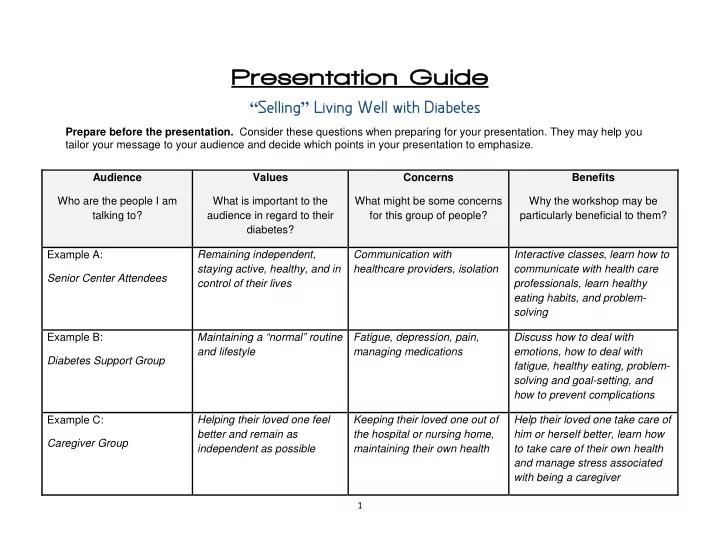
Prepare before the presentation. Consider these questions when preparing for your presentation. They may help you tailor your message to your audience and decide which points in your presentation to emphasize. Audience Who are the people I am talking to? Values What is important to the audience in regard to their diabetes? Concerns What might be some concerns for this group of people? Benefits Why the workshop may be particularly beneficial to them? Example A: Senior Center Attendees Remaining independent, staying active, healthy, and in control of their lives Communication with healthcare providers, isolation Interactive classes, learn how to communicate with health care professionals, learn healthy eating habits, and problem- solving Example B: Diabetes Support Group Maintaining a “normal” routine and lifestyle Fatigue, depression, pain, managing medications Discuss how to deal with emotions, how to deal with fatigue, healthy eating, problem- solving and goal-setting, and how to prevent complications Example C: Caregiver Group Helping their loved one feel better and remain as independent as possible Keeping their loved one out of the hospital or nursing home, maintaining their own health Help their loved one take care of him or herself better, learn how to take care of their own health and manage stress associated with being a caregiver

slide-2
SLIDE 2

2

Brief Presentation for Living Well with Diabetes

I’m here to tell you about an exciting new program we’re starting. It’s a workshop called Living Well with Diabetes and it was developed and researched at Stanford University of California to improve health and confidence, reduce hospitalizations, doctor visits, and emergency department visits for people with type 2 diabetes, pre-diabetes and those who live with someone who does. How many of you have diabetes, or have a friend or relative who has type 2 diabetes?

  • Pause. It’s serious, isn’t it? It’s tough how it can really change your life, what you eat,

and how you live. The statistics about diabetes are very staggering: Did you know that … (pick 3-5 statistics that are relevant to your audience). Here are the sources retrieved in 2017: Center for Disease Control (CDC)

https://www.cdc.gov/diabetes/pubs/statsreport14/national-diabetes-report-web.pdf

American Diabetes Association (ADA)

http://www.diabetes.org/diabetes-basics/statistics/#sthash.SG2TKv7U.dpuf http://main.diabetes.org/dorg/PDFs/Advocacy/burden-of-diabetes/minnesota.pdf

Centers for Medicare & Medicaid Services (CMS)

https://www.cms.gov/research-statistics-data-and-systems/statistics-trends-and-reports/chronic-conditions/downloads/2012chartbook.pdf

  • Approximately 466,638 people in Minnesota, or 10.5% of the adult population,

have diabetes. Around 26,000 new cases are diagnosed in Minnesota each year (ADA).

  • Diabetes and prediabetes cost an estimated $4.4 billion in Minnesota each year

(ADA).

  • The total Direct and Indirect cost for diabetes in the U.S. is estimated at $245

billion (CDC). $176 billion for medical costs and $69 billion in reduced

  • productivity. That is 2.3 times higher medical costs than those without diabetes.

(ADA)

  • Around 1 in 4 people with diabetes do not know that they have the disease.

(ADA)

  • Prevalence of diabetes in Seniors is high: The percentage of Americans age 65

and older is 25.9%, or 11.2 million seniors (diagnosed and undiagnosed). (ADA)

  • 28% - that’s more than 1/4 - of all Medicare beneficiaries had diabetes in 2010.

(CMS)

  • The risk of death among people with diabetes is 1.5 times higher than those

without diabetes of similar age. (CDC)

  • Diabetes is the leading cause of blindness, heart disease, stroke, amputation of

lower extremities, kidney disease, and death. (ADA).

slide-3
SLIDE 3

3

What would you think of spending just 2-1/2 hours a week for six weeks to learn how you can take control of your diabetes and your life? Here’s what you’ll learn:

  • healthy eating
  • reading nutrition labels and

planning low-fat meals

  • fun ways to get active
  • foot care
  • preventing or delaying

complications

  • preventing low blood sugar
  • tips for talking with your doctor

and family about your diabetes and general health You’ll learn from two Leaders and the rest of your group. This is NOT a lecture, rather, it’s a workshop where everyone participates and can learn from each other. How many of you would be interested in attending this workshop to develop tools to live a healthier life? Excellent! Here’s some information on how to register (printed materials). Go over the details:

  • date, day, and time of event
  • location
  • phone number
  • website
  • cost

I look forward to having each of you join the workshop, feel free to bring a friend. Remember class size is limited to 8-16 people, so please register as soon as possible! Thank you! Do you have any questions?