Preliminary VIIRS calibration for estimating flared gas volumes - - PowerPoint PPT Presentation

preliminary viirs calibration for estimating flared gas
SMART_READER_LITE
LIVE PREVIEW

Preliminary VIIRS calibration for estimating flared gas volumes - - PowerPoint PPT Presentation

Preliminary VIIRS calibration for estimating flared gas volumes Christopher D. Elvidge, Ph.D. Earth Observation Group NOAA-NESDIS National Geophysical Data Center Boulder, Colorado USA chris.elvidge@noaa.gov Kimberly Baugh, Mikhail


slide-1
SLIDE 1

Preliminary VIIRS calibration for estimating flared gas volumes

Christopher D. Elvidge, Ph.D. Earth Observation Group NOAA-NESDIS National Geophysical Data Center Boulder, Colorado USA chris.elvidge@noaa.gov Kimberly Baugh, Mikhail Zhizhin, Feng-Chi Hsu, Tilottama Ghosh Cooperative Institute for Research in the Environmental Sciences (CIRES) University of Colorado May 21, 2014

1

slide-2
SLIDE 2

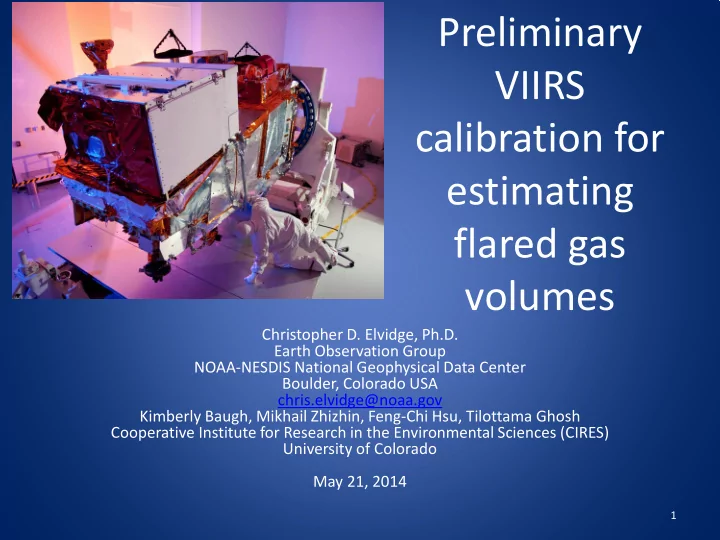
VIIRS

  • The Visible Infrared Imaging Radiometer Suite (VIIRS) is

the primary imaging sensor flown on the NASA/NOAA Suomi National Polar Partnership satellite.

  • Launched on October 28, 2011, VIIRS began to collect

usable data in late-February 2012.

  • 22 spectral channels, most with 750 meter pixels at

nadir.

  • 3000 km swath. Overpasses at ~01:30 and 13:30 daily.
  • VIIRS is unique for collecting near and short-wave

infrared data at night.

2

slide-3
SLIDE 3

M11

Requested

3

slide-4
SLIDE 4

Gas flares are readily detected in the VIIRS M10 spectral band

4

slide-5
SLIDE 5

Nighttime data processed on 24 hour increments Typical gas flare detection

Daily files are in csv and kmz formats

5

slide-6
SLIDE 6

Detection Limits

M10 M13

6

slide-7
SLIDE 7
  • Five nights per month.
  • Account for cloud obscuration using the VIIRS cloud

product.

  • Account for intermittent flaring by checking all cloud-free
  • bservations for detection.
  • Filter to remove biomass burning and non-flare sources.

Retain features 1400 K and hotter on land, 1000 K on water.

  • Normalize for latitudinal variation in pixel area.
  • Estimate flared gas volume for individual flares and

countries.

  • Generate ranked lists for flares and countries.

How to assemble a preliminary estimate for 2012?

7

slide-8
SLIDE 8

Total number of coverages

8

slide-9
SLIDE 9

Cloud-free coverages

9

slide-10
SLIDE 10

Calibration based on monthly reported data

Annual BCM = 0.08306 * Average M10 radiance R2 = 0.90 N = 840

10

slide-11
SLIDE 11

Total 2012 flared gas volume estimated at 165 BCM (preliminary)

11

slide-12
SLIDE 12

The largest single gas flare is in Venezuela

12

slide-13
SLIDE 13

Are the results affected by atmospheric differences?

13

Not much!

M10 is in a very clear atmospheric window, with near 90% transmissivity worldwide.

slide-14
SLIDE 14

Summary

  • VIIRS is well suited for global monitoring of gas flares.

– Global data collected every day – Spectral band centered on peak radiant emission from flares is collected at night – That band is in one of the clearest atmospheric windows – Suite of spectral bands provides for cloud product and measurement of cloud optical thickness

  • The preliminary estimates for 2012 find:

– 165 BCM total – Iraq is the country with the most flaring, followed by Russia, Iran, Venezuela, Algeria and Nigeria.

  • Why are VIIRS estimates different from DMSP?

– No signal saturation on VIIRS – DMSP could not distinguish light from flare and facility

  • Next steps:

– Add larger flares to calibration – Develop automated approach to discriminate clear versus cloud impacted flares based on the width of spikes – Fill out the processing for all dates in 2012, 2013, 2014 – Improve the separation of flares and fires using temporal leverage – Other next steps…………

14
slide-15
SLIDE 15

Data Access

  • Daily data (all detections):

http://ngdc.noaa.gov/eog/viirs/download_viirs_fire.html

  • Daily data (flares only):

http://ngdc.noaa.gov/eog/viirs/download_viirs_flares_o nly.html

  • Results on gas flaring (annual composite, spreadsheets,

flare rankings):

http://ngdc.noaa.gov/eog/viirs/vnf_flaring_cal_n_est.html

15

slide-16
SLIDE 16

Reference

Elvidge, C.D.; Zhizhin, M.; Hsu, F.-C.; Baugh, K.E. VIIRS Nightfire: Satellite Pyrometry at Night. Remote Sens. 2013, 5, 4423-4449. doi:10.3390/rs5094423

16