Preliminary results from Quad test beam Kees Ligtenberg LC-TPC - - PowerPoint PPT Presentation

preliminary results from quad test beam
SMART_READER_LITE
LIVE PREVIEW

Preliminary results from Quad test beam Kees Ligtenberg LC-TPC - - PowerPoint PPT Presentation

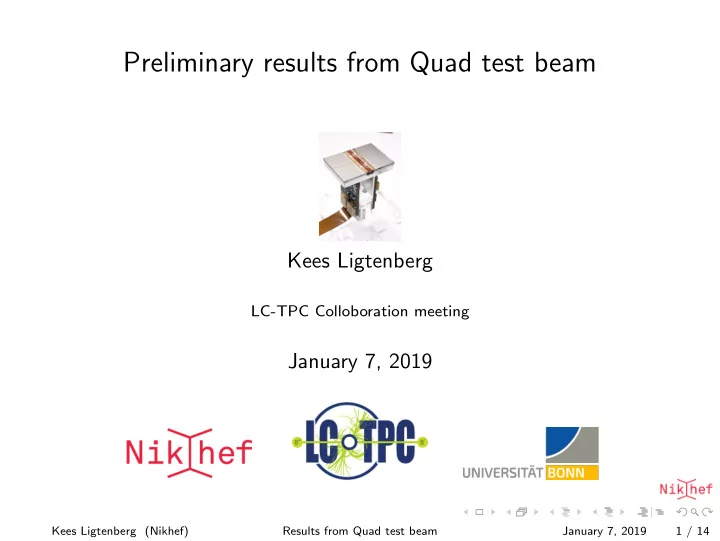
Preliminary results from Quad test beam Kees Ligtenberg LC-TPC Colloboration meeting January 7, 2019 Kees Ligtenberg (Nikhef) Results from Quad test beam January 7, 2019 1 / 14 Table of Contents Introduction 1 Synchronization issues 2

slide-1
SLIDE 1

Preliminary results from Quad test beam

Kees Ligtenberg

LC-TPC Colloboration meeting

January 7, 2019

Kees Ligtenberg (Nikhef) Results from Quad test beam January 7, 2019 1 / 14

slide-2
SLIDE 2

Table of Contents

1

Introduction

2

Synchronization issues

3

Quad results

Kees Ligtenberg (Nikhef) Results from Quad test beam January 7, 2019 1 / 14

slide-3
SLIDE 3

Introduction

Quad is a module consisting of 4 Timepix3 chips, with all services under the active area Quad detector is put inside a test box with guards and field shaping, filled with T2K gas See also introduction talk by Peter Kluit

Kees Ligtenberg (Nikhef) Results from Quad test beam January 7, 2019 2 / 14

slide-4
SLIDE 4

Test beam setup

2.5 GeV electrons provided by the ELSA facility (Bonn) at a 10 kHz rate Events are triggered by a scintillating plane The telescope consist of 6 mimosa planes with 18.4 µm × 18.4 µm sized pixels

Kees Ligtenberg (Nikhef) Results from Quad test beam January 7, 2019 3 / 14

slide-5
SLIDE 5

Timepix readout procedure

Timepix readout procedure The Timepix3 registers the fine time of a hit and stores it near the pixel to be read out. 4 Timepix3 chips are connected with one 160 Mb/s link to the SPIDR each

◮ 12 links with a maximum speed of 640 Mb/s per link are available

The SPIDR boards adds a course time stamp (409.6µs per tick) to each hit and transmits it to the DAQ PC. Hits that arrive too late at the SPIDR board receive the wrong course time Because the link speed was not fast enough for the rates, a maximum of 1.3 MHits/s was read out per chip

Kees Ligtenberg (Nikhef) Results from Quad test beam January 7, 2019 4 / 14

slide-6
SLIDE 6

Synchronization issues

hits

N 100 200 300 400 500 600 700 800 900 1000 Entries 50 100 150 200 250 300

quad chip 0 (RMS = 54.26) quad chip 1 (RMS = 55.52) quad chip 2 (RMS = 80.85) quad chip 3 (RMS = 53.45) < 1000)

hits

single chip (RMS=180 for 20 < N

The number of hits per 409.6 µs does hardly fluctuate (Teal represents the 2017 single chip)

s] µ Shifted time [409.6 20 40 60 80 100 120 140 160 180 200 Entries 20 40 60 80 100 120 140 160 180

3

10 ×

Hits after selection: some hits are not read

  • ut until after 160 cycles of 409.6 µs

The solution is to stack hits from up to 200 cycles after the original trigger

Kees Ligtenberg (Nikhef) Results from Quad test beam January 7, 2019 5 / 14

slide-7
SLIDE 7

Selections

Use runs 668, 672, and 676 (center, right, left respectively): Vdrift = 400 V/cm, which is near the maximum drift velocity because

  • f a water vapor concentration of around 4000 ppm

VGrid = 330 V Threshold at ∼550 e (55 DAC counts above noise) Selection −500 ns < thit − ttrigger < 500 ns Hit ToT > 0.10 µs Reject outliers ( rx < 1.5 mm, rz < 3 mm ) Nhits > 20 (Nrx<1.5mm / Nrx<5mm) > 0.8 xhit − xtrack < 0.3 mm

Kees Ligtenberg (Nikhef) Results from Quad test beam January 7, 2019 6 / 14

slide-8
SLIDE 8

Hit maps

Run 668 Run 672 Run 676

Kees Ligtenberg (Nikhef) Results from Quad test beam January 7, 2019 7 / 14

slide-9
SLIDE 9

Drift velocity

Because of water vapor content (0.6%), the drift velocity is expected to be slower than normally for a T2K gas The measured drift speed (55 µm/ns) is slightly smaller than expected for this water vapor concentration (60 µm/ns)

6789 102 2 3 4 5 6789 103 2 3 4 5 6789 10 20 30 40 50 60 70 80 90

E [V/cm] vdrift [µm/ns]

Kees Ligtenberg (Nikhef) Results from Quad test beam January 7, 2019 8 / 14

slide-10
SLIDE 10

Time walk correction?

Kees Ligtenberg (Nikhef) Results from Quad test beam January 7, 2019 9 / 14

slide-11
SLIDE 11

Resolution in the transverse direction

z-position [mm] 2 4 6 8 10 from fit to track-residual [mm]

x

σ 0.05 0.1 0.15 0.2 0.25 0.3 0.35 0.4 0.45 0.5

x

D cm m/ µ 464 z0 1.08 mm − / ndf

2

χ 22105 / 96

σx =

  • σ2

x0 + D2 T(z − z0)

Kees Ligtenberg (Nikhef) Results from Quad test beam January 7, 2019 10 / 14

slide-12
SLIDE 12

Resolution in the drift direction

z-position [mm] 2 4 6 8 from fit to track-residual [mm]

z

σ 0.1 0.2 0.3 0.4 0.5 0.6 0.7 0.8

z

D cm m/ µ 187

z0

σ m µ 264 z0 1.08 mm − / ndf

2

χ 6023 / 97

s (10%) µ s < ToT < 0.30 µ 0.10 s (89%) µ ToT > 0.30

L

D cm m/ µ 187

z0

σ m µ 264 z0 1.08 mm −

σz =

  • σ2

z0 + D2 L(z − z0)

Kees Ligtenberg (Nikhef) Results from Quad test beam January 7, 2019 11 / 14

slide-13
SLIDE 13

Deformations in the pixel plane

Calculate the mean x-residual per 4 × 4 pixels Alignment problem in the left two chips will be looked at before Thursday

x [mm] 5 10 15 20 25 y[mm] 10 − 5 − 5 10 15 20 25 mean x-residual [mm] 0.1 − 0.08 − 0.06 − 0.04 − 0.02 − 0.02 0.04 0.06 0.08 0.1 Kees Ligtenberg (Nikhef) Results from Quad test beam January 7, 2019 12 / 14

slide-14
SLIDE 14

Deformations after correction

To be added before Thursday

Kees Ligtenberg (Nikhef) Results from Quad test beam January 7, 2019 13 / 14

slide-15
SLIDE 15

Conclusions

A good set of data with the Quad was taken using 2.5 GeV electrons A synchronization problem was identified, and a work-around is in place The hit resolution will be further investigated In the first diagrams, systematic deformations are small Analysis is well under way

Kees Ligtenberg (Nikhef) Results from Quad test beam January 7, 2019 14 / 14

slide-16
SLIDE 16

Deformations in the drift direction

without per column calibration

x [mm] 5 10 15 20 25 y[mm] 10 − 5 − 5 10 15 20 25 mean z-residual [mm] 0.1 − 0.08 − 0.06 − 0.04 − 0.02 − 0.02 0.04 0.06 0.08 0.1 Kees Ligtenberg (Nikhef) Results from Quad test beam January 7, 2019 15 / 14