
SLIDE 1
Preliminaries Assumption1lighthouse sensor system - - PowerPoint PPT Presentation
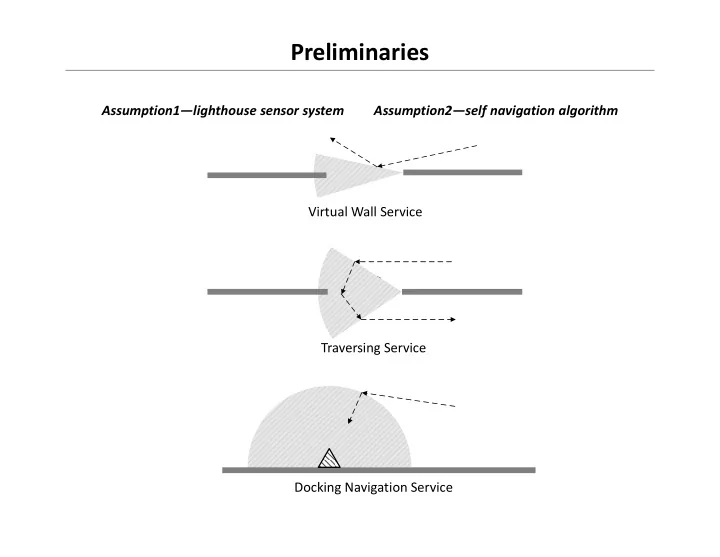
Preliminaries Assumption1lighthouse sensor system Assumption2self navigation algorithm Virtual Wall Service Traversing Service Docking Navigation Service Problem Formulation Key concept 1cleaning in a battery-reserving mode
State 1: charging Entry action 1. Starts manually 2. Starts as self-charging Exit action 1. Enters state 2, cleans in the regular mode 2. Enters state 4, travels from A to B 3. Enters state 6, terminates state machine State 2: cleaning in the regular mode Entry action 1. Starts after charging State 3: cleaning in the battery reserving mode Entry action 1. Starts after charging with regular mode Exit action 1. Enters state 4, travels from A to B 2. Enters state 5, requests the lighthouse signal State 4: traveling from A to B Entry action 1. Starts after charging 2. Starts after receiving the signal 3. Starts after finishing the task in the regular mode 1. Starts after charging 2. Starts after finding the right position 3. Starts when entering a new room Exit action 1. Enters state 5, requests for lighthouse signal 2. Enters state 4, travels from A to B 3. Enters state 3, cleans in the battery-reserving mode State 5: requesting for the lighthouse navigation signal Entry action 1. Starts after cleaning a room with sufficient battery 2. Starts after cleaning a room with the battery-reserving mode Exit action 1. Enters state 4, travels from A to B 3. Starts after finishing the task in the regular mode 4. Starts after finishing the task in the battery-reserving mode Exit action 1. Enters state 2, cleaning in the regular mode 2. Enters state 3, cleans in the battery-reserving mode 3. Enters state 1, charging