Predication and Speculation Last time Instruction scheduling - - PDF document

predication and speculation
SMART_READER_LITE
LIVE PREVIEW

Predication and Speculation Last time Instruction scheduling - - PDF document

Predication and Speculation Last time Instruction scheduling Profile-guided optimizations How can we increase our scheduling window? How can we move excepting instructions (loads) above splits? A Today Brief history of


slide-1
SLIDE 1

1

CS553 Lecture Predication and Speculation 2

Predication and Speculation

Last time

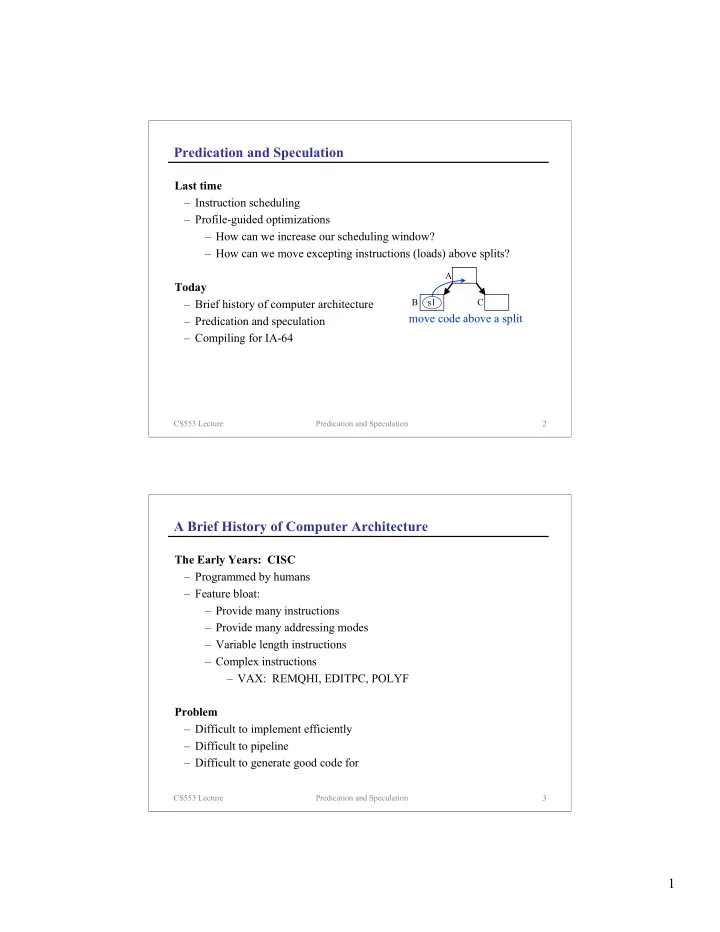
– Instruction scheduling – Profile-guided optimizations – How can we increase our scheduling window? – How can we move excepting instructions (loads) above splits?

Today

– Brief history of computer architecture – Predication and speculation – Compiling for IA-64

B A C s1

move code above a split

CS553 Lecture Predication and Speculation 3

A Brief History of Computer Architecture

The Early Years: CISC

– Programmed by humans – Feature bloat: – Provide many instructions – Provide many addressing modes – Variable length instructions – Complex instructions – VAX: REMQHI, EDITPC, POLYF

Problem

– Difficult to implement efficiently – Difficult to pipeline – Difficult to generate good code for

slide-2
SLIDE 2

2

CS553 Lecture Predication and Speculation 4

A Brief History of Computer Architecture (cont)

The Early 1980s: RISC

– Simplify the ISA to facilitate pipelining – Uniform instruction format simplifies decoding – Uniform instructions easier to pipeline – Pipelining improves clock speeds

Uniform ISA Simplifies Compilation

– Stanford: Produce an architecture that leverages their strong compiler group – Berkeley: Produce an architecture that does not require heroic compilation

Problems

– Uncertain latency – No binary compatibility

CS553 Lecture Predication and Speculation 5

A Brief History of Computer Architecture (cont)

The 1990’s: Dynamic Superscalar

– Simplified pipelining and more transistors enable hardware scheduling – Re-order instructions – Hardware speculation (branch prediction) – Increased issue width

Note

– We’re talking about implementation trends here, not changes in the architecture

Problems

– The bureaucracy problem – More and more resources being devoted to control and management – Fewer and fewer resources being devoted to actual work – ILP limited (typically between 1 and 2)

slide-3
SLIDE 3

3

CS553 Lecture Predication and Speculation 6

A Brief History of Computer Architecture (cont)

The 1990’s: CISC implemented on RISC core

– Provide binary compatibility – Dynamically translate CISC instructions to RISC instructions – Best of both worlds?

Note

– This again is a microarchitectural change, not an architectural change

Problems

– Hardware complexity – Hardware still needs to discover parallelism – Still have the n2 scheduling problem – Still difficult to compile for

CS553 Lecture Predication and Speculation 7

Implicitly Sequential Instruction Stream

Problems

– Compilers can expose parallelism – Compilers must eventually emit linear code – Hardware must then re-analyze code to perform OoO execution – Hardware loses information available to the compiler – Compiler and hardware can only communicate through the sequential stream of instructions, so hardware does redundant work

How can we solve this problem?

source code compiler parallelized code machine code hardware program FPU’s

slide-4
SLIDE 4

4

CS553 Lecture Predication and Speculation 8

Explicitly Parallel Instruction Stream

A solution

– Hardware does not need to re-analyze code to detect dependences – Hardware does not perform OoO execution

VLIW: Very Long Instruction Word

– Each instruction controls multiple functional units – Each instruction is explicitly parallel

source code compiler parallelized code parallel machine code hardware program FPU’s

CS553 Lecture Predication and Speculation 9

VLIW

Basic idea – Each instruction controls multiple functional units – Rely on compilers to perform scheduling and to identify parallelism – Simplified hardware implementations

Benefits

– Compiler can look at a larger window of instructions than hardware – Can improve the scheduler even after a chip has been fabricated

Problems

– Slow compilation times – No binary compatibility – Difficult for compilers to deal with aliasing and long latencies – Code is implementation-specific

slide-5
SLIDE 5

5

CS553 Lecture Predication and Speculation 10

VLIW and IA-64

VLIW

– Big in the embedded market – Binary compatibility is less of an issue – An old idea – Horizontal microcode – Multiflow (1980’s) – Intel i860 (early 1990’s)

Terminology

– EPIC: Explicitly Parallel Instruction Computer – New twist on VLIW – Don’t make code implementation-specific – IA-64 is Intel’s EPIC instruction set – Itanium is the first IA64 implementation

CS553 Lecture Predication and Speculation 11

Explicitly Parallel Instruction Sets: IA-64

IA-64 Design Philosophy

– Break the model of implicitly sequential execution – Use template bits to specify instructions that can execute in parallel – Issue these independent instructions to the FPU’s in any order – (Templates will cause some increase in code size) – The hardware can then grab large chunks of instructions and simply feed them to the functional units – Hardware does not spend a lot of time figuring out order of execution; hence, simplified hardware control – Statically scheduled code – Hardware can then provide a larger number of registers – 128 (about 4 times more than current microprocessors) – Number of registers fixed by the architecture, but number of functional units is not

slide-6
SLIDE 6

6

CS553 Lecture Predication and Speculation 12

IA-64

A return to hardware “simplicity”

– Revisit the ideas of VLIW – Simplify the hardware to make it faster – Spend larger percentage of cycles doing actual work – Spend larger percentage of hardware on registers, caches, and FPU’s – Use larger number of registers to support more parallelism

Engineering goal

– Produce an “inherently scalable architecture” – Design an architecture―an ISA―for which there can be many implementations – This flexibility allows the implementation to change for “years to come”

parallel machine code hardware program program

CS553 Lecture Predication and Speculation 13

Two Key Performance Bottlenecks

Branches

– Modern microprocessors perform good branch prediction – But when they mispredict, the penalty is high and getting higher – Penalties increase as we increase pipeline depths – Estimates: 20-30% of performance goes to branch mispredictions [Intel98] – Branches also lead to small basic blocks, which restrict latency hiding

  • pportunities

Memory latency

– CPU speed doubles every 18 months (60% annual increase) – Memory speed increase about 5% per year

slide-7
SLIDE 7

7

CS553 Lecture Predication and Speculation 14

−Control dependences inhibit parallelism −Don’t know whether to execute instr3 or instr5 until the cmp is completed

instr1 instr2 . . . P1,P2 ← cmp(r2,0) (P2)jump else instr3 instr4 jump Exit instr5 instr6 . . . instr7

Branches Limit Performance

if then else

CS553 Lecture Predication and Speculation 15

Idea −Add a predicate flag to each instruction −If predicate is true, the instruction is executed −If predicate is false, the instruction is not executed −Predicates are simply bits in a register −Converts control flow into data flow −Exposes parallelism −With predicate flags, instr3 – instr7 can all be fetched in parallel

instr1 instr2 . . . P1,P2 ← cmp(r2,0) (P2)jump else (P1)instr3 (P1)instr4 jump Exit (P2)instr5 (P2)instr6 . . . instr7

Predicated Execution

if then else This is called if-conversion Benefits? −Fewer branches (fewer mispredictions) −Larger basic blocks −More parallelism

slide-8
SLIDE 8

8

CS553 Lecture Predication and Speculation 16

The Memory Latency Problem

Memory Latency

– Writes can be done out of order and can be buffered – Loads are the problem: processor must wait for loads to complete before using the loaded value – Standard latency-hiding trick: issue non-blocking load as early as possible to hide latency

The Problem

– Loads typically issued at beginning

  • f basic block

– Can’t move the Load outside the basic block – If the Load were to cause an exception when the basic block is not executed, then the early Load causes an erroneous exception

instr1 instr2 . . . (P2)jump else Load instr3 jump Exit

CS553 Lecture Predication and Speculation 17

Benefits? −More freedom to move code– can now move Loads above branches as long as the check is in the original basic block −Complication: What happens if chk.s is issued without a corresponding load.s? −This is clearly an error, so we need to be careful about where we move the load.s

(Control) Speculative Loads

Split-phase operation

– Standard trick in parallel computing – Issue the load (load.s) as early as you wish – Detect any exception and record it somewhere with the target of the load – Can later check to see whether the load completed successfully: chk.s

load.s r13 instr1 instr2 jump P2 load instr3 chk.s r13 . . .

slide-9
SLIDE 9

9

CS553 Lecture Predication and Speculation 18

(Data) Speculative Loads

Issue

– Want to speculate that a load is not data dependent on a preceding store

Split-phase operation

– Issue early advanced load (record entry in advanced load address table (ALAT)) – Clear corresponding ALAT entries at store – Check instruction looks for ALAT entry (branch to patch code if not found)

Note

– Can speculate instructions that depend on load, too load.a r13 instr1 instr2 store load chk.a r13 instr3

reg # addr size reg # addr size reg # addr size

. . .

chk/ld compare and match on reg # st, compare and match on addr

CS553 Lecture Predication and Speculation 19

Predication is an Old Idea

High performance computing

– SIMD machines (Single Instruction Multiple Data) – All processors operate in lock-step but operate on different data – What do you do with control flow?

if (A[i][j] < 0) A[i][j] = -A[i][j]

– Compute a mask of 0’s and 1’s – Execute both halves of the control flow using the appropriate mask – Can do this in either hardware or software

Mask[i][j] = (A[i][j] < 0) A[i][j] -= Mask[i][j] * 2 * A[i][j]

slide-10
SLIDE 10

10

CS553 Lecture Predication and Speculation 20

Is Predication a Good Idea?

Where should we perform predication? Runtime information helps −Branch behavior −Load latencies Degree of predication depends on issue width −The ISA can be implementation-independent −But the compilers that emit code cannot be implementation-independent Opportunities for profiling

CS553 Lecture Predication and Speculation 21

Where should predication occur?

Hyperblocks

– not Extended Basic Blocks, because EBBs do not include any join nodes except possibly the head – not Superblocks, because they involve only one path – single entry, multiple exits, no nested inner loops

[Mahlke et. al. 92] paper

– Basic blocks put into hyperblock based on ... – instruction frequency (more frequent is better) – size of the basic block (smaller is better) – instruction characteristics (procedure calls and unresolvable memory accesses are bad)

slide-11
SLIDE 11

11

CS553 Lecture Predication and Speculation 22

Is Speculation a Good Idea?

What are the disadvantages of speculation?

– Wasted work

The real question: Who should perform speculation?

– The hardware can exploit runtime information – The compiler can exploit a much larger scope

Speculation increases parallelism

– Increase performance by exploiting parallelism – Other examples of this? – Asynchronous communication in parallel computing – Continuations in functional languages – Multi-tasking

CS553 Lecture Predication and Speculation 23

Implications

IA64

– The ideas are not new – The willingness to change the ISA is new and significant

Implications for compilers

– Increased role of the compiler – More control over sequencing, prefetching, stores, branch prediction – Hardware doesn’t “undo” the compiler’s work

Future systems

– What is the right division of labor between the compiler and the hardware? – How else can compilers be used to simplify the hardware and make the hardware more effective? – Can we improve the communication between the compiler and hardware?

slide-12
SLIDE 12

12

CS553 Lecture Predication and Speculation 24

Epilogue

Intel announces 64-bit IA-32

– The end of IA-64

What went wrong with IA-64? What does the future hold for Dynamic Superscalar? VLIW?

CS553 Lecture Predication and Speculation 25

Concepts

Predication and speculation Performance bottlenecks

– Branches, memory latency

IA-64 characteristics

– VLIW – Support for data/control speculation (if-conversion), predication, and on and on...

Role of compiler

– Must work hard! – Has less available information – Has larger scope

slide-13
SLIDE 13

13

CS553 Lecture Predication and Speculation 26

Next Time

Lecture

– Dynamic compilation