Precision Muon Tracking Detectors and Read-out Electronics for - - PowerPoint PPT Presentation

precision muon tracking detectors and read out
SMART_READER_LITE
LIVE PREVIEW

Precision Muon Tracking Detectors and Read-out Electronics for - - PowerPoint PPT Presentation

Precision Muon Tracking Detectors and Read-out Electronics for Operation at Very High Background Rates at Future Colliders S. Nowak O. Kortner H. Kroha R. Richter K. Schmidt-Sommerfeld Ph. Schwegler Max-Planck-Institut f ur Physik, Munich


slide-1
SLIDE 1

Precision Muon Tracking Detectors and Read-out Electronics for Operation at Very High Background Rates at Future Colliders

  • S. Nowak
  • O. Kortner
  • H. Kroha
  • R. Richter
  • K. Schmidt-Sommerfeld
  • Ph. Schwegler

Max-Planck-Institut f¨ ur Physik, Munich

Motivation

  • The muon spectrometers of experiments at HL-LHC at a Future Circular

Hadron Collider (FCC-hh) require efficient muon tracking with very high spatial resolution (30-40 µm) at high background rates.

  • ATLAS Monitored Drift Tube (MDT) chambers have proven high reliability

and high-precision tracking up to neutron and γ fluxes of 500 Hz

cm2.

  • Background rates at HL-LHC are x 10 and at FCC x 40 than at LHC
  • sMDT chambers are very well suited large area muon tracking at FCC

experiments.

  • Like the ATLAS MDT chambers for HL-LHC, sMDT chambers can also be

used for high selective Level-1 muon triggers at FCC.

sMDT chambers

30 mm MDT 15 mm sMDT

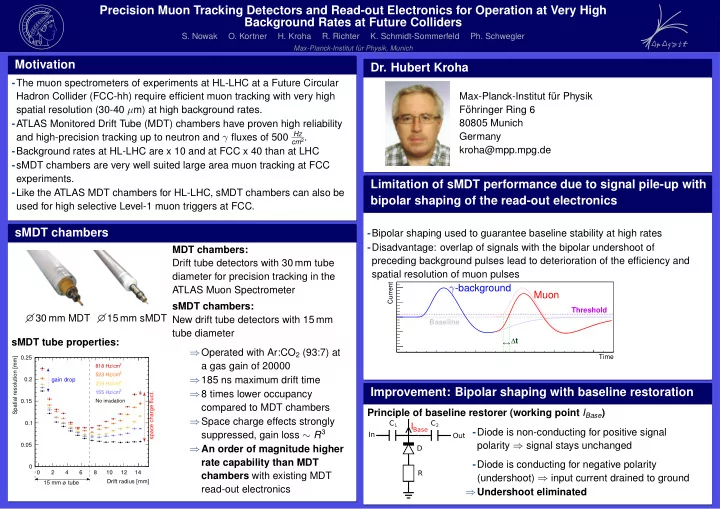
MDT chambers: Drift tube detectors with 30 mm tube diameter for precision tracking in the ATLAS Muon Spectrometer sMDT chambers: New drift tube detectors with 15 mm tube diameter sMDT tube properties:

Drift radius [mm] 2 4 6 8 10 12 14 0.05 0.1 0.15 0.2 0.25

No irradation

2

155 Hz/cm

2

259 Hz/cm

2

523 Hz/cm

2

818 Hz/cm

space charge fluct. gain drop 15 mm ⌀ tube Spatial resolution [mm]

⇒Operated with Ar:CO2 (93:7) at

a gas gain of 20000

⇒185 ns maximum drift time ⇒8 times lower occupancy

compared to MDT chambers

⇒Space charge effects strongly

suppressed, gain loss ∼ R3

⇒An order of magnitude higher

rate capability than MDT chambers with existing MDT read-out electronics

  • Dr. Hubert Kroha

Max-Planck-Institut f¨ ur Physik F¨

  • hringer Ring 6

80805 Munich Germany kroha@mpp.mpg.de

Limitation of sMDT performance due to signal pile-up with bipolar shaping of the read-out electronics

  • Bipolar shaping used to guarantee baseline stability at high rates
  • Disadvantage: overlap of signals with the bipolar undershoot of

preceding background pulses lead to deterioration of the efficiency and spatial resolution of muon pulses

Time Current

t ∆ Threshold Baseline

Muon

γ-background

Improvement: Bipolar shaping with baseline restoration

Principle of baseline restorer (working point IBase)

  • Diode is non-conducting for positive signal

polarity ⇒ signal stays unchanged

  • Diode is conducting for negative polarity

(undershoot) ⇒ input current drained to ground

⇒Undershoot eliminated

slide-2
SLIDE 2

Precision Muon Tracking Detectors and Read-out Electronics for Operation at Very High Background Rates at Future Colliders

  • S. Nowak
  • O. Kortner
  • H. Kroha
  • R. Richter
  • K. Schmidt-Sommerfeld
  • Ph. Schwegler

Max-Planck-Institut f¨ ur Physik, Munich

Bipolar shaping circuit with baseline restoration

PreAmp Filter 1 Filter 2 BLR Comparator

LVDS out sMDT

  • High bandwidth (700 MHz) transimpedance amplifier (PreAmp)
  • Bipolar shaping circuit (2 filter stages) with baseline restoration and

comparator with LVDS output to TDC (as MDT read-out chip)

Bipolar shaped pulses with baseline restoration

Time [ns]

200 400 600 800

Signal [V]

  • 0.5

0.5 1 1.5

Gamma response without BLR Shaped signal Unshaped signal (10x) Time [ns]

200 400 600 800

Signal [V]

  • 0.5

0.5 1 1.5

Gamma response with BLR Shaped signal Unshaped signal (10x) Time [ns]

200 400 600 800

Signal [V]

0.5 1

Muon response without BLR Shaped signal Unshaped signal (10x) Time [ns]

200 400 600 800

Signal [V]

0.5 1

Muon response with BLR Shaped signal Unshaped signal (10x)

  • γ-pulses push shaper in saturation (larger signals with longer undershoot

compared to muon pulses)

  • Clear undershoot suppression with baseline restoration

sMDT single-tube resolution under γ irradiation (GIF/CERN)

]

2

Photon hit flux [kHz/cm 5 10 15 20 Spatial resolution [mm] 0.02 0.04 0.06 0.08 0.1 0.12 0.14 0.16 0.18 0.2 MDT Expectation from MDT sMDT without BLR sMDT with BLR

MDT sMDT sMDT with BLR

  • sMDT resolution limited at high counting rates by signal pile-up effects of

the electronics, in contrast to MDTs where space charge effects dominate

  • Suppression of signal pile-up effects with baseline restoration

sMDT single-tube muon efficiency

Photon hit rate [kHz/tube] 500 1000 1500 2000 ) efficiency σ Drift tube muon (3 0.1 0.2 0.3 0.4 0.5 0.6 0.7 0.8 0.9 1 MDT, 820 ns dead time, no BLR s sMDT, 220 ns dead time, no BLR sMDT, 220 ns dead time, with BLR 50 ns dead time, with BLR sMDT,

MDT sMDT sMDT + BLR sMDT + BLR + short dead time

  • At high counting rates limited by read-out electronics
  • Use of minimum electronics dead time possible for sMDTs
  • Suppression of signal pile-up effects at short dead times with baseline

restoration

slide-3
SLIDE 3

Precision Muon Tracking Detectors and Read-out Electronics for Operation at Very High Background Rates at Future Colliders

  • S. Nowak
  • O. Kortner
  • H. Kroha
  • R. Richter
  • K. Schmidt-Sommerfeld
  • Ph. Schwegler

Max-Planck-Institut f¨ ur Physik, Munich

MDT and sMDT occupancies at HL-LHC and maximum FCC-hh luminosity

Occupancies of MDT and sMDT tubes at maximum FCC luminosity in the ATLAS geometry (ATLAS operating parameters and tube lengths) Background rates in muon system ATLAS at LHC design luminosity → x 10 at HL-LHC → x 4 at FCC-hh (MDT: max. 500 Hz

cm2, max. 30% occupancy)

  • Maximum sMDT occupancy at FCC is half of the MDT occupancy at

HL-LHC

  • FCC detectors not limited to ATLAS operating parameters and

geometry

⇒ Further optimisation of tube parameters and read-out electronics

sMDT design and construction

  • sMDT chamber design and assembly procedures optimized for mass

production

  • Simple and cheap drift tube design with high reliability
  • Special plastic materials selected to prevent outgassing and cracking
  • Industrial standard Al tubes
  • Wire positioning accuracy better than 10 µm
  • No wire aging observed up to 9 C

cm charge on wire (15 x ATLAS

requirement)

External reference surface Internal wire locator

O-ring

⌀4×1.5

Signal cap (brass) Insulator Grounding pin Grounding pin base Contact disc End-plug insulator (Crastin) Aluminum tube

⌀15×0.4

Plastic stopper (Pocan) T wister O-ring ⌀10×2.0 Aluminum ring Brass insert with precision surface Plastic gas connector (Pocan) Crimp tubelet (copper) Gas inlet

slide-4
SLIDE 4

Precision Muon Tracking Detectors and Read-out Electronics for Operation at Very High Background Rates at Future Colliders

  • S. Nowak
  • O. Kortner
  • H. Kroha
  • R. Richter
  • K. Schmidt-Sommerfeld
  • Ph. Schwegler

Max-Planck-Institut f¨ ur Physik, Munich

sMDT Chamber Construction Construction of a sMDT chamber already installed in ATLAS

  • Semi-automated drift-tube production and chamber assembly take

place in a air-conditioned clean room

  • Automated testing of tube leakage rate, leakage current and wire

tension

  • 2 sMDT chambers already installed in the ATLAS detector
  • Additional 12 (16) sMDT chambers under construction until 2016 (2018)

Tube positioning using precisely machined jigs 3D coordinate measurement Residual distribution of horizontal and vertical coordinates (σ < 10µm)

  • Wire positioning accuracy is reached due to tube external reference surface

and high precisely machined jigs.

  • Wire positioning accuracy better than 10 µm (most precise chambers so far)
  • Chamber assembly is conducted within one working day

Summary

  • sMDT chambers are a well suited for high-accuracy large area muon

tracking at high background levels as required for max. luminosity at the FCC.

  • The high reliability of the MDT and sMDT chambers has been proven in

ATLAS.

  • An order of magnitude smaller occupancies of sMDT compared to MDT

chambers.

  • Space charge effects are strongly suppressed for sMDT tubes.
  • Performance of sMDT tubes can be further increased by optimised read-out

electronics.