SLIDE 1 Inf1-DA 2010–2011 II: 83 / 119
Pre-processing and annotation
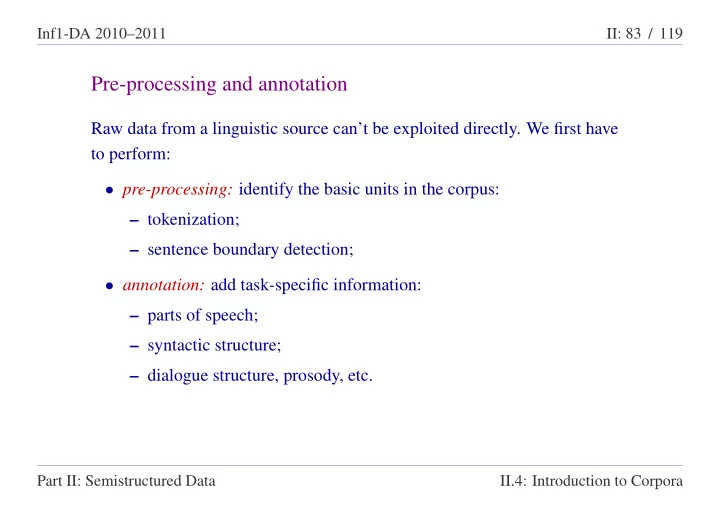
Raw data from a linguistic source can’t be exploited directly. We first have to perform:
- pre-processing: identify the basic units in the corpus:
– tokenization; – sentence boundary detection;
- annotation: add task-specific information:
– parts of speech; – syntactic structure; – dialogue structure, prosody, etc.
Part II: Semistructured Data II.4: Introduction to Corpora
SLIDE 2 Inf1-DA 2010–2011 II: 84 / 119
Tokenization
Tokenization: divide the raw textual data into tokens (words, numbers, punctuation marks). Word: a continuous string of alphanumeric characters delineated by whitespace (space, tab, newline). Example: potentially difficult cases:
- amazon.com, Micro$oft
- John’s, isn’t, rock’n’roll
- child-as-required-yuppie-possession
(As in: “The idea of a child-as-required-yuppie-possession must be motivating them.”)
Part II: Semistructured Data II.4: Introduction to Corpora
SLIDE 3 Inf1-DA 2010–2011 II: 85 / 119
Sentence Boundary Detection
Sentence boundary detection: identify the start and end of sentences. Sentence: string of words ending in a full stop, question mark or exclamation mark. This is correct 90% of the time. Example: potentially difficult cases:
- Dr. Foster went to Gloucester.
- He said “rubbish!”.
- He lost cash on lastminute.com.
The detection of word and sentence boundaries is particularly difficult for spoken data.
Part II: Semistructured Data II.4: Introduction to Corpora
SLIDE 4
Inf1-DA 2010–2011 II: 86 / 119
Corpus Annotation
Annotation: adds information that is not explicit in the data itself, increases its usefulness (often application-specific). Annotation scheme: basis for annotation, consists of a tag set and annotation guidelines. Tag set: is an inventory of labels for markup. Annotation guidelines: tell annotators (domain experts) how tag set is to be applied; ensure consistency across different annotators.
Part II: Semistructured Data II.4: Introduction to Corpora
SLIDE 5 Inf1-DA 2010–2011 II: 87 / 119
Part-of-speech (POS) annotation
Part-of-speech (POS) tagging is the most basic kind of linguistic annotation. Each linguistic token is assigned a code indicating its part of speech, i.e., basic grammatical status. Examples of POS information:
- singular common noun;
- comparative adjective;
- past participle.
POS tagging forms a basic first step in the disambiguation of homographs. E.g., it distinguishes between the verb “boot” and the noun “boot”. But it does not distiguish between “boot” meaning “kick” and “boot” as in “boot a computer”, both of which are transitive verbs.
Part II: Semistructured Data II.4: Introduction to Corpora
SLIDE 6 Inf1-DA 2010–2011 II: 88 / 119
Example POS tag sets
- CLAWS tag set (used for BNC): 62 tags; (Constituent Likelihood Automatic Word-tagging System)
- Brown tag set (used for Brown corpus): 87 tags:
- Penn tag set (used for the Penn Treebank): 45 tags.
Category Examples CLAWS Brown Penn Adjective happy, bad AJ0 JJ JJ Adverb
PNI CD CD Determiner this, each DT0 DT DT Noun aircraft, data NN0 NN NN Noun singular woman, book NN1 NN NN Noun plural women, books NN2 NN NN Noun proper singular London, Michael NP0 NP NNP Noun proper plural Australians, NP0 NPS NNPS Methodists Part II: Semistructured Data II.4: Introduction to Corpora
SLIDE 7
Inf1-DA 2010–2011 II: 89 / 119
POS Tagging
Idea: Automate POS tagging: look up the POS of a word in a dictionary. Problem: POS ambiguity: words can have several possible POS’s; e.g.: Time flies like an arrow. (1) time: singular noun or a verb; flies: plural noun or a verb; like: singular noun, verb, preposition. Combinatorial explosion: (1) can be assigned 2 × 2 × 3 = 12 different POS sequences. Need more information to resolve such ambiguities. It might seem that higher-level meaning (semantics) would be needed, but in fact great improvement is possible using the probabilities of different POS.
Part II: Semistructured Data II.4: Introduction to Corpora
SLIDE 8
Inf1-DA 2010–2011 II: 90 / 119
Probabilistic POS tagging
Observation: words can have more than one POS, but one of them is more frequent than the others. Idea: assign each word its most frequent POS (get frequencies from manually annotated training data). Accuracy: around 90%. Improvement: use frequencies of POS sequences, and other context clues. Accuracy: 96–98%. Example output from a POS tagger (not XML format!): Our/PRP$ enemies/NNS are/VBP innovative/JJ and/CC resourceful/JJ ,/, and/CC so/RB are/VB we/PRP ./. They/PRP never/RB stop/VB thinking/VBG about/IN new/JJ ways/NNS to/TO harm/VB our/PRP$ country/NN and/CC our/PRP$ people/NN, and/CC neither/DT do/VB we/PRP ./.
(George W. Bush) Part II: Semistructured Data II.4: Introduction to Corpora
SLIDE 9 Inf1-DA 2010–2011 II: 91 / 119
Use of markup languages
An important general application of markup languages, such as XML, is to separate data from metadata. In a corpus, this serves to keep different types of information apart;
- Data is just the raw data.
In a corpus this is the text itself.
- Metadata is data about the data.
In a corpus this is the various annotations. Nowadays, XML is the most widely used markup language for corpora. The example on the next slide is taken from the BNC XML Edition, which was released only in 2007. (The previous BNC World Edition was formatted in SGML.)
Part II: Semistructured Data II.4: Introduction to Corpora
SLIDE 10
Inf1-DA 2010–2011 II: 92 / 119
Example from the BNC XML Edition
<wtext type="FICTION"> <div level="1"> <head> <s n="1"> <w c5="NN1" hw="chapter" pos="SUBST">CHAPTER </w> <w c5="CRD" hw="1" pos="ADJ">1</w> </s> </head> <p> <s n="2"> <c c5="PUQ"> </c> <w c5="CJC" hw="but" pos="CONJ">But</w> <c c5="PUN">,</c> <c c5="PUQ"> </c> <w c5="VVD" hw="say" pos="VERB">said </w> <w c5="NP0" hw="owen" pos="SUBST">Owen</w> <c c5="PUN">,</c> <c c5="PUQ"> </c> <w c5="AVQ" hw="where" pos="ADV">where </w> <w c5="VBZ" hw="be" pos="VERB">is </w> <w c5="AT0" hw="the" pos="ART">the </w> <w c5="NN1" hw="body" pos="SUBST">body</w> <c c5="PUN">?</c> <c c5="PUQ"> </c> </s> </p> .... </div> </wtext>
Part II: Semistructured Data II.4: Introduction to Corpora
SLIDE 11 Inf1-DA 2010–2011 II: 93 / 119
Aspects of this example
This example is the opening text of J10, a novel by Michael Pearce. Some aspects of the tagging:
- The wtext element stands for written text. The attribute type
indicates the genre.
- The head element tags a portion of header text (in this case a chapter
heading).
- The s element tags sentences. (N.B., a chapter heading counts as a
sentence.) Sentences are numbered via the attribute n.
- The w element tags words. The attribute pos is a POS tag, with more
detailed POS information given by the c5 attribute, which contains the CLAWS code. The attribute hw represents the root form of the word (e.g., the root form of “said” is “say”).
- The c element tags punctuation.
Part II: Semistructured Data II.4: Introduction to Corpora
SLIDE 12 Inf1-DA 2010–2011 II: 94 / 119
Syntactic annotation (parsing)
Syntactic annotation: information about the structure of sentences. Prerequisite for computing meaning. Linguists use phrase markers to indicates which parts of a sentence belong together:
- noun phrase (NP): noun and its adjectives, determiners, etc.
- verb phrase (VP): verb and its objects;
- prepositional phrase (PP): preposition and its NP;
- sentence (S): VP and its subject.
Phrase markers group hierarchically in a syntax tree. Syntactic annotation can be automated. Accuracy: around 90%.
Part II: Semistructured Data II.4: Introduction to Corpora
SLIDE 13 Inf1-DA 2010–2011 II: 95 / 119
Example syntax tree
Sentence from the Penn Treebank corpus:
S NP PRP They VP VB saw NP NP DT the NN president PP IN
NP DT the NN company
Part II: Semistructured Data II.4: Introduction to Corpora
SLIDE 14
Inf1-DA 2010–2011 II: 96 / 119
The same syntax tree in XML:
<s> <np><w pos="PRP">They</w></np> <vp><w pos="VB">saw</w> <np> <np><w pos="DT">the</w> <w pos="NN">president</w></np> <pp><w pos="NN">of</w> <np><w pos="DT">the</w> <w pos="NN">company</w></np> </pp> </np> </vp> </s>
Note the conventions used in the above document: phrase markers are represented as elements; whereas POS tags are given as attribute values. N.B. The tree on the previous slide is not the XML element tree generated by this document.
Part II: Semistructured Data II.4: Introduction to Corpora