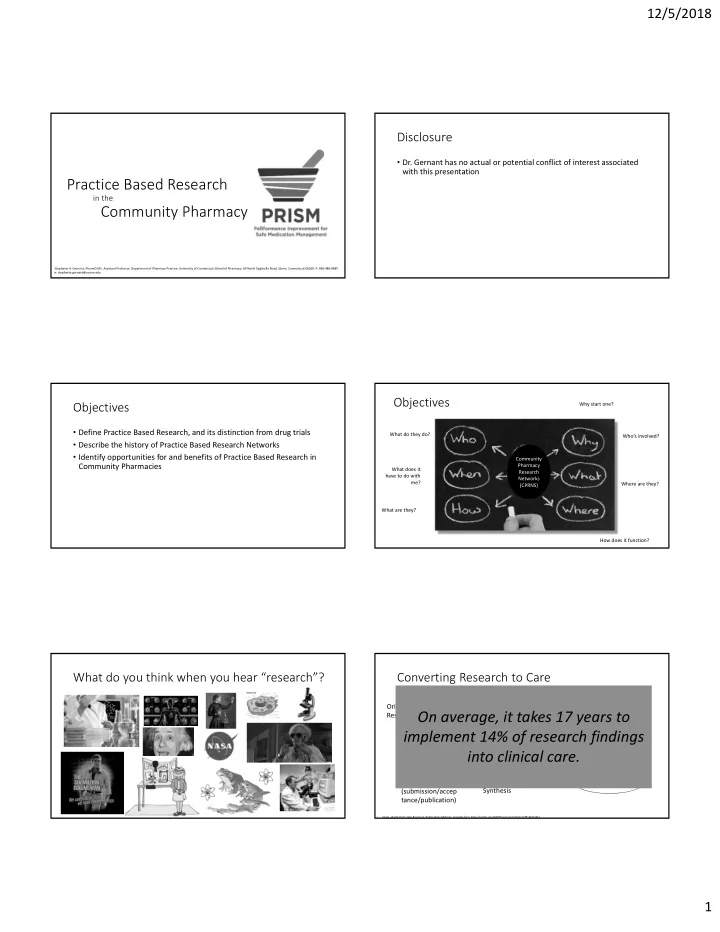
Practice Based Research in the Community Pharmacy Stephanie A. - - PDF document

practice based research
SMART_READER_LITE
LIVE PREVIEW

Practice Based Research in the Community Pharmacy Stephanie A. - - PDF document

12/5/2018 Disclosure Dr. Gernant has no actual or potential conflict of interest associated with this presentation Practice Based Research in the Community Pharmacy Stephanie A. Gernant, PharmD MS. Assistant Professor, Department of Pharmacy


slide-1
SLIDE 1

12/5/2018 1

Practice Based Research

in the

Community Pharmacy

Stephanie A. Gernant, PharmD MS. Assistant Professor, Department of Pharmacy Practice. University of Connecticut School of Pharmacy. 69 North Eagleville Road. Storrs, Connecticut 06269. P: 860‐486‐8887 e: stephanie.gernant@uconn.edu

Disclosure

  • Dr. Gernant has no actual or potential conflict of interest associated

with this presentation

Objectives

  • Define Practice Based Research, and its distinction from drug trials
  • Describe the history of Practice Based Research Networks
  • Identify opportunities for and benefits of Practice Based Research in

Community Pharmacies

Objectives

How does it function? Community Pharmacy Research Networks (CPRNS) Who’s involved? What are they? What do they do? Where are they? Why start one? What does it have to do with me?

What do you think when you hear “research”? Converting Research to Care

  • Image adapted from: Ross Brownson. British Sports Medicine. Available from: https://twitter.com/BJSMPlus/status/1052111739146432512

Original Research Original Research Peer Review (submission/accep tance/publication) Research Synthesis Guidelines Implementation Benefits to Patients

On average, it takes 17 years to implement 14% of research findings into clinical care.

slide-2
SLIDE 2

12/5/2018 2

Benefits of Practice‐Based Research

  • Slow and insufficient use of research findings
  • Study  Practice = Average 17 years
  • Only ~14% of findings are implemented into

practice

  • Patients receive only 55% of recommended care
  • Practice‐Based Research address traditional

research challenges

  • Clinicians involved in research process and

idea development = quick, useful findings

1) Fraser I. Demand‐driven research: working through delivery‐based networks. San Diego: AcademyHealth Annual Research Meeting. June 8,2004. 2) McGlynn EA, Asch SM, Adams j, et al. The quality of health care delivered to adults in the United States. N Eng J Med 2003;348:2635‐45. 3) Yawn BP, Graham DG, Bertram SL, et al. Practice‐based research network studies and institutional review boards: two new issues. J Am Board Fam Med. 2009;22:453‐460.

“Practice‐Based Research”

Image from: Gilbert, G. Improving dental care through research. National Institute of Dental and Craniofacial Research; The National Dental Practice‐Based Research Network. December, 2014. Available from: [http://www.nidcr.nih.gov/ScienceSpotlight/InterviewsbyTopic/DentalPBRN/Improving‐Dental‐Care‐through‐Research.htm]

1907, London:

Larry A. Green, MD and John Hickner, MD, MSc. A Short History of Primary Care Practice‐based Research Networks: From Concept to Essential Research Laboratories J Am Board Fam Med. 2006 Jan‐Feb;19(1):1‐

  • 10. Image from: https://www.dundee.ac.uk/museum/exhibitions/medical/cardiology/cardiology1/

Sir James Mackenzie

“I fear the day may come when a heart specialist will no longer be a physician looking at the body as a whole, but one with more and more complicated instruments working in a narrow and restricted area of the body ….. I had not been long in the practice when I discovered how defective was my knowledge…. I came to recognize that the kind of information I wanted did not exist.”

University of Dundee. Museum Services. https://www.dundee.ac.uk/museum/exhibitions/medical/cardiology/cardiology1/ Brought to Life Science Museum. http://broughttolife.sciencemuseum.org.uk/broughttolife/objects/display?id=93324. James Mackenzie’s first polygraph, United Kingdom, 1906‐1910

Providers as Investigators: The Early Years Fast Forward: Primary Care in the 1980’s

Larry A. Green, MD and John Hickner, MD, MSc. A Short History of Primary Care Practice‐based Research Networks: From Concept to Essential Research Laboratories J Am Board Fam Med. 2006 Jan‐Feb;19(1):1‐10.

  • Collaboration between practitioners and researchers
  • Examine questions that are relevant to real‐world practice
  • Determine results in a rapid and applicable way
  • Increase generalizability

1) Bakken S, Lantiqua RA, Busacca LV, et al. Barriers, enablers, and incentives for research participation: a report from the Ambulatory Care Research Network (ACRN). J Am Board Fam Med. 2009;22(4):436‐45. 2) Image from: Wikipedia. Amphiprioninae. Available from: [http://en.wikipedia.org/wiki/Clownfish#Symbiosis_and_mutualism].

The Arrival of Practice‐Based Research Networks

slide-3
SLIDE 3

12/5/2018 3

Clinicians in PBRNs are NOT passive data collectors

Which is a benefit of PBRNs?

  • A. PBRNs slow down the translation of research findings into clinical practice to

protect patients from unproven therapies

  • B. PBRN research is controlled by Universities, so the studies are grounded in

theory

  • C. PBRN clinician members must participate in all research studies to increase

generalizability

  • D. PBRN research is clinician‐driven, to increase translatability into practice

What does PBRN Stand for?

  • A. Practice‐Based Research Network
  • B. Physician‐Based Rapid Notetaking
  • C. Patient‐Built Referral Network
  • D. Pharmacist‐Based Rapid Notetaking

Today: Agency for Healthcare Research and Quality Types of Practice Based Research Networks

Professional Regional Condition

Images from: 1) National Dental Practice‐Based Research Network. Available from: [http://www.nationaldentalpbrn.org/]. 2) Greater Rochester Practice‐Based Research Network. Available from: [http://www.urmc.rochester.edu/gr‐pbrn]. 3)Stanley Manne Children's Research Institute. Avilable from: [http://www.luriechildrensresearch.org/pprg/]. 4) California Newborn Screening Program. Available from: [http://www.cdph.ca.gov/programs/nbs/Pages/NBSCFParents.aspx]

Population

Practice Based Research Networks in New England

slide-4
SLIDE 4

12/5/2018 4

CPRNs

  • Community Pharmacy Based Research Networks (CPRNs) are a type
  • f Practice Based Research Network (PBRN)
  • CPRNs are not Service Networks; they are NOT GPO’s:

Service Networks CPRNs Purpose Help pharmacists deliver care to patients through various resources like Help pharmacists IDENTIFY AND RESEARCH ways to deliver care to patients Examples Community Pharmacy Enhanced Services Network (CPESN) ACCP, RxSafeNet, UConn’s NE‐ CPRN

What Institution Registers PBRNS?

  • A. Centers for Disease Control (CDC)
  • B. Agency for Healthcare Research and Quality (AHRQ)
  • C. Food and Drug Administration (FDA)
  • D. Connecticut Commission of Pharmacy

Now that I know what a PBRN is, what does this have to do with Community Pharmacy? Why Research Community Pharmacies?

1) Pharmacy Times. Pharmacists rank among most trusted professionals. Available from: [http://www.pharmacytimes.com/news/Pharmacists‐Rank‐Among‐Most‐Trusted‐Professionals]. 2) Dickerson LM Kraus CK, Kuo GM, et al. Formation of primary care pharmacist practice‐based research network. Am J Health‐Syst Pharm. 2007;64:2044‐49. 3) National Center for Health Statistics. Health, United States, 2013: With Special Feature on Prescription Drugs. Hyattsville, MD. 2014.

% of patients age ≥65 on chronic medication by class

PBRNs in Pharmacy

: 1) ACCP Research Institute. ACCP PBRN Announces First Research Publication. Available at: [http://www.accp.com/docs/positions /research/MEDAP_Drug_Errors.pdf]. 2) College of Pharmacy‐The University of Tennessee Health Science Center. Available from: [http://www.uthsc.edu/pharmacy/] in Feb, 2014. 3) Minnesota Pharmacis

  • Association. Available from: www.poha.org] in Feb, 2015. 4) University of Minnesota College of Pharmacy. Available from: [http://pharmacy.umn.edu] in Feb, 2015. 5) MN Pharmacy Practice Based Research Network. Available from: [http://www.mpha.org/associations/9746/files/PBRN/index.html] in Feb, 2015. 6) Medication Safety

Research Network of Indiana. Available from: [http://www.pharmacy.purdue.edu/rx‐safenet] in Feb, 2015. 7) Center for the Advancement of Pharmacy Practice within the University of Kentucky College of Pharmacy. Available from: [http://pharmacy.mc.uky.edu/capp/files/CAPPNet_Info.pdf] in Feb, 2015

Which of the following is True?

A. You have to have research experience to be part of a PBRN

  • B. You can’t be a part of a PBRN unless you’re a physician
  • C. Community Pharmacy PBRNs exist, and community pharmacists are

a part of them

  • D. Community Pharmacy PBRNs only study insurance claims data
slide-5
SLIDE 5

12/5/2018 5

Examples of Community Pharmacy Research Network Studies

Previous Research In Community Pharmacy Networks

“A Needs Assessment of Drug Disposal Practices: A Study from the Medication Safety Research Network of Indiana”

Kozak MA, Melton J, Kleyman S, Snyder ME. A needs assessment of drug disposal practices: a study from the Medication Safety Research Network of Indiana (Rx‐SafeNet). 2014 North American Primary Care Research Group PBRN Annual Conference in Bethesda, Maryland. Image from: Lake Oswego Police Department. Drug/medicine disposal. Available from:[http://www.ci.oswego.or.us/police/drug‐medicine‐disposal]

41.2% 37.7% 22.1%

  • AACP MEDAP study:
  • Kuo, GM, Touchette, DR, and

Marinac, JS Drug errors and related interventions reported by United States clinical pharmacists: the American College of Clinical Pharmacy practice‐based research network medication error detection, amelioration and prevention

  • study. Pharmacotherapy, 2013.

33(3): p. 253‐65.

Images from: [http://www.accp.com/docs/positions /research/MEDAP_Drug_Errors.pdf] and [http://pharmacy.mc.uky.edu/capp/cappnet.php]

Previous Research In Community Pharmacy Networks

  • “Evaluation of Care Coordination Through

Community‐Pharmacy Delivered Medication Therapy Management”

  • Intervention RPh’s found more drug therapy

problems per patient than Usual Care RPh’s (14.8 vs 6.7 problems/patient p=0.01).

  • Intervention RPh’s gave more preventative

recommendations per patient, than Usual Care RPh’s (3.4 vs. 2.5 problems/patient p= 0.04).

Kleyman SA, Snyder ME. The impact of care coordination of community pharmacist delivered medication therapy management: a study from the Medication Safety Research Network of Indiana (Rx‐SafeNet). 2014 North American Primary Care Research Group PBRN Annual Conference in Bethesda, Maryland.

Previous Research In Community Pharmacy Networks

State Public Health Actions to Prevent and Control Diabetes, Heart Disease, Obesity, and Associated Factors and Promote School Health (SHAPE): Pharmacy Initiative

Previous Research In Community Pharmacy Networks

Comprehensive MTM services to 354 patients with hypertension and/or diabetes:

  • 39% improvement achieving BP goal;
  • 23% improvement achieving A1c goal;
  • Adherence improved 38% from initial to final MTM

encounter

Why would we need a CPRN? How could this be good for our future?

slide-6
SLIDE 6

12/5/2018 6

How Can CPRNs Benefit Pharmacies?

  • Research
  • For pharmacy faculty, university faculty, outside institutions
  • Community involvement
  • Pharmacies, health departments, public health organizations, schools, private companies etc…
  • Strengthen partnerships with state organizations
  • Partner with in‐state/out of state PBRNS
  • Could lead to a new and sustained practices

American Society of Health System Pharmacists. Online residency directory. Available from: [http://accred.ashp.org/aps/pages/directory/residencyProgramSearch.aspx]

How Could a CPRN Benefit Community Pharmacists?

“The involvement of community pharmacy sites with PBRNs has the potential to be a driving force in practice innovation, improving patient care and professional satisfaction” “…’improving job satisfaction’ ranked high on the list

  • f reasons to become involved in the network…”

“…pharmacists are easily accessible to the public and are very commonly the first line when patients are being managed with a chronic disease state. PBRNs in the community setting can help emphasize the importance of the community pharmacist and really show the impact being made by the staff at these locations.”

1) Goode KR, Mott DA, Chater R. Collaborations to facilitate success of community pharmacy practice‐based research networks. J Am Pharm Assoc. 2008;48:153‐162. 2) Seston A, Hassel K, Contrill J, et al. Experiences of establishing and maintaining a community pharmacy research

  • network. Primary Health Care Research and Development. 2003;4: 245‐255. 3) Dickerson LM Kraus CK, Kuo GM, et al. Formation of primary care pharmacist practice‐based research network. Am J Health‐Syst Pharm. 2007;64:2044‐49.

“All of our studies have patient‐

centered outcomes, such as pain and the alleviation of pain as well as quality of life.”

How can CPRNs Benefit Practice?

Hamann MS, Hayes K, Adams A, Maxwell D. National Institute of Dental and Craniofacial Research Office of Science Policy and Analysis. Midcourse (Year 4) Evaluation of the General Dental Practice-Based Research Networks. Final Report. September 17, 2009

My Pharmacist Cares About Me

Barriers to Community Pharmacy PBRN Research

1) Bakken S, Lantigua RA, Busacca LV, et al. JABFM. 2009;22(4): 436‐45. 2) Longe RL, Taylor AT, Wade WE, et al. Dis Manage Health Outcomes. 1999;6:261‐268. 3) Pace WD, Staton EW, Holcomb S. Ann Fam Med. 2005;3(Suppl 1) S38‐S45. 4) Rosenbloom K, Taylor K, Harding G. Int J Pharm

  • Pract. 2000:8;103‐10. 5) Seel LV, Hultgren KE, Snyder ME. Innovations in Pharmacy. 2012; 3(2): Article 79. 6) ACCP Research Institute. Available from: [http://www.accpri.org/pbrn/faqs.aspx]. 7) Bakken S, Lantigua RA, Busacca LV, et al. JABFM. 2009;22(4): 436‐45. 8) Calmbach WL, Ryan JG,

Baldwin LM, et al. JABFM. 2012:25;572‐76. 9) Pace WD, Staton EW, Holcomb S.. Ann Fam Med. 2005;3(Suppl 1) S38‐S45. 10) Snyder ME, Frail CK, Seel LV, Hultgren KE. Innovations in Pharmacy. 2010; 1(2): Article 14. 11) Calmbach WL, Ryan JG, Baldwin LM, Knox L. JABFM. 2012;25:572‐76

Barrier Suggested Solution

  • 1. Time Constraints

Participation in research that fits the practice

  • 2. Financial Concerns

Compensation for time spent

  • 3. Limited Research Background

Clinician’s focus is patient care, not research

  • 4. Data Sharing

Some PBRNs share data, some do not

  • 5. Recruitment

“One‐pagers”

What are the purpose of PBRNs?

  • A. When clinicians are involved in research processes and idea

development, original research can turn into useful findings quicker

  • B. When PBRN member clinicians serve as data collectors, rather than

helping in idea generation, the studies are more rigorous

  • C. When health systems are members of PBRNs, they can receive more

money from CMS

  • D. PBRNs serve to help health systems have better purchasing power and

bill for services

Recap

  • 1. Community Pharmacy research can benefit both patients and the

profession

  • 2. Traditional research is slow, and not always generalizable
  • 3. Community Pharmacy Practice Based Research Networks promote

quick implementation of relevant findings into practice