Practical Considerations on the Use of Preference Learning for - - PowerPoint PPT Presentation

practical considerations on the use of preference
SMART_READER_LITE
LIVE PREVIEW

Practical Considerations on the Use of Preference Learning for - - PowerPoint PPT Presentation

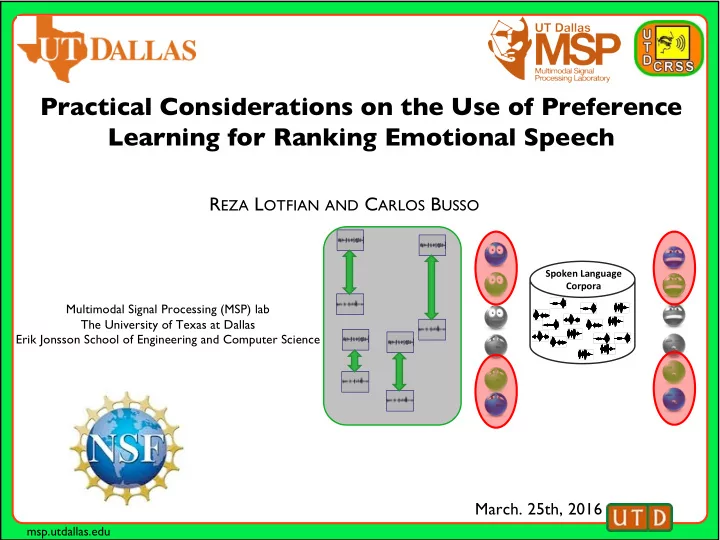
Practical Considerations on the Use of Preference Learning for Ranking Emotional Speech R EZA L OTFIAN AND C ARLOS B USSO Spoken Language Corpora Multimodal Signal Processing (MSP) lab The University of Texas at Dallas Erik Jonsson School of


slide-1
SLIDE 1

msp.utdallas.edu

Practical Considerations on the Use of Preference Learning for Ranking Emotional Speech

Multimodal Signal Processing (MSP) lab The University of Texas at Dallas Erik Jonsson School of Engineering and Computer Science

  • March. 25th, 2016

REZA LOTFIAN AND CARLOS BUSSO

Spoken Language Corpora

slide-2
SLIDE 2

msp.utdallas.edu 2

Motivation

  • Creating emotions aware human computer interaction
  • Binary or multi-class speech emotion classification
  • Preference learning offers an appealing alternative
  • Widely explored in images, music, video, text
  • Few studies on preference learning for emotion recognition
  • Emotion retrieval from speech
  • Call centers
  • Healthcare applications
slide-3
SLIDE 3

msp.utdallas.edu

Definition of the problem

  • Binary/multiclass classification versus preference learning
  • Binary class: training samples
  • low or high arousal?
  • Preference learning: training samples
  • Is the arousal level of sample1 higher than arousal level of sample2?

3

Valence Valence Arousal Arousal Binary problem Preference learning

slide-4
SLIDE 4

msp.utdallas.edu

Definition of the problem

  • Absolute ratings of the emotions are noisy
  • Binary problem
  • Remove samples close to boundary of different classes
  • Preference learning

  • Questions
  • How many samples are available for training?
  • How reliable are the labels?
  • What are the optimum parameters? (margin + size of training set)
  • How does it compare to alternative methods?

4

Arousal Valence Arousal Valence

slide-5
SLIDE 5

msp.utdallas.edu

SEMAINE database

5

  • Emotionally colored machine-human interaction
  • Sensitive artificial listener framework
  • Only solid SAL used (operator was played with

another human)

  • 91 sessions, 18 subjects (user)
  • Time-continuous dimensional labels
  • Annotated by FEELTRACE
  • We focus on arousal and valence dimensions

User Operator

Arousal (a)

slide-6
SLIDE 6

msp.utdallas.edu

Acoustic features

6

  • Speaker state challenge feature set at INTERSPEECH 2013
  • 6308 high level descriptors
  • OpenSMILE toolkit
  • Feature selection (separate for arousal and valence)
  • Step 1: 6308→500
  • Information gain separating binary labels (e.g., low vs high

arousal)

  • Step 2: 500→50
  • Floating forward feature selection
  • Maximizing the precision of retrieving 10% top and 10% bottom
slide-7
SLIDE 7

msp.utdallas.edu

How many samples are available for training?

7

  • Applying thresholds increases the reliability of training labels
  • Removing ambiguous labels
  • Larger margin:

+

more reliable labels

  • less samples for training
  • How does different margins affect available training samples in

binary and pairwise problems? Valence

slide-8
SLIDE 8

msp.utdallas.edu

How many samples are available for training?

8

  • Binary labels

Valence

  • Pairwise labels

Samples included in training/testing sets Proportion of potential pairwise comparisons included in training testing sets Samples included in binary classification

slide-9
SLIDE 9

msp.utdallas.edu 9

  • Binary labels

Valence

  • Pairwise labels

How many samples are available for training?

slide-10
SLIDE 10

msp.utdallas.edu 10

  • Binary labels

Valence

  • Pairwise labels

How many samples are available for training?

slide-11
SLIDE 11

msp.utdallas.edu 11

  • Binary labels

Valence

  • Pairwise labels

How many samples are available for training?

slide-12
SLIDE 12

msp.utdallas.edu 12

  • Binary labels

Valence

  • Pairwise labels

How many samples are available for training?

slide-13
SLIDE 13

msp.utdallas.edu 13

  • More samples remain in training

set in pairwise classification Arousal Valence

How many samples are available for training?

slide-14
SLIDE 14

msp.utdallas.edu

How reliable are the labels?

14

  • Precision of subjective evaluations
  • Find the average of ratings for all evaluators except one
  • Compare his/her labels to aggregated score
  • Pairwise labels: higher agreement between subjective

evaluations for different thresholds evaluations

  • Few sample for margin >0.7 lead to noisy binary labels

Valence Arousal

slide-15
SLIDE 15

msp.utdallas.edu

What are the optimum parameters?

15

  • Rank SVM problem
  • and are feature vectors of pair 𝑗 where ​𝑡↓1 is preferred
  • ver ​𝑡↓2

: nonzero slack variable : soft margin variable

  • Testing: is preferred over if
slide-16
SLIDE 16

msp.utdallas.edu

Preference learning

16

  • Training samples
  • Speaker independent partitioning for
  • Development (feature selection): 8 randomly selected speakers
  • Cross validation: 5 speakers for training, 5 speakers for testing
  • Set of pairwise preferences (rankings of length 2)
  • Samples that satisfy the margin’s threshold are selected
  • Different sample size is evaluated
slide-17
SLIDE 17

msp.utdallas.edu

Measure of retrieval performance

17

Precision at K (P@K)

  • Speech samples ordered by Rank-SVM
  • Select K/2 samples from top, K/2 samples from bottom
  • Example: P@100 → binary classification
  • Success if the sample is in the right side
  • Black → high; Gray → bottom
  • We can compare this approach to other machine

learning algorithm Ordered speech samples

Valence Arousal

Precision K[%]

slide-18
SLIDE 18

msp.utdallas.edu

What are the optimum parameters?

18

  • Optimum margin threshold
  • Arousal → 0.5
  • Valence → 0.4

Valence Arousal

1000 sample size: 5000 10000

slide-19
SLIDE 19

msp.utdallas.edu

What are the optimum parameters?

19

  • Optimum sample size
  • ~5000

Valence Arousal

1000 sample size: 5000 10000

slide-20
SLIDE 20

msp.utdallas.edu

How does it compare to alternative methods?

20

  • Support vector machine (SVM) → Binary classifiers
  • Support vector regression (SVR) → Regression

Valence Arousal

Dimension Rank-SVM [%] SVR [%] SVM [%] Arousal 77.1 65.5 68.1 Valence 66.8 62.1 61.7

(P@100)

slide-21
SLIDE 21

msp.utdallas.edu

Conclusion

21

  • Considerations in preference training for emotion

retrieval

  • Trade-offs
  • Label reliability vs training size
  • Optimize the margin between emotion labels in training

samples

  • Preference learning provides more reliable labels and larger

training set

  • Preference learning has higher precision in retrieval
  • Higher performance in binary classification
  • 7% arousal
  • 5.1% valence
slide-22
SLIDE 22

msp.utdallas.edu

Thanks for your attention!

http://msp.utdallas.edu/

Reza Lotfian Ph.D. Student Affective computing