Post-discharge Outcomes in CDH patients Herniated contents: Liver - - PowerPoint PPT Presentation

post discharge outcomes in cdh patients
SMART_READER_LITE
LIVE PREVIEW

Post-discharge Outcomes in CDH patients Herniated contents: Liver - - PowerPoint PPT Presentation

4/20/2018 Congenital Diaphragmatic Hernia (Bochdalek) Post-discharge Outcomes in CDH patients Herniated contents: Liver Stomach Spleen April 20, 2018 Small intestine Colon Hypoplastic lung Lan Vu, MD Assistant Professor of Surgery


slide-1
SLIDE 1

4/20/2018 1

Post-discharge Outcomes in CDH patients

April 20, 2018

Lan Vu, MD Assistant Professor of Surgery Division of Pediatric Surgery University of California, San Francisco

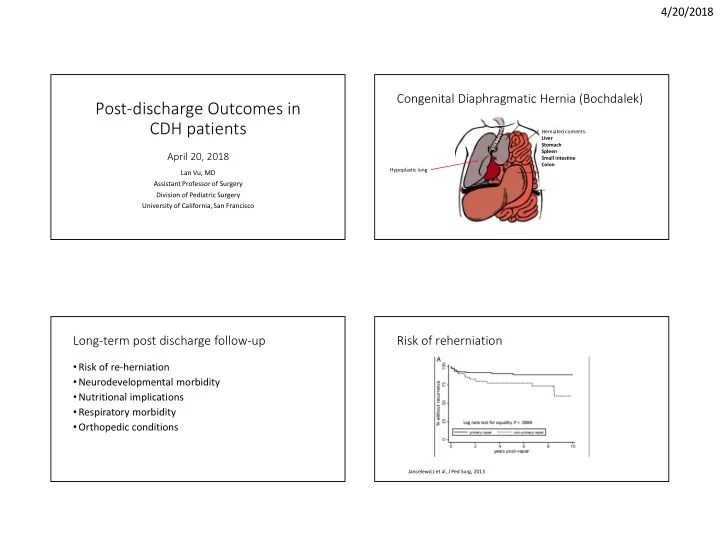
Congenital Diaphragmatic Hernia (Bochdalek)

Hypoplastic lung Herniated contents: Liver Stomach Spleen Small intestine Colon

Long-term post discharge follow-up

  • Risk of re-herniation
  • Neurodevelopmental morbidity
  • Nutritional implications
  • Respiratory morbidity
  • Orthopedic conditions

Risk of reherniation

Jancelewicz et al, J Ped Surg, 2013

slide-2
SLIDE 2

4/20/2018 2

Diaphragm Diaphragm Reherniation

slide-3
SLIDE 3

4/20/2018 3

Neurodevelopment impairment

  • Hearing loss
  • Motor dysfunction
  • Cognitive delays
  • Sensory processing disorders/autism spectrum
  • Behavioral disorders (ADHD)

High-Risk Infant Follow-up Program at UCSF

  • Structured medical, social, developmental history and exam
  • 6, 12-18, 30 months, and 4.5 years (8-12 years of age for subset of

research subjects)

  • Prior to 2009, children with CDH were standardly followed to 30

months of age

  • All patients in TO trial were evaluated between 2.5-5 years
  • Extended to visits at 4.5 years since 2009

What has been published?

  • Cortes, Keller et al (2005): no difference in NDI at 1 and 2 years

between tracheal occlusion and conventionally treated CDH, but

  • verall high rates of morbidity
  • >50% with cognitive delays
  • 40% with neuromotor delays
  • 7/16 with hearing loss requiring amplification between 2.5-5 years of

age

slide-4
SLIDE 4

4/20/2018 4

NDI and CDH

  • Danzer et al (2010): moderate to severe delays in psychomotor,

cognitive, or language scores on Bayley-3 testing in 41 CDH patients born between 2004-2007 < 3 year olds

  • > 50% had moderate to severe delays in at least one domain
  • 51% abnormal muscle tonicity
  • 7% rate of autism

NDI and CDH

  • Predictors of poor outcome:
  • ECMO
  • supplemental oxygen at 28 days
  • tube feedings at discharge
  • lower socioeconomic status
  • rehospitalization in the first 2 years of life

Wynn J, et al. J Pediatr Surg. 2013 Oct

Older patients with CDH

  • Older assessments more favorable than those < 3 years
  • At preschool age, 22% had borderline scores
  • 11% showed significant delays in at least one domain
  • Danzer et al., Preschool neurological assessment in congenital diaphragmatic

hernia survivors: outcome and perinatal factors associated with neurodevelopmental impairment. Early Hum Dev. 2013 Jun.

  • At 9 years of age in survivors, outcomes in 33 patients were not

statistically different than norms, except in motor dysfunction

  • Tureczek I, Long-term motor and cognitive outcome in children with

congenital diaphragmatic hernia. Acta Paediatr. 2012 May

Nutritional implications

  • Poor growth
  • Gastrostomy tube dependence
  • Oral feeding difficulties/aversion
  • Gastroesophageal reflux disease
slide-5
SLIDE 5

4/20/2018 5

First few years of life

  • Leeween et al, J Ped Surg, 2014 (single center, cohort of 24 pts)
  • FTT (z scores > -2.0 in weight for age and/or weight for length):

63% in the first 6 months

  • Catch up growth occurs between 6-12 months: FFT only in 21% of cohort at 12

month visit

  • Childhood and adolescence

Haliburton et al, J Ped Surg, 2015 (single center, ages 5-17 years, N=116)

  • 25% feeding tubes (FT) placed

during infancy

  • 60% remained at 7 years of age
  • Those with FT were shorter and

lighter (similar BMI)

  • Increased REE in 58% of patients

(based on indirect calorimetry)

Respiratory Issues

  • Pulmonary hypertension
  • Chronic lung disease

Natural history of pulmonary hypertension

  • Lusk et al, J Pediatr, 2015 (single center, 140 patients)
  • 98 had resolution of pulm HTN at discharge/death
  • mean time to resolution 18 days
slide-6
SLIDE 6

4/20/2018 6

  • Wong et al, J Ped Surg, 2018 (single center)
  • PH generally resolves by age 5 years
  • Lung perfusion scans do not change over time (unclear reason for PH

resolution)

Risk of pneumonia

  • Reported as 7% within the first year of life
  • Both aspiration and infectious
  • Preventive measures:
  • treatment of chronic lung disease and other associated conditions

(oromotor dysfunction, GERD)

  • appropriate vaccination (RSV vaccination for the first two years:

recommended in the AAP policy statement, 2003). Long term pulmonary sequelae in adult survivors of CDH

  • Vanamo et al, J Ped Surg, 1996 (Finland)
  • 60 patients (age 11-41 years)
  • self report: 12% asthma, 7% increased susceptibility to infxn
  • PFTs: 51% had ventilatory impairment

15% obstructive 12% restrictive 25% mixed obstructive and restrictive 35% had bronchial hyperreactivity

Orthopedic Conditions

  • Type of repair (primary, patch, muscle flap)
  • Surgical approach (thoracotomy, laparotomy)
  • Differential growth of the lung
slide-7
SLIDE 7

4/20/2018 7

Conclusions

  • Multiple factors contribute to chronic conditions
  • Improvement seen with time
  • Multidisciplinary follow-up is needed in patients with CDH
  • pediatric surgeon
  • nutritionist
  • neurodevelopmental team
  • cardiologist
  • pulmonologist
  • social worker
  • feeding therapist