PORT MASTER PLAN 2050 A Road Map for the Next 30 Years **Hatch: - - PowerPoint PPT Presentation

port master plan 2050
SMART_READER_LITE
LIVE PREVIEW

PORT MASTER PLAN 2050 A Road Map for the Next 30 Years **Hatch: - - PowerPoint PPT Presentation

PORT MASTER PLAN 2050 A Road Map for the Next 30 Years **Hatch: Please provi de images used on GID pr esentation title page. Also please provide r eplace image of 1 WTC wi th something different (too controversial) October 21, 2019 NJTPA


slide-1
SLIDE 1

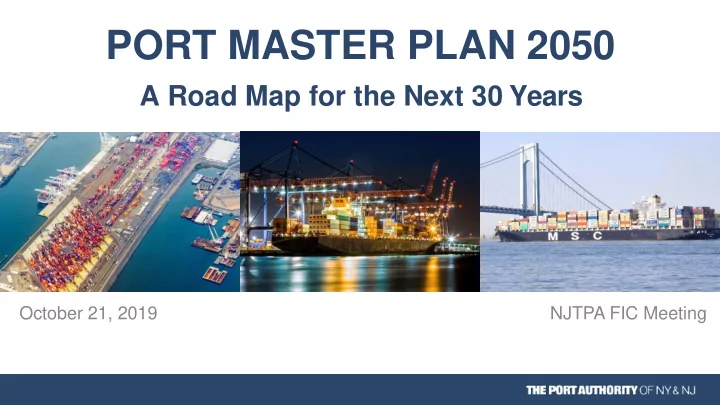
PORT MASTER PLAN 2050

A Road Map for the Next 30 Years

October 21, 2019 NJTPA FIC Meeting de images used on GID pr eplace image of 1 WTC wi esentation title page. th something different **Hatch: Please provi Also please provide r (too controversial)

slide-2
SLIDE 2

2

The Port Master Plan Is and Is Not…

A Framework

Provides a framework of potential options and a guide for future land use decisions

Commercial

Facilitates commerce and business growth

Consistent

Ensures future development is consistentwith goals and policies

Change-Based

Considers changes in shipping, population, environmental impacts and technological advances

Near and Long

Provides near and long-term strategies toensure delivery

  • f needed infrastructure

Economic

Supports long-term economic benefits to the region, including jobs and tax revenue

Holistic

Helps integrate Port facilities into a transportation network

Flexible

Adapts to changes inthe baseline assumptions and provides flexibility over time

Definitive

Not absolute in its recommendations

Final

Not the final plan for all development over the next 30 years

…and implementation will require design, permits,

  • utreach and authorization
slide-3
SLIDE 3

3 Key Statistics: Port Department Facilities

Acres 3,000+ Port Newark 846 Elizabeth PAMT 1,124 Howland Hook MT 279 Port Jersey PAMT 419 Brooklyn PAMT 151 Tenants ~60

Current State of the Port

Cargo Volumes (2018)

7.2 million Containers (TEU) 645,760 By Rail (Lifts) 3.6 million Dry Bulk (Tons) 573,035 Autos (Units) 856,271 Cruise (Passengers)

slide-4
SLIDE 4

4

CONNECTIVITY AND SUPPORTING INDUSTRIES

  • Direct access to major road and rail networks.
  • Over 1 billion square feet of warehouses and

distribution centers within 50 miles of port.

  • More first port of call services than any other East

Coast port

INVESTMENT

  • Significant private and public sector investment to

support future growth

reated re or resnar ro the No n Pro e t

LOCATION

  • Located in the middle of the largest consumer

markets in one of the most affluent parts of the world

  • Greatest port reach on the East Coast. 45 million

people within 4 ho rs’ drive, 1/3 o the nation’s DP

  • Access to 125 million people within a 36-hour drive

reated Maha ah ro the No n Pro e t

PONYNJ Benefits

slide-5
SLIDE 5

Analyze Market, Land Use and Capacity Develop and Assess Options Gather Key Data, Project Goals and Visions

2 3

Write Plan, Review Feedback and Present Final

Stakeholder Outreach PANYNJ Workshops

Port Master Plan Process

3Q/2017 4Q/2017 1Q/2018 - 2Q/2019 4Q/2016 – 2Q/2017

5

4 1

slide-6
SLIDE 6

6

Port Master Plan 2050 Vision

…leadin by example, the Port Authority will continue to drive down carbon emissions, minimize noise, congestion and environmental impacts at its facilities and throughout the Port of New York and New Jersey. Sustainable and Resilient State of the Art …with technology, safety and data management at the heart of improved

  • perations.

A Platform for Partnership …with communities, customers, operators, shippers, logistics providers, and potential investors all actively involved in decision- making and implementation. Shaping Future Growth …a o odatin the future needs of shippers, rationalizing land uses, consolidating containers, autos, and bulk, and partnering to improve regional rail, road, and off-site facilities. An Economic Generator …with increased jobs

  • n the Port and in the

region, enabling small and large businesses to thrive and providing

  • pportunities for

training, job creation and entrepreneurship.

Create a flexible roadmap to develop a competitive, financially successful port, maximizing regional jobs and economic impacts, and minimizing environmental effects
slide-7
SLIDE 7

7

Current Tenants Rail and Terminal Operators Federal, State, and Local Agencies Harbor Pilots Shipping and Labor Management Associations Labor Trucking and Logistics Companies NY & NJ Elected Officials Transportation Authorities and Planning Agencies Commercial Real Estate & Property Management Groups Technology Leaders Academic Institutions Environmental Justice Groups Host Communities

45+

Total Presentations to Regional Stakeholders and Community Groups

400+

Stakeholders across New York & New Jersey

50+

Planning Workshops, Interviews, and Activities

STAKEHOLDERS INCLUDED

Port Master Plan Engagement and Outreach

slide-8
SLIDE 8

8

  • Container volumes

are projected to double or triple by 2050

  • Ocean carrier

consolidation and alliances

  • Vessel size

increasing rapidly

  • Use of real-time

decision making and

  • ther technologies

Containers Trends and Emerging Issues

Capacity 18,000 TEU Class ULCV Length (LOA) 399 m (1,310 ft) Beam (max) 54 m (177 ft) Draft 16 m (52 ft) Air Draft (est.) 59 m (194 ft)

Design Vessel

Present 2050 Acres 1,649 1,779 – 1,815

Estimated Leasehold Acreage

0.0 5.0 10.0 15.0 20.0 5 10 15 20 25 30

Millions Years

Market Forecast (TEU)

Low High

slide-9
SLIDE 9

9

  • Auto volumes

remain strong

  • Mobility as an on-

demand service

  • Autonomous

vehicles

  • Electric and hybrid

vehicles

Autos Trends and Emerging Issues

Capacity 9,000–10,000 CEU Class PCTC Length (LOA) 265 m (869 ft) Beam (max) 42 m (138 ft) Draft 13 m (43 ft) Air Draft (est.) 52 m (171 ft)

Design Vessel

Present 2050 Acres 291 390

Estimated Leasehold Acreage

0.0 0.5 1.0 1.5 5 10 15 20 25 30

Millions Years

Market Forecast (CEU)

Low High

slide-10
SLIDE 10

10

  • Bulk volumes

remain strong

  • Offshore wind and
  • ther renewable

energy sources

  • LNG bunkering
  • Additive

manufacturing (i.e. 3D printing)

  • Beneficial use of

recycled commodities

Bulk Trends and Emerging Issues

Capacity 80,000 DWT Class Panamax Length (LOA) 290 m (950 ft) Beam (max) 32.3 m (106 ft) Draft 14.6 m (47.9 ft) Air Draft (est.) 40 m (132 ft)

Design Vessel

Present 2050 Acres 160 179 – 281

Estimated Leasehold Acreage

0.0 2.0 4.0 6.0 5 10 15 20 25 30

Millions Years

Market Forecast (Tons)

Low High

slide-11
SLIDE 11

11

  • Consistent growth

in passenger volumes

  • Increasing vessel

size

  • NY/NJ as port of

call

Cruise Trends and Emerging Issues

Capacity 5,400 pax Class Oasis Class Length (LOA) 362 m (1,188 ft) Beam (max) 65.5 m (215 ft) Draft 9.1 m (30 ft) Air Draft (est.) 57 m (187 ft)

Design Vessel

Present 2050 Acres No change

Estimated Leasehold Acreage

0.0 1.0 2.0 3.0 5 10 15 20 25 30

Millions Years

Market Forecast (Pax)

Low High

slide-12
SLIDE 12

12 Capacity Not Applicable Class Length (LOA) Beam (max) Draft Air Draft (est.)

Design Vessel

Present 2050 Acres (included in container leaseholds)

Estimated Leasehold Acreage

0.0 1.0 2.0 3.0 4.0 5 10 15 20 25 30

Millions Years

Market Forecast (Lifts)

Low High

  • Potential demand

for inland port facilities

  • Need for additional
  • ff-terminal

facilities (including storage tracks)

  • Discretionary

market opportunity

Intermodal Rail Trends and Emerging Issues

slide-13
SLIDE 13

13

  • Truck data capture
  • Shared chassis pools and empty

container depots

  • Autonomous trucking and platooning
  • Driver supply
  • Intelligent transportation systems (ITS)
  • Digitization of information streams

Trucking and Logistics

Other Emerging Trends and Issues

  • Kill Van Kull channel becomes a

greater constraint without mitigation

  • Modal split has opportunity to

increase, including rail and marine highway (barge)

  • Tenants want to invest in capacity to

support growth

Infrastructure and Terminals

slide-14
SLIDE 14

~10%

75-80%

Elizabeth + Newark

~10%

Current Container Capacity of Port

14 <5%

slide-15
SLIDE 15

Current Container Capacity vs. Forecast Demand

15 4 8 12 16 20 5 10 15 20 25 30

Container Throughput (million TEU) Year

GROWTH BASED ON DISCRETIONARY FOCUS GROWTH BASED ON LOCAL MARKET FOCUS EXISTING BASELINE CAPACITY

17M TEU 12M TEU

slide-16
SLIDE 16

Forecast of PONYNJ Container Fleet Vessel Size

16

CMA CGM T. Roosevelt (14,414 TEU)

actual

Anticipated to peak at 18,000 TEU

Ever-Larger Vessels → Long-Term Decrease in Vessel Calls → Less Pollution

slide-17
SLIDE 17

17

Port Truck Distribution

Interstate highways, showing major routes for Port trucks and peak traffic congestion

reated reative tall ro the No n Pro e t reated reative tall ro the No n Pro e t

Primary destinations (first stop) for Port truck traffic (top 4 counties account for almost 75% of trucks)

slide-18
SLIDE 18

18

Port Truck Distribution

Interstate highways, showing major routes for Port trucks and peak traffic congestion Key east-west corridors: I-78 and I-80 (along with I-280 and NJ 24) Key north-south corridors: I-95, I-287 and NJ 17

reated reative tall ro the No n Pro e t reated reative tall ro the No n Pro e t

Primary destinations (first stop) for Port truck traffic (top 4 counties account for almost 75% of trucks)

slide-19
SLIDE 19

19

Port Master Plan 2050

slide-20
SLIDE 20

20 20

Phase 1 The First 15 Years

slide-21
SLIDE 21

21 21

  • Continue to set green goals and policies aimed at

driving down port-related impacts

  • Establish working group, planning forum and policies

for inclusion in projects, processes and leases

  • Scope NYNJ waterways capacity study project, South

Brooklyn studies, intermodal initiatives

  • Establish consistent stakeholder outreach procedure
  • Develop scope of work for Port Ivory and Port Jersey

South (former MOTBY) development projects

  • Conduct detailed future capacity analysis of New York

and New Jersey waterways

  • Collaboratively plan for the future – expansion options

at Newark/Elizabeth and/or Port Jersey

  • Increase intermodal (discretionary) rail cargo volume

(planning marketing)

ACTIONS

  • Support growth of existing tenants
  • Allow PANYNJ to meet

sustainability/resiliency goals

  • Lay the foundation for future

investments

GOALS

Phase 1 The First 15 Years Port-Wide

slide-22
SLIDE 22

22 22

Phase 1 Facilities

PORT NEWARK AND ELIZABETH PAMT

  • Focus investment on road-

and rail-enabling projects

  • Implement alternate power

source program over time

  • Seek to work with Cities of

Elizabeth and Newark to envision greater public access

slide-23
SLIDE 23

23

Phase 1: Port Newark/Elizabeth PAMT

IMPLEMENT

An alternate power source program converting to low- emissions operations and equipment

DEVELOP

A site-wide communications and electrical platform that is forward thinking and resilient

IMPLEMENT

Roadside improvement projects including Port Street realignment, data capture utilizing E-Z Pass or GPS reader technology and chassis and empty container storage location studies

IMPROVE

Connectivity with I-95 and I-78

INCREASE

Intermodal rail volume to ensure ExpressRail facilities are operating efficiently and increase container on barge usage intra-harbor and regionally

RO-RO

slide-24
SLIDE 24

24

Improve circulation along common transportation spine and local port streets 01 | Establish upgraded power and communications network (study phase, implementation to follow) 02 | Establish community access & education programs 03 | Continue move to low emission operations 04 |

PROJECT

Next Steps: Port Newark & Elizabeth PAMT

TIMELINE (YEARS)

1 2 3 4 5+

slide-25
SLIDE 25

25 25

Phase 1 Facilities

  • Continue to support

establishment of ferry terminal

  • Investigate container

expansion alternatives PORT JERSEY PAMT

slide-26
SLIDE 26

26 26

Phase 1: Port Jersey PAMT

COMPLETION

Of the 14A interchange and enhanced separation of port and public vehicles

SUPPORT

Progressive expansion that could eventually lead to an expanded ICTF Greenville Yard network that provides high-efficiency (i.e. longer working track)

  • n-dock rail capability

INVESTIGATE

Expansion alternatives for future additional container capacity north

  • f the existing facility

ACQUIRE

Land if needed to enable the envisaged plan and seek potential partnering for development that will improve circulation and ease congestion

slide-27
SLIDE 27

27 27

Phase 1: Port Jersey PAMT

DEVELOP

A coordinated distribution and warehousing hub in conjunction with adjacent property owners along Port Jersey South (former MOTBY)

CONTINUE

To support the establishment of a ferry terminal

ENHANCE

Provisions for a future second cruise berth

slide-28
SLIDE 28

28

Establish ferry terminal service 01 | Strategic land acquisition 02 | Assist development of Port Jersey South 03 | Expand GCT Bayonne 04 |

Next Steps: Port Jersey

Plan for future capacity 05 | TIMELINE (YEARS)

1 2 3 4 5

PROJECT

slide-29
SLIDE 29

29 29

Phase 1 Facilities

  • Support enhanced container-handling

capacity

  • Potential to develop Port Ivory site as a

facility for logistics and distribution or to support offshore wind and other renewable energies HOWLAND HOOK MARINE TERMINAL

slide-30
SLIDE 30

30 30

Phase 1: Howland Hook Marine Terminal

SUPPORT

Enhanced container-handling capability

LEVERAGE

Logistics and distribution center developments through greater connectivity between the facilities, marine terminal and local road & interstate networks

DEVELOP

Port Ivory into a logistics facility linked to the existing ExpressRail network with a realigned Western Avenue (Parcel B)

BROADEN

Potential cargoes and take advantage of emerging opportunities in

  • ffshore wind and renewable energy support on Port Ivory (Parcel C)
slide-31
SLIDE 31

31

Support HHMT growth, including review of current Howland Hook Toll Reimbursement Program 01 | Implement coordinated marketing strategy 02 | Develop Port Ivory & realign Western Ave 03 |

Next Steps: Howland Hook

TIMELINE (YEARS)

1 2 3 4 5+

PROJECT

slide-32
SLIDE 32

32 32

Phase 1 Facilities

  • Continue evaluating alternatives to

maintain and grow East-of-Hudson marine cargo operations

  • Partnering and collaboration among

numerous public and private stakeholders BROOKLYN PAMT AND WATERFRONT FACILITIES

slide-33
SLIDE 33

33 33

Phase 1: Brooklyn PAMT and Waterfront Facilities

DEVELOPMENT

At SBMT could enable establishment of a state-of-the art marine facility with

  • pportunities for expansion to meet the future needs of the East-of-Hudson market

ACTIONS

Arising from the study of alternatives are dependent on timing, and partnering/collaboration among public and private stakeholders

CONTINUATION

Of ongoing Red Hook marine activity at Brooklyn Port Authority Marine Terminal (BPAMT) will necessitate additional investment in infrastructure improvements and exploration of ways to improve capacity to grow

EVALUATE

Alternatives to maintain and grow East-of-Hudson marine cargo operations

slide-34
SLIDE 34

34

Maintain and grow container and maritime activity

  • n the Brooklyn waterfront

01 | Continue to support and maintain operations at Brooklyn PAMT facilities 02 | PROJECT

Next Steps: Brooklyn PAMT

TIMELINE (YEARS)

1 2 3 4 5+

slide-35
SLIDE 35

35 35

Phase 2 15-30 Years

slide-36
SLIDE 36

36

Port Master Plan 2050 Results

… reenho se as emissions reduced by 35% by 2025 and 80% by 2050 …alternative-fuel vehicles deployed …alternative ener sources harnessed …new onstr tion includes resiliency measures …in reasin odal split Sustainable and Resilient State of the Art …levera in technology developments to: …i prove sa et …strea line infrastructure

  • perations and

maintenance (O&M) …in rease e i ien across the port and the region A Platform for Partnership … o nit engagement …ind str or s and summits …p li a ess Shaping Future Growth …proa tive rather than reactive …partnerin with state and regional planning

  • rganizations

An Economic Generator …80,000 new o s created regionally …$25 illion in incremental economic activity …i ple ents 30 a or projects and develops unused space …work or e development and education opportunities

When successfully implemented, the PONYNJ will be a competitive and financially successful port that is environmentally sustainable and provides the maximum benefit for regional jobs and economic impact.

slide-37
SLIDE 37

Beth Rooney Deputy Director, Port Department berooney@panynj.gov

37 37

Charlie Bontempo Senior Program Manager, Port Department cbontempo@panynj.gov

Thank You